
A GGUF file’s size tells you how large the stored model artifact is—not how much GPU memory an inference session will need. VRAM can also be used by GPU-resident model layers, the active context’s KV cache, execution buffers, and backend or CUDA runtime allocations. The total depends on the model, runtime, backend, and settings.
What a GGUF file’s size measures
GGUF is a binary model format used with GGML and GGML-based executors. It contains metadata and tensor data corresponding to model weights; the tensor data may differ from the original model because of quantization or other inference optimizations. The format supports memory mapping, which describes how file contents can be accessed—not a limit on how much memory inference can allocate. See the GGUF specification.
File size is therefore a useful first approximation for stored weights, particularly when considering how much memory full GPU residency might require. It is not a complete peak-VRAM estimate: runtime allocations are related to the artifact but are not the same measurement.
What else occupies VRAM during inference
GPU-resident model layers
Inference software can keep some or all model layers on the GPU. In llama.cpp, the GPU-layer setting controls how many layers are stored in VRAM. With partial offload, only part of the weights is GPU-resident; full offload places more of them there. The llama.cpp server options document GPU-layer controls, including --gpu-layers and --n-gpu-layers.
What’s actually slowing this PC down?
Pick the symptom - the matching free tool is one click away.
#1 Best Overall

- Professional AI & Creator Workstation: AMD Radeon AI PRO R9700 GPU with 32GB GDDR6 is engineered for AI development, professional content creation, and compute-intensive workloads.
- Massive 32GB Memory Capacity: 32GB of GDDR6 memory on a 256-bit bus provides ample bandwidth for large AI models, 8K video editing, and complex 3D rendering.
- Advanced RDNA 4 with AI Accelerators: 64 Compute Units with 3rd Gen Ray Tracing and dedicated 2nd Gen AI Accelerators for groundbreaking AI performance and visual computing.
- Professional Blower Cooling: Efficient single blower design exhausts heat directly out of the chassis, ideal for multi-GPU workstation and server configurations.
- Enterprise-Grade Thermal Solution: Vapor chamber heatsink with industrial Honeywell PTM7950 thermal interface material ensures reliable cooling under sustained professional loads.
KV cache for the active context
During generation, the runtime maintains a key/value (KV) cache containing attention state for the active context. Its memory use depends on the model and context configuration, so there is no single cache figure that applies to every GGUF. A larger context can increase cache allocation. llama.cpp provides controls for KV placement and the data types used for K and V, including --kv-offload, --no-kv-offload, --cache-type-k, and --cache-type-v; check the documentation for your installed version.
Execution buffers and runtime allocations
Batch and microbatch settings affect execution buffers, which are separate from the stored weights. llama.cpp’s startup output reports backend buffer sizes. There can also be backend or CUDA allocations beyond the reported buffers: in a llama.cpp discussion, maintainer slaren noted, “The CUDA runtime also needs some memory that may not be accounted elsewhere.”
Rank #2

- AI Performance: 767 AI TOPS
- OC mode: 2632 MHz (OC mode)/ 2602 MHz (Default mode)
- Powered by the NVIDIA Blackwell architecture and DLSS 4
- Axial-tech fan design features a smaller fan hub that facilitates longer blades and a barrier ring that increases downward air pressure
- A 2.5-slot design maximizes compatibility and cooling efficiency for superior performance in small chassis
How to diagnose a larger-than-expected footprint
Use the inference program’s loading and startup output alongside GPU monitoring. The file size alone cannot identify which allocation accounts for the difference, and logs may not include every runtime allocation.
- Record the GGUF file size and quantization, along with the model, inference runtime, and backend.
- Read the loading log for KV-cache and backend-buffer allocations. llama.cpp maintainer slaren recommends checking these messages because they report the size of almost every backend buffer the program allocates.
- Check the run’s context, batch, and microbatch settings, plus KV-cache placement and K/V data types. In llama.cpp, relevant options include
--ctx-size,--batch-size,--ubatch-size,--kv-offload/--no-kv-offload,--cache-type-k, and--cache-type-v. - Check how many layers are on the GPU and whether automatic fitting is enabled; llama.cpp documents
--gpu-layers/--n-gpu-layersand--fit. - Compare observed GPU use with the logged allocations, allowing for backend or runtime memory that may not appear in those totals.
Option names and defaults can change, so confirm them against the documentation for your installed llama.cpp version. A user report in the discussion above attributed part of one setup’s use to KV cache and batch buffers and suggested reducing context; treat that as an example, not a universal measurement or default.
Rank #3
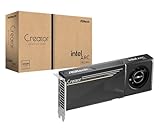
- System Compatibility Note: 2-slot card, 271x112x39mm, single 8-pin power, 200W TDP. Verify chassis clearance and PSU capacity before purchase.
- Dedicated Support: Please contact us directly through Amazon for any product questions or assistance you may require.
- 24GB GDDR6 on 192-Bit Bus: Massive 24GB memory with 456 GB/s bandwidth – ideal for LLMs, AI inference, 3D rendering, and generative design.
- Intel Xe2-HPG Architecture: Built on Intel's next-gen architecture with 20 Xe cores and 160 XMX engines for AI acceleration (197 INT8 TOPS).
- PCIe 5.0 Support: PCI Express 5.0 x16 interface for maximum bandwidth with the latest workstation platforms.
Which settings can change VRAM use?
- Context size: A smaller context can reduce the amount of cached attention state, but also limits how much context is available.
- Batch and microbatch sizes: These affect execution buffers; changing them can alter the memory profile and may affect processing behavior.
- KV cache placement and data type: Moving the cache where supported or choosing different K/V cache types can change GPU-memory use, with possible performance or output-behavior trade-offs.
- GPU-layer count: Offloading fewer layers can free VRAM, while leaving more model work outside the GPU.
- Model quantization: Quantization changes the stored tensor data and can affect weight residency, but it does not eliminate cache, buffer, or runtime allocations.
These controls do not imply a fixed amount of memory saved. Measure the result with your model, runtime, backend, and workload; a setting’s effect varies with that configuration.
Independent reader supportYour contribution helps us test, update, and keep practical guides available for everyone.Plan for the workload, not just the file
There is no established universal multiplier for converting GGUF file size into required VRAM. For a capacity decision, account for the model and quantization, intended context length, GPU-layer allocation, cache settings, and runtime/backend behavior. If those needs still exceed available VRAM after configuration changes, a GPU with more memory may be relevant—but assess the complete workload budget rather than choosing from the GGUF file size alone.
Quick Recap
Best Value

- System Compatibility Note: 2.5‑slot card measuring 303 mm (L) x 131 mm (W) x 45 mm (H); requires a single 8‑pin power connector and a recommended 550W power supply. Please verify chassis clearance and power supply capacity before purchase.
- Dedicated Support: Please contact us directly through Amazon for any product questions or assistance you may require.
- AMD RDNA 3 Architecture with AI & Ray Tracing Acceleration: Powered by 32 RDNA 3 Compute Units featuring 3rd Gen Ray Tracing Accelerators and 2nd Gen AI Accelerators, delivering lifelike lighting, shadows, and superior machine learning performance for enhanced gaming and content creation.
- Powerful 1080p & 1440p Gaming Engine: Features a max boost clock of up to 2695 MHz, a game clock of 2280 MHz, and 2048 stream processors, ensuring outstanding frame rates in the latest titles.
- 8GB High‑Speed GDDR6 Memory: Equipped with 8GB of GDDR6 memory on a 128‑bit interface running at 18 Gbps, delivering up to 288 GB/s bandwidth for high‑resolution textures and demanding game workloads.
Rank #4

- 16 Xe2 CORES WITH 170 TOPS AI PERFORMANCE: Built on Intel Xe2 architecture with 16 Xe cores and 128 XMX AI engines. 170 TOPS INT8 compute delivers powerful local AI inference — run 7B FP8 models smoothly on a single card.
- 16GB GDDR6 FOR COMPLEX WORKLOADS: 16GB dedicated memory with 224 GB/s bandwidth handles AI models, 3D simulations, high-resolution video editing, and ray tracing workloads without compromise.
- LOW-PROFILE DESIGN FOR SFF BUILDS: Ultra-compact 167 × 69 × 18.4 mm with only 70W TBP — no external power connector needed. Perfect for ITX cases, slim workstations, and space-constrained professional deployments.
- INDUSTRY-GRADE CERTIFICATION: Certified for AutoCAD, SolidWorks, Revit, Maya, 3ds Max, Catia, and more. Trusted for engineering, architecture, product design, and media production workflows.
- DUAL CODECS + 8K MULTI-DISPLAY OUTPUT: Hardware encode/decode for AV1, H.265, H.264, and VP9. 2× HDMI 2.1 + 1× DP 2.1 support 8K output — accelerate video editing, streaming, and multi-monitor setups.
Product prices and availability are accurate as of the date/time indicated and are subject to change. Any price and availability information displayed on Amazon at the time of purchase will apply.

