
Free tools Windows power users keep installed
One-click scans. No signup required.
A cache can be running and still be doing nothing for your application. If a production setting sends requests around the cache, reads that it normally absorbs can land directly on the database instead—raising the risk of slow responses, timeouts, and errors. The MegaShop outage described in a 2025 DZone article is explicitly fictional, but its failure chain illustrates how configuration, monitoring, and recovery plans can make or break a caching layer.
How the fictional failure unfolded
In Ravi Teja Thutari’s June 6, 2025 DZone article, the imagined MegaShop system uses application servers, a database, a distributed in-memory key-value cache, and a CDN. A production configuration update leaves the cache-enabled flag set to false because a staging-oriented value was not overridden. In the article’s simplified logic, the application then skips both cache reads and writes and queries the database directly. The cache servers remain available, but the application is not using them.

That distinction matters because the database may have been sized on the assumption that the cache would absorb some reads. When requests bypass the cache, backend query load rises; in the fictional account, the resulting pressure leads to latency, timeouts, and errors. A second configuration issue compounds the story: a five-minute TTL is interpreted as five seconds because of a unit mismatch. These are narrative details, not measurements from a verified company outage or monitoring system. Read the DZone case study.
Why cache health is not the same as cache use
A cache service’s health check can show that its process is reachable while telling you nothing about whether application requests are actually using it. A disabled feature flag, incorrect environment override, or other routing mistake can leave the cache operational but irrelevant. In that state, the application may continue to function—until the database receives more work than it can comfortably handle.
#1 Best Overall

- Durable Carbon Steel: Rack mount screws and cage nuts are made of high-quality carbon steel with a black finish for high strength and dependable durability.
- Easy Installation: Clear metric threads and uniform pitch for better grip. Nylon washers help secure screws and protect equipment surfaces.
- Organized Storage: All parts are packed in a portable storage box for easy organization and access.
- Wide Compatibility: Fits most square-hole racks and cabinets—ideal for server racks, network cabinets, equipment enclosures, and A/V gear.
- 20-Set Kit: Includes 20 mounting screws with nylon washers (M6 x 20 mm) and 20 square cage nuts—40 pieces in total—meeting daily install and replacement needs.
Cache behavior also affects what happens after a fix. If entries have expired or were never written, restoring cache access can create a cold-cache period: requests miss and go to the database while popular values are repopulated. Turning caching back on is not, by itself, proof that the database is out of danger.
What to monitor together
Monitoring should connect cache activity to the downstream systems and user experience it is meant to protect. A healthy cache process alone is not sufficient evidence that the application is receiving the intended benefit.
- Cache hit rate: Watch whether requests are being served from the cache, and investigate a sudden drop or a sustained rate that differs from the expected workload.
- Cache latency: Track the time spent accessing the cache; a high hit rate is less useful if cache operations themselves are slow.
- Database fallbacks and load: Observe how often misses or bypasses send work to the database, alongside query volume and other database pressure indicators.
- Service health: Correlate those signals with request latency, timeouts, and errors so that infrastructure changes are visible in customer-facing behavior.
Prevent configuration mistakes before deployment
The story’s trigger is not a cache-server failure; it is a setting that changes whether the application uses the cache. Deployment safeguards should therefore validate configuration as well as infrastructure.
- Make environment-specific values explicit. Do not let a staging-oriented setting silently become a production default.
- Validate critical flags during deployment, especially settings that can bypass protective infrastructure.
- Check units and expected ranges for values such as TTLs. A syntactically valid number can still represent the wrong duration if the application expects a different unit.
- Where practical, surface the effective production configuration and alert on changes to high-impact settings.
Recover without overwhelming the backend
Thutari’s fictional recovery sequence corrects the cache configuration and TTL, warms popular entries, temporarily adds database capacity, reduces noncritical workload, and watches cache-hit and service-health metrics as demand recedes. The account says recovery took roughly 30 minutes; that is a story detail, not a general recovery benchmark.
Rank #3

- Versatile Compatibility - The M6 rack mounting screw kit is designed for universal compatibility with most rack and cabinet systems with square holes. It is perfect for mounting 19 inch / 10 inch network cabinet, server cabinets, electronics enclosures, racks, shelf
- Length of M6 screws - The total length of the M6 screw is 19.7 mm (0.77 inches), the thread length - nominal length of the M6 screw is 16 mm (0.63 inches)
- Robust construction - These M6 screws and cage nuts are made of high-quality carbon steel and offer exceptional strength, corrosion resistance and durability, ensuring long-term performance even in extreme conditions
- Complete installation kit - Each pack contains 20 rack mounting screws, 20 square cage nuts and 20 washer plastic and provides a comprehensive solution for all your mounting needs and ensures you have enough material for different projects
- Effortless and efficient installation - With precise threads and a smooth design, these M6 screws allow easy insertion and secure attachment, optimise the installation process and improve work efficiency
The operational lesson is to restore the cache while also controlling the work that reaches the database during recovery. Depending on the system, graceful degradation or load shedding can limit noncritical demand. Cache warming can help populate frequently requested values, but the refill itself should be managed so it does not create a burst of backend queries. Teams should define the safe sequence for their architecture rather than assume that every cache can be repopulated the same way.
Independent reader supportYour contribution helps us test, update, and keep practical guides available for everyone.Turn the failure mode into a rehearsal
Cache loss and cache bypass are useful failure scenarios to test in a controlled environment. A rehearsal can reveal whether alerts detect a falling hit rate, whether database capacity and fallback behavior are adequate, and whether load shedding works before users encounter a production incident.
Quick Recap
Best Value

- Product Type Flash Backed Write Cache
- Application/Usage Server
- Data Backup Type Flash
Rank #4
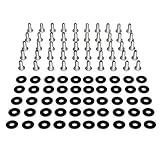
- Threaded hole hardware kit - 50 each #12-24 screws
- Fastens equipment to threaded hole rack mount rails
- Compatible with all #12-24 threaded hole racks
- Verify alerts for cache hit rate, cache latency, database fallbacks, database load, and user-facing errors.
- Test what happens when the cache is unavailable and when it is available but application traffic bypasses it.
- Confirm that environment overrides and TTL units resolve to the intended production values.
- Practice restoring cache use while protecting the database during cold-cache refill.
Product prices and availability are accurate as of the date/time indicated and are subject to change. Any price and availability information displayed on Amazon at the time of purchase will apply.

