
Satellites can run compact AI for fast, mission-specific jobs: filtering unusable images, spotting a defined target or change, prioritizing data for downlink, and deciding whether to take another observation. Ground-based AI is generally better suited to compute-heavy or frequently updated analysis, combining large datasets, and work that can wait for data to reach Earth. Many missions benefit from both: onboard triage and timely action, followed by deeper ground analysis.
What satellite AI can do onboard
Onboard AI is most useful when a spacecraft needs to make a limited decision using data it already has, before a ground team can review it. The aim is often not to reproduce a full Earth-based analysis in orbit. It is to reduce data, identify something worth attention, or trigger a mission-defined response.
- Filter data: detect clouds or other quality problems and avoid storing or transmitting imagery that is unlikely to be useful.
- Classify or detect: look for a narrowly defined feature, such as a vessel or a cloud, in a sensor’s data.
- Find changes or events: compare observations, flag a possible event, and prioritize it for follow-up.
- Reduce data: send a compact classification, event boundary, or alert metadata instead of—or ahead of—large raw files.
- Adjust observations: use an onboard result to retarget an instrument or schedule another observation, where the mission permits it.
- Support spacecraft autonomy: help with time-sensitive payload, communications, or health-related decisions, subject to rigorous safety and verification.
These workloads are strongest when the spacecraft can make a useful first decision without waiting for a downlink. They are not all equally mature, and an example on one mission does not mean every satellite can perform the same task.
What demonstrations show
Dynamic Targeting: decide whether to image
NASA/JPL reported on 24 July 2025 that a flight test on CogniSAT-6 let an Earth-observing satellite analyze imagery and decide where to point an instrument in less than 90 seconds, without human involvement. The setup looked about 500 km ahead and focused on cloud avoidance: if clouds obscured a target, the satellite could cancel imaging and preserve storage for another opportunity. The report describes wildfire, volcanic eruption, and rare-storm targeting as intended future capabilities, not results of that initial test. NASA/JPL’s account of the Dynamic Targeting test.
Free tools Windows power users keep installed
One-click scans. No signup required.
#1 Best Overall

- HOBBY MODEL KIT – Unassembled model packed in an envelope with easy to follow instructions. Ideal for ages 14 and up.
- NO GLUE OR SOLDER NEEDED – Parts can be easily clipped from the metal sheets. Tweezers are the recommended tool for bending and twisting the connection tabs.
- VOYAGER – 1.5 Sheet Model with a moderate difficulty level. Assembled Size: 1.38 x 1.77 x 6.70 inches.
- FROM STEEL SHEETS TO 3D – Pop out the pieces and connect using tabs and holes. Includes illustrated instructions.
- HIGHLY DETAILED ETCHED MODEL – Display your 3D model once completed - collect and build them all.
Φsat-2: several narrow Earth-observation applications
ESA says Φsat-2 launched on 16 August 2024 and carries an eight-band imager. Its mission page lists six AI applications, including filtering cloudy images, detecting and classifying maritime vessels, and turning imagery into street maps for disaster response. These are mission-specific applications; the list does not establish that each has the same maturity or is a general capability of other spacecraft. ESA’s Φsat-2 mission information.
Prithvi: adapt a model, then compress it for orbit
NASA reported on 7 May 2026 that a compressed version of the Prithvi geospatial model was uploaded to South Australia’s Kanyini satellite and to the IMAGIN-e payload on the International Space Station, where flood and cloud detection were tested. NASA says the model was trained on 13 years of data and can be adapted for tasks such as floodplain mapping, disaster monitoring, and crop-yield prediction. The example illustrates why deployment may involve adapting and compressing a model for a particular task rather than sending a large general model unchanged. NASA also notes that bandwidth can make large software updates to active satellites difficult; a smaller task-specific decoder may take less bandwidth to upload than a whole new model. NASA’s account of Prithvi in orbit.
Rank #2

- Model Kit
- May Require Paints and Glues to Assemble
- Accurate Scale Model
- Detailed Instructions Provided
- Decals/Transfers Included
Autonomous Sciencecraft: detect, plan, and revisit
NASA/JPL’s Autonomous Sciencecraft Experiment describes algorithms that detect science events or changes and use planning software to revise activities. Examples include detecting flooding, ice melt, and lava flows, then retargeting on a later orbit to map the event. The project also discusses future planetary-science uses, such as short-lived volcanic eruptions on Io and cometary jets. These are experiment capabilities and mission concepts, not standard functions of all satellites. NASA/JPL’s Autonomous Sciencecraft Experiment page.
Networked observation and communications
ESA’s 3CS4EO project describes a proposed architecture in which onboard AI, heterogeneous sensors, cooperative “tip and cue” observations, direct user alerts, and in-orbit software deployment work together. It illustrates a possible way to coordinate observations, but it should be read as a project architecture rather than proof of a mature operational service. ESA Φ-lab’s 3CS4EO project page.
What’s actually slowing this PC down?
Pick the symptom - the matching free tool is one click away.
Rank #3

- HOBBY MODEL KIT – Unassembled model packed in an envelope with easy to follow instructions. Ideal for ages 14 and up
- NO GLUE OR SOLDER NEEDED – Parts can be easily clipped from the metal sheets. Tweezers are the recommended tool for bending and twisting the connection tabs
- APOLLO CSM – 3.5 Sheet Model with a challenging difficulty level. Assembled Size: 5.07 L x 2.28 W x 3.45 H inches.
- FROM STEEL SHEETS TO 3D – Pop out the pieces and connect using tabs and holes. Includes illustrated instructions
- HIGHLY DETAILED ETCHED MODEL – Display your 3D model once completed - collect and build them all
Onboard processing is not limited to Earth imagery. ESA’s ASCEND description identifies communications use cases such as real-time radio-frequency interference detection and mitigation, dynamic spectrum resource management, and modulation recognition. Its page also identifies radiation qualification of high-performance commercial processors and thermal management as challenges. Product-page performance claims are not independent benchmarks or proof that a processor is qualified for flight. ESA’s ASCEND project description.
Which workloads are usually better on the ground?
Ground processing is generally preferable when the analysis can wait for a downlink and benefits from resources or information that a spacecraft does not have. These are engineering tendencies, not universal rules: powerful onboard hardware, inter-satellite links, and mission-specific design can move the boundary.
Rank #4

- HOBBY MODEL KIT – Unassembled model packed in an envelope with easy to follow instructions. Ideal for ages 14 and up.
- NO GLUE OR SOLDER NEEDED – Parts can be easily clipped from the metal sheets. Tweezers are the recommended tool for bending and twisting the connection tabs.
- JAMES WEBB SPACE TELESCOPE - 2.75 Sheet Model with a moderate difficulty level. Assembled Size: 4.13 L x 2.75 W x 2.75 H inches. 1:221 Scale. 62 Pieces
- FROM STEEL SHEETS TO 3D – Pop out the pieces and connect using tabs and holes. Includes illustrated instructions.
- HIGHLY DETAILED ETCHED MODEL – Display your 3D model once completed - collect and build them all.
- Large or compute-intensive inference: a model may exceed the spacecraft’s available compute, memory, power, or thermal budget.
- Frequent model changes or retraining: large uploads can be constrained by communications bandwidth, and models may need validation before deployment.
- Broad data fusion: combining observations from many satellites, external datasets, and long historical archives is difficult when that information is not available onboard.
- Exploratory work and human review: analysts may need to inspect raw data, compare alternative explanations, or investigate an unexpected result.
- High-consequence decisions needing extensive validation: onboard AI can flag an event, while ground systems and people perform the richer checks before a consequential response.
NASA’s 2026 SmallSat avionics report describes the conventional pattern: collect and temporarily store raw data onboard, then transmit it for ground post-processing. The goal of edge processing is to send more distilled, useful information instead of relying only on unfiltered raw data. In that report’s terminology, edge computing describes where processing happens, machine learning identifies patterns or makes predictions, and AI supports higher-level interpretation, prioritization, and action. NASA’s 2026 SmallSat avionics report, section 8.2.6.
Independent reader supportYour contribution helps us test, update, and keep practical guides available for everyone.How to choose where a workload runs
Decide based on the mission’s response needs and constraints, not on whether a task is labelled “AI.” A simple detector may still be a poor onboard choice if it is unsafe to act on without review; a more complex model may be worthwhile if it prevents a time-critical loss of data.
Do these 3 things before closing this tab:
1Repair Windows errors before they cause bigger problems2Scan for outdated or missing drivers - takes under a minute3Clear out junk files and repair common Windows errorsBest Value
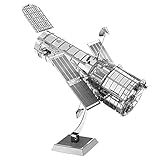
- HOBBY MODEL KIT – Unassembled model packed in an envelope with easy to follow instructions. Ideal for ages 14 and up.
- NO GLUE OR SOLDER NEEDED – Parts can be easily clipped from the metal sheets. Tweezers are the recommended tool for bending and twisting the connection tabs.
- HUBBLE TELESCOPE – 1 Sheet Model with a moderate difficulty level. Assembled Size: 3.00 x 2.00 x 2.50 inches.
- FROM STEEL SHEETS TO 3D – Pop out the pieces and connect using tabs and holes. Includes illustrated instructions.
- HIGHLY DETAILED ETCHED MODEL – Display your 3D model once completed - collect and build them all.
- Set the required response time. If the spacecraft must react before the next useful ground contact, onboard inference may be necessary. If the result can wait, ground processing may be simpler and more capable.
- Estimate the downlink value. Compare the volume of raw sensor data with the compact outputs a filter or detector could send. Onboard processing is attractive when it meaningfully reduces data or identifies a rare event among many routine observations.
- Match the model to available resources. Account for model size, compute throughput, memory, power, mass, volume, and heat removal—not just accuracy on a terrestrial computer.
- Plan for updates and validation. Consider how often the model will change, how it will be tested, and whether the spacecraft can receive the required files and recover safely from an error.
- Set the acceptable error consequences. A false alarm, missed detection, or unnecessary observation can have different costs. Keep human or ground validation in the loop where the mission’s risk warrants it.
- Define the output and split the pipeline. The spacecraft might send an alert or event boundary immediately, while downlinking the underlying data for ground confirmation and analysis.
Why space hardware changes the calculation
A developer board that runs a model on Earth is not automatically suitable for orbit. NASA notes that radiation can damage electronic components over time and cause computing errors. Space systems must also manage power, heat, memory, reliability, fault recovery, and limited communications while meeting mission assurance requirements.
NASA’s High Performance Spaceflight Computing program targets improvements in performance, power management, fault tolerance, and connectivity. As of March 2026, NASA said HPSC was undergoing tests for power, performance, reliability, and radiation tolerance; that status is not a claim that the processor was fully space-qualified. NASA’s project page states a target capability over 100 times that of current space processors, which is a project target rather than a completed qualification result. NASA’s HPSC program page.
For a prototype, a developer kit can help test whether a workload’s model and software approach are practical at the edge. It cannot establish flight readiness: satellite deployment requires mission-specific hardware selection, radiation and thermal qualification, and reliability testing. ESA’s ASCEND description, for example, says its Sterna unit is built around NVIDIA Jetson Orin NX, but that does not establish direct compatibility or flight suitability for a particular developer kit.
Why a hybrid design is often the practical answer
Onboard and ground AI solve different parts of the same problem. A spacecraft can filter an image, flag a likely event, or decide to collect another observation while the opportunity is still available. The ground can then combine that result with other satellites, historical records, and human review. A useful design sends the smallest timely product needed for action while preserving or downlinking underlying data for deeper analysis when bandwidth allows.
There is no universal model-size threshold or rule that says a workload must run on Earth. Demonstrations differ by orbit, sensor, processor, and mission, so the right division depends on latency, available data and compute, update needs, and the consequences of an incorrect decision.
Quick Recap
Product prices and availability are accurate as of the date/time indicated and are subject to change. Any price and availability information displayed on Amazon at the time of purchase will apply.

