
What’s actually slowing this PC down?
Pick the symptom - the matching free tool is one click away.
Spacecraft and telescopes reveal different layers and properties of Venus’s atmosphere, but no single view captures it all. Cameras map cloud patterns, spectra identify atmospheric signatures, radio measurements help reconstruct vertical structure, and a descending probe can sample local air directly. The wavelength used—and the angle from which Venus is observed—determines what scientists can infer.
Why Venus’s atmosphere must be studied indirectly
Venus is hidden beneath a dense, global cloud deck, so an ordinary visible-light image shows the cloudy disk rather than the surface. The atmosphere is mostly carbon dioxide, and its clouds contain sulfuric acid. At the surface, pressure is about 93 times Earth’s sea-level pressure, according to NASA Science’s Venus facts page.
That opacity does not make Venus unreadable. Instruments observe reflected ultraviolet light, infrared emission, or narrow spectral features; spacecraft can also use radio signals to probe the atmosphere. Each measurement responds to a different part of the atmosphere and answers a different question.
What spacecraft can measure
Cloud patterns and circulation
JAXA’s Akatsuki carries cameras operating from ultraviolet through infrared wavelengths. Its images map cloud patterns and temperature-related features, while repeated observations let scientists track cloud motion and estimate winds. Its ultraviolet imager also maps sulfur dioxide and unidentified ultraviolet absorbers. Infrared observations can help examine motion in lower-atmosphere clouds and the distribution of water vapor. These instruments observe remotely; the image is a wavelength-dependent view of atmospheric features, not a photograph through the clouds to the surface. See Akatsuki’s spacecraft and instruments and JAXA’s summary of Akatsuki science.
Free tools Windows power users keep installed
One-click scans. No signup required.
#1 Best Overall

- Superior Optics: 400mm(f/5.7) focal length and 70mm aperture, fully coated optics glass lens with high transmission coatings creates stunning images and protect your eyes. Perfect full positive telescope for astronomers to explore stars and moon.
- Magnification: Come with two replaceable eyepieces and one 3x Barlow lens.3x Barlow lens trebles the magnifying power of each eyepiece. 5x24 finder scope with mounting bracket and cross-hair lines inside make locating objects easily.
- Wireless Remote: This refractor telescope includes one smart phone adapter and one Wireless camera remote to explore the nature of the world easily through the screen and take amazing celestial images.
- Adjustable Tripod: This telescope allows for many different viewing positions with a adjustable aluminum alloy tripod and a carry bag, the telescope and tripod can fit inside the bag for easy traveling and storage.
- Satisfaction: Buy with confidence from a leading manufacturer.
Vertical temperature and pressure structure
A flat image locates features across the visible disk, but does not by itself say how conditions change with altitude. Akatsuki’s ultra-stable oscillator and radio-science observations can derive vertical profiles of temperature and pressure. Radio occultation-style measurements use changes in a spacecraft’s radio signal as it passes behind or emerges from Venus, providing altitude-sensitive constraints rather than just a surface map. The technique and mission instruments are described by JAXA and Akatsuki’s science overview.
Direct measurements during a descent
A probe can measure the air it passes through instead of inferring every property from light or radio signals. NASA describes the planned DAVINCI probe as measuring atmospheric chemistry, temperature, pressure, and winds during descent, alongside flyby imaging. These are planned capabilities, not completed results. Unlike repeated orbital images, a descent samples a particular path through the atmosphere: it can provide local, altitude-by-altitude measurements, not a global map. NASA outlines the mission at DAVINCI and its planned atmospheric measurements at NASA’s instrument overview.
Rank #2

- BRIGHT, SHARP VIEWS ANYWHERE: Unlike many beginner telescopes, this quality refractor features fully coated glass lenses and a 70mm aperture for crisp, clear views of the Moon, planets, and daytime scenery—all in a lightweight, travel-ready design.
- PERFECT FIRST TELESCOPE FOR BEGINNERS: Designed for adults and kids to enjoy together, this beginner-friendly telescope sets up in minutes and delivers rewarding views with no prior experience required.
- EASY NO-TOOL SETUP: No complicated assembly or tools needed. The full-height tripod and telescope tube set up in seconds and pack neatly into the included backpack—so you’re always ready to observe on the go.
- DUAL EYEPIECES FOR VERSATILE VIEWS: Includes 20mm and 10mm eyepieces for wide and close-up views of celestial and terrestrial targets. Spot craters on the Moon at night or wildlife during the day.
- BONUS BACKPACK AND SOFTWARE: Includes a padded backpack with room for accessories, a finderscope, star diagonal, eyepieces, and a free download of Starry Night software to help you identify celestial objects and plan your next stargazing session.
Earlier orbital context
Venus Express also carried radio-science and imaging and spectroscopy instruments. Its radio link was used to investigate atmospheric density, temperature, and pressure over an altitude range. Akatsuki complements that earlier mission; Venus Express orbited Venus until 2014, according to NASA’s Akatsuki mission page.
What telescopes can reveal
Ultraviolet views trace cloud features
Ultraviolet images can make patterns in Venus’s cloud tops distinctive even when visible-light views do not. Hubble’s ultraviolet images show these atmospheric features, which act as tracers: comparing their positions over time helps estimate the motion of the clouds and the winds carrying them. The patterns are in the atmosphere, not a view of the obscured surface. NASA’s Venus cloud-top images document this kind of view.
Rank #3
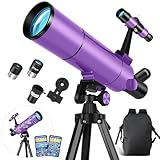
- Advanced Optics: The Dianfan 80×500 astronomical telescope features a 80mm aperture and a 500mm focal length.The telescope features fully multi-coated optics for high light transmission and brighter, clearer images.A great choice for kids beginners and astronomy enthusiasts alike
- High Magnification: Equipped with two high-quality eyepieces and a 3× Barlow lens, this telescope offers magnification ranging from 20× to 150×. Ideal for exploring the Moon’s surface and discovering its many details.A suitable telescope for adults high powered
- Easy to Assemble and Use: Designed with a user-friendly structure, this telescope can be set up in about 15 minutes, even for first-time users.Clear illustrated manual and components ensure a simple, clear, and quick assembly process.The intuitive design lets beginners focus on exploring the night sky instead of dealing with complex installation
- Portability and Versatility: This telescope set includes a phone adapter and backpack for versatile use. The phone adapter helps to record stargazing moments. The water-resistant, custom-fit backpack allows for easy transport and storage.This telescope is suitable for observing the Moon, bright planets, distant landscapes, birds, and nature views. Its portable design makes it convenient for backyard stargazing, camping trips, travel, and outdoor exploration
- Creativity: The telescope includes 2 reusable astronomy-themed and alphabet stickers, allowing kids to personalize their telescope. With its purple design and easy-to-use structure, this telescope is suitable for both kids and adults. It helps encourage curiosity about astronomy, science, and nature, making it a meaningful choice for family activities, beginner stargazing, and educational exploration
Infrared observations reveal emissions and chemistry
Infrared instruments detect thermal emission and wavelength-specific signatures that can be used to investigate atmospheric composition and motion. In 2022, NASA’s SOFIA airborne observatory conducted infrared observations of Venus’s atmospheric composition. Because SOFIA flew above most of Earth’s infrared-blocking atmosphere, it could observe bands that are difficult for ground observatories to access. NASA describes the observations in its SOFIA account.
High-resolution spectroscopy can resolve molecular features
Some ground-based observations use infrared heterodyne spectroscopy to resolve narrow molecular emission features. NASA Goddard’s HIPWAC instrument has been used at observatories including NASA’s Infrared Telescope Facility and Subaru on Mauna Kea. The technique has supported measurements of planetary winds and composition, including for Venus. Its value is not simply that it produces an infrared picture: it separates spectral features that carry information about molecules and atmospheric motion. See NASA Goddard’s HIPWAC overview.
Rank #4
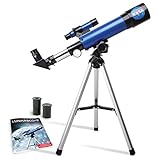
- INSPIRE CURIOSITY – The NASA Lunar Telescope allows your child to see the moon in incredible detail; the perfect gift for girls and boys interested in space, the moon, and astronomy!
- HIGH-QUALITY OPTICAL GLASS AND FINDER SCOPE – This easy-to-use telescope comes with a finder scope, low power, and high-power eyepieces; when used correctly, this combination will allow your child to easily locate the moon then zoom in for a close-up view.
- TABLETOP TRIPOD & SMOOTH MOUNT SYSTEM – Use the included tripod to steady your Lunar Telescope for optimal viewing, with a smooth mounting system that allows easy scanning of the entire lunar surface.
- PERFECT FOR BEGINNERS – This telescope is easy to assemble and use, making it ideal for young scientists and parents to enjoy together.
- AMAZON EXCLUSIVE - Blue Marble has developed this product exclusively for Amazon.
A transit offers a special view through the atmospheric limb
When Venus passes in front of the Sun as seen from Earth, some sunlight crosses the thin atmospheric edge, or limb, before reaching an observer. During the 2012 transit, researchers analyzed X-ray and ultraviolet images from NASA’s Solar Dynamics Observatory to measure how Venus’s atmosphere absorbed light at different wavelengths. This geometry can reveal wavelength-dependent absorption, but it is available only during a transit; it is not the same as a routine full-disk image. NASA explains the analysis in its report on the transit images.
Independent reader supportYour contribution helps us test, update, and keep practical guides available for everyone.How wavelength and viewing geometry change the result
An instrument does not record “the atmosphere” in the abstract. It measures a particular signal, from a particular direction, over a particular area or path. That determines which features stand out and what conclusions are possible.
Recommended Free Tools
| Method or signal | What it measures or reveals | Coverage and limitation |
|---|---|---|
| Ultraviolet imaging | Cloud-top patterns and absorbers such as sulfur dioxide or unidentified ultraviolet absorbers | Maps visible atmospheric features; the observed patterns do not show the surface. |
| Infrared imaging and spectroscopy | Thermal emission and wavelength-specific atmospheric signatures; certain bands help examine lower clouds and water vapor | What is detected depends on the band, instrument, and observing conditions. |
| Cloud tracking | Motion of atmospheric features, used to estimate winds | Requires images suitable for tracking; measures cloud motion rather than a direct wind reading at every altitude. |
| Radio occultation and radio science | Altitude-sensitive constraints, including vertical temperature and pressure profiles | Samples a specific radio path through the atmosphere rather than producing a global image. |
| Descent probe | Local atmospheric chemistry, temperature, pressure, and winds along the descent path | Direct measurements at sampled locations and altitudes, not global coverage; DAVINCI’s described measurements are planned. |
| Transit observation | Wavelength-dependent absorption through the atmospheric limb | Depends on the special geometry of Venus crossing the Sun as viewed by the observer. |
In practical terms, images are especially useful for mapping structures and following their movement; spectroscopy identifies and quantifies wavelength-specific signatures; radio methods help recover changes with altitude; and probes directly sample air along a descent. These methods complement one another rather than compete to provide one definitive picture.
Can a telescope see through Venus’s clouds?
Not in ordinary visible light: the global cloud deck blocks a direct view of the surface. Other wavelengths can reveal atmospheric properties and features hidden in visible-light images, but that does not mean every telescope can see through the clouds to the ground. A backyard telescope can show Venus’s bright disk and phases; the atmospheric measurements described here require specialized instruments, observing conditions, or spacecraft.
Quick Recap
Product prices and availability are accurate as of the date/time indicated and are subject to change. Any price and availability information displayed on Amazon at the time of purchase will apply.

