
PicoMite is firmware that runs Geoff Graham’s Microsoft BASIC-compatible MMBasic interpreter on Raspberry Pi Pico-family boards. It lets BASIC programs work with microcontroller hardware—including GPIO, serial, I2C, SPI, ADC, displays and storage—using board-specific firmware builds. The project documents support for Pico, Pico W, Pico 2, Pico 2 W and modules based on RP2040 or RP2350 processors.
What PicoMite does
PicoMite combines an MMBasic interpreter with drivers for the Raspberry Pi Pico’s hardware. The official project describes it as a complete operating system with a Microsoft BASIC-compatible interpreter and support for peripherals such as touch-sensitive LCD panels, SD cards and Wi-Fi/Internet. Peter Mather led the port and wrote hardware drivers; Geoff Graham wrote the interpreter and manual. Geoff Graham’s PicoMite project page and the PicoMite User Manual explain the project and its capabilities.
This is firmware for a microcontroller, not a desktop version of BASIC. A Pico board running PicoMite can execute BASIC programs that interact with connected electronics through the interfaces supported by its firmware variant.
Which Raspberry Pi Pico boards are supported?
The manual lists Raspberry Pi Pico, Pico W, Pico 2 and Pico 2 W, along with modules using RP2040 or RP2350 processors. The source repository also records PicoCalc support and build selections for first-generation Pico and Pico 2. Check the selected firmware build against the exact board and its processor before flashing it.
#1 Best Overall

- The Raspberry Pi Pico is a beginner-friendly microcontroller board that uses MicroPython to give you a taste of the Internet of Things and microcontrollers. The RP2040 is a well-designed microprocessor that can be utilized in almost any Internet of Things project. It has enough power to complete the task quickly.
- 【Raspberry Pi RP2040 Microcontroller】Raspberry Pi Pico features Dual-core ARM Cortex M0+ processor, flexible clock running up to 133 MHz. With 264KB of SRAM, and 2MB of on-board Flash memory.Supports up to 16 MB of off chip flash memory via a dedicated QSPI bus
- 【Multiple Software Support】Pico has rich and complete software support, it comes with a complete Rasberry Pi official C/C++ SDK, Micropython SDK.The programming and burning of Pico need to be carried out on the computer. Supported operating systems and computers include:Raspberry Pie with Raspberry Pi OS,Other platforms equipped with Debian based Linux system Computer with MacOS, Computers with Windows, etc.
- 【Rich Hardware Interface】Raspberry Pi Pico has 30 GPIO pins, 4 pins for analog signal input and 26 × multi-function GPIO pins, 2 × SPI, 2 × I2C, 2 × UART, 3 × 12-bit ADC, 16 × controllable PWM channels.USB 1.1 supported by host and device, The installation mode can be flexibly selected by users to facilitate welding with other development boards.
- 【Build Project in Tiny Size】Only 2.1cm*5.1cm ( as small as your thumb). Pico has been designed to use either soldered 0.1" pin-headers or can be used as a surface-mountable 'module'.
For someone asking specifically about the Raspberry Pi Pico 2 W: it is among the documented targets. As with other boards, use the matching firmware variant and consult its manual for the correct pins and feature configuration.
Hardware and add-on support
What a PicoMite build can connect to depends on the board, firmware variant and wiring. The manual documents digital input/output on GP0–GP28, UART serial interfaces (COM1/COM2), I2C/I2C2 and SPI/SPI2. The project’s feature documentation also lists CPU-clock control and ADC, as well as add-ons such as displays, SD storage and networking. See the official PicoMite feature page and manual pinout and hardware sections for variant-specific details.
Rank #2
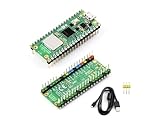
- RPi Pico 2 W Microcontroller Board (pre-soldered header (color-coded)), Based on Official RP2350 Chip, Dual-core & Dual-architecture Design. Upgraded hardware from Pico 2 with wireless communication, onboard antenna, features 2.4GHz 802.11n WIFI and Bluetooth 5.2.
- Adopts unique dual-core and dual-architecture design: dual-core Arm Cortex-M33 processor and dual-core Hazard3 RISC-V processor, flexible clock running up to 150 MHz.
- Onboard Infineon CYW43439 wireless chip, supports WIFI 4 wireless and Bluetooth 5.2.
- 520KB of SRAM, and 4MB of on-board Flash memory.
- Castellated module allows soldering direct to carrier boards. USB 1.1 with device and host support. Low-power sleep and dormant modes. Drag-and-drop programming using mass storage over USB.
Displays and input
Supported display options vary by build. The project documents touch-sensitive LCD panels, VGA and HDMI configurations, and reference designs for VGA/PS2 and HDMI/USB. Some configurations support USB keyboards, mice or gamepads. These are not interchangeable pin layouts: VGA builds reserve GP16–GP21, while HDMI builds reserve GP12–GP19. USB input variants can reserve serial-console pins, so verify the selected build’s pin map before connecting peripherals.
Storage, networking and common interfaces
Depending on the firmware and attached hardware, PicoMite can use SD cards and Wi-Fi/Internet features alongside GPIO, UART, I2C, SPI and ADC. The feature list establishes that these capabilities are supported in relevant configurations; it does not mean every board build includes every peripheral or that the Pico board alone supplies all required accessories.
Windows Errors? Fix Them Before They Spread
Repair common Windows errors and clear accumulated junk for a smoother, more stable PC - no reinstall needed.Free scan · no reinstallCrashes, No Sound, or Screen Glitches?
Random freezes, missing sound and display glitches usually trace back to one bad driver. Find and replace yours safely.Free scan · under a minuteRank #3

- Latest Version: Higher core clock speed, double memory, more powerful Arm cores, optional RISC-V cores (compared to the 1 series) (This W version has onboard wireless LAN and Bluetooth)
- Switchable Cores: Allows users to choose between dual industry-standard Arm Cortex-M33 cores and dual open-hardware Hazard3 cores
- Compatibility: Delivers a significant performance boost, while retaining software- and hardware-compatible with the 1 series
- Detailed Tutorial: Provides step-by-step guide with MicroPython, C and Processing (Java) Code (The download link can be found on the product box) (No paper tutorial)
- Example Projects: Each project has schematics, wiring diagrams, complete code and detailed explanations (Need extra items)
How to install and start using PicoMite
The usual workflow is to obtain the firmware for the correct board and feature variant, put the board into bootloader mode, copy or flash the UF2 file, then connect a serial console to enter MMBasic commands. Exact steps and pin assignments depend on the chosen build; use the matching manual rather than assuming one UF2 works for every Pico model.
- Choose the target and variant. Confirm whether the board is a Pico, Pico W, Pico 2, Pico 2 W or another documented RP2040/RP2350 module. Then select the build for the display, USB or other features you intend to use.
- Download the matching UF2 and manual. Geoff Graham’s PicoMite page provides firmware downloads and links to the documentation. The page describes the manual as approximately 280 pages; check the version associated with the firmware download you select.
- Enter bootloader mode and flash. Follow the board’s bootloader procedure, connect it to the computer, and install the selected UF2 using the procedure specified by the firmware documentation.
- Connect a serial console. Use the console configuration and pins documented for that build, particularly if the selected variant reserves serial-console pins for USB or display functions.
- Consult the manual before wiring accessories or writing hardware commands. Check the build’s pin reservations, supported interfaces and command details before connecting an LCD, SD card, sensor or other hardware.
Building the firmware from source is a separate route. The project repository includes build instructions; USB builds require the Pico SDK and TinyUSB dependencies specified there.
Rank #4

- RPi Pico 2 microcontroller board (with yellow Pre-Soldered Header) is powered by Official RP2350 microcontroller chip, with unique dual-core and dual-architecture design, running up to 150 MHz, embedded 520KB of SRAM and 4MB of on-board Flash memory, as well as 26x multi-function GPIO pins
- Adopts unique dual-core and dual-architecture design: dual-core Arm Cortex-M33 processor and dual-core Hazard3 RISC-V processor, flexible clock running up to 150 MHz
- 520KB of SRAM, and 4MB of on-board Flash memory
- 26 × multi-function GPIO pins. 2 × SPI, 2 × I2C, 2 × UART, 3 × 12-bit ADC, 24 × controllable PWM channels
- Castellated module allows soldering direct to carrier boards. USB 1.1 with device and host support. Low-power sleep and dormant modes.
Firmware and manual versions
Geoff Graham’s official page currently lists PicoMite firmware V6.03.00. The online manual search result identifies version 6.00.03, revision 1, dated 18 July 2025, while the PDF result identifies revision 3, dated 8 September 2025. Because the page and manual listings do not use identical version labels, check the version information attached to the firmware and documentation you download rather than assuming every manual revision matches every firmware release.
A Raspberry Pi forum announcement from 5 May 2023 describes an earlier MMBasic 5.07.07 release, including standard Pico, VGA/PS2 and Wi-Fi versions, SD-card and flash filesystems, VGA graphics and networking. It is useful as historical context, not as a description of the current release. Read the 2023 forum announcement.
Best Value

- Compatible models: Raspberry Pi Pico / Pico H / Pico W / Pico WH / Pico 2 / Pico 2 W (NOT included in this kit)
- GPIO status LED: LED on if GPIO outputs / inputs high level, LED off if GPIO outputs / inputs low level
- Independent LED: The status LED is driven by the chip instead of the GPIO so the GPIO will not be affected
- Terminal block and header: Connect to all pins of the main board, 2.54 mm (0.1 inch) pitch
- Pin name: The name of each pin is printed next to it
What to compare before choosing PicoMite
If you are evaluating PicoMite against another Pico firmware or BASIC platform, compare features that affect your actual project rather than relying on an unsupported speed or reliability claim:
- Whether the exact board and MCU are supported.
- Which display outputs—LCD, VGA or HDMI—are available in the relevant build.
- How the build handles storage, networking and USB input.
- Which peripheral interfaces and BASIC commands are documented.
- How firmware installation works and whether the build requires source compilation.
- Whether the manual version and community guidance correspond to the firmware you plan to use.
The project documentation describes capabilities and build options, but it does not establish controlled performance benchmarks. Choose based on compatibility, required peripherals and the documentation for your intended configuration.
Quick Recap
Product prices and availability are accurate as of the date/time indicated and are subject to change. Any price and availability information displayed on Amazon at the time of purchase will apply.

