
Nuclear waste follows different routes depending on what it is. Spent reactor fuel is first cooled and shielded in deep water pools, then some is transferred to sealed dry-storage systems. Other radioactive waste, such as contaminated clothing and equipment, is handled under separate rules. In the United States, spent-fuel storage is an interim step: it remains at licensed sites while the country’s planned deep geological disposal endpoint is unavailable.
Why “nuclear waste” does not describe just one material
Radioactive waste includes materials with very different levels of radioactivity, heat output, and handling needs. Spent fuel removed from a reactor remains highly radioactive and generates heat. Low-level waste can include contaminated tools, clothing, filters, or other materials, and follows different disposal pathways.
The U.S. Nuclear Regulatory Commission (NRC) defines high-level waste to include spent reactor fuel when it is accepted for disposal, as well as residues from reprocessing. Its descriptions of radioactive waste distinguish these materials from low-level waste. NRC: high-level waste and NRC: radioactive waste backgrounder.
For scale, the NRC reports that U.S. disposal facilities received 3,301,006 cubic feet of low-level radioactive waste containing 172,630 curies in 2023. Those figures cover U.S. low-level waste disposed of that year—not spent fuel and not global radioactive waste. NRC low-level waste disposal statistics.
The Tool Desk
Outbyte PC Repair FREEClear out junk files and repair common Windows errorsFree Scan →Outbyte Driver Updater FREEScan for outdated or missing drivers - takes under a minuteDriver Scan →#1 Best Overall

- Outer Dimensions (approximate) Diameter: 2 inch (50.76 mm) Height: 3 1/2 inch (88.88 mm)
- Inner Dimensions (approximate) Diameter: 1 inch (25.39 mm) Bottom Depth: 1 3/4 inch (44.53 mm) Upper Depth: 3/4 inch (19.04 mm) Total Depth: 2 1/2 inch (63.41 mm)
- Lead Thickness (approximate) 1/4 inch (6.23 mm)
What happens to spent fuel after it leaves a reactor?
1. It goes into a spent-fuel pool
Fuel is removed when it is no longer efficient for producing electricity, but it remains hot and highly radioactive. At U.S. nuclear plants, it is initially placed underwater in a spent-fuel pool. Water carries away heat and shields radiation.
The NRC describes typical pools as reinforced concrete with steel liners and about 40 feet of water. Its pool information says at least 20 feet of water above the fuel assemblies provides adequate shielding. These are regulatory-backgrounder descriptions, not universal dimensions for every facility. NRC backgrounder and NRC spent-fuel pools.
Rank #2

- Product is sold for research or further manufacturing use only, not for food or drug use.
2. Some cooled fuel moves to dry storage
After cooling in a pool, some fuel is loaded into dry-storage systems. NRC material describes transfer as possible as early as one year in some circumstances, while typical cooling periods are several years; an NRC FAQ describes an industry norm of around ten years. These are not universal waiting periods. Timing depends on the fuel, the cask design, the site’s license, and operating practice. NRC radioactive waste backgrounder and NRC spent-fuel FAQ.
What is dry cask storage?
A dry-storage system places fuel inside a sealed metal cylinder, with additional steel or concrete providing shielding. Depending on the design, the package may sit in a vertical concrete vault, a horizontal module, or a vertical cask on a concrete pad. Closures can be welded or bolted; designs do not all use identical components.
Free tools Windows power users keep installed
One-click scans. No signup required.
Rank #3

- Designed for radioactive waste or any other laboratory waste that requires containment
- These safe storage containers may be used with disposable NRC-approved waste bags
- Constructed of heavy duty 1/2" cast acrylic for maximum protection of laboratory personnel
- Comes with hinged lid
- Measures 13-3/4" width by 17-1/2" height by 11" depth
Dry systems typically remove heat passively. Heat moves through the package to its outer surface and then into surrounding air through natural convection, rather than relying on the same water-cooling arrangement as a pool. For design details, see the NRC dry-cask backgrounder and the IAEA report on extended spent-fuel storage.
How do you know the pools and dry systems are safe?
Safety is based on multiple protective functions, not on a claim that risk is zero. IAEA Safety Standards Series No. SSG-15, quoted in the IAEA’s report on extended spent-fuel storage, states that safety is ensured by “appropriate containment of the radionuclides involved, criticality safety, heat removal, radiation shielding and retrievability.” In plain terms, a system must keep radioactive material contained, prevent the fuel from sustaining a chain reaction, remove heat, limit radiation exposure, and allow fuel to be retrieved.
Rank #4
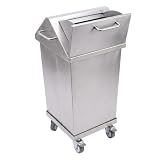
- Stainless Steel Construction — Built with high-grade stainless steel for a professional look that is easy to decontaminate and sanitize.
- Ergonomic Handling — Integrated handles facilitate safe lifting and emptying of the unit.
- Shielding Integrity: The lead lining is seamless, ensuring no radiation leakage during storage.
- Easy Maintenance and Waste Removal — Two heavy-duty lifting handles allow the top to be removed once the contents have decayed.
- Standard Options Available — Attenutech also offers these lead-lined waste containers in standard sizes with 1/4” or 1/8” lead shielding.
In the United States, the NRC says cask systems receive engineering review, site-specific assessment, licensing or certification, and inspection. Reviews address radiation protection, structural strength, criticality prevention, heat management, materials, credible natural hazards, and accident conditions; NRC oversight includes design, fabrication, and use. This is the regulator’s safety assessment, not a guarantee that accidents or failures are impossible. NRC spent-fuel FAQ and NRC storage oversight.
Spent-fuel pools vs. dry storage
| Factor | Spent-fuel pool | Dry storage |
|---|---|---|
| Cooling and shielding | Water removes heat and shields radiation. | A sealed package contains the fuel; steel or concrete provides shielding, and heat is typically removed through passive airflow. |
| Operational reliance | Operators maintain water level, cooling, make-up water, and water treatment. | Relies more on passive heat transfer through the storage system and surrounding air. |
| Monitoring and access | Water level and chemistry can be monitored; fuel is accessible underwater. | Fuel is less accessible inside sealed packages. |
| Trade-off | Large water inventories and thermal inertia, alongside the need to maintain pool systems. | Passive operation, alongside limited access to fuel and potentially higher fuel temperatures. |
The IAEA notes that both approaches have operated reliably for decades. These differences do not establish one storage method as the universal winner; the suitable approach depends on the fuel, facility, and regulatory conditions. IAEA spent-fuel storage report.
Best Value
- Stainless Steel Construction — Built with high-grade stainless steel for a professional look that is easy to decontaminate and sanitize.
- Ergonomic Handling — Integrated handles facilitate safe lifting and emptying of the unit.
- Shielding Integrity: The lead lining is seamless, ensuring no radiation leakage during storage.
- Easy Maintenance and Waste Removal — Two heavy-duty lifting handles allow the top to be removed once the contents have decayed.
- Custom Solutions — While we offer standard 1/8” and 1/4” lead protection, Phillips Safety can manufacture these lead-lined waste containers in any lead thickness or size to meet your exact clinical specifications.
What is the plan for storage of spent nuclear fuel going forward?
In the United States, spent fuel remains at reactor or storage sites under license until an endpoint is available. The NRC describes the policy endpoint as permanent disposal in a deep underground geological repository. Yucca Mountain, Nevada, is a proposed repository, not an operating facility, and the NRC’s materials do not establish a reliable date for it to begin accepting spent fuel. See the NRC spent-fuel FAQ and NRC high-level waste disposal.
Other countries make different choices, including reprocessing or direct disposal. The IAEA reports that about 10,000 tonnes of heavy metal of spent fuel was discharged from nuclear power plants in 30 IAEA Member States per year; that is the scope and annual figure given in its report published in 2025, not a global total. The report also explains that uncertainty about a final endpoint can extend storage and require license renewals. IAEA report on extended spent-fuel storage.
Storage is therefore an interim stage, even when it lasts a long time. The IAEA report quotes SSG-15 guidance that “storage cannot be considered the ultimate solution for the management of spent fuel, which requires a defined end point such as reprocessing or disposal.”
Quick Recap
Product prices and availability are accurate as of the date/time indicated and are subject to change. Any price and availability information displayed on Amazon at the time of purchase will apply.

