
Western Digital’s next capacity milestone is a 40TB UltraSMR ePMR hard drive, but it is not announced as a consumer product. In a February 3, 2026 announcement, WD said the drive was being qualified with two hyperscale customers and that volume production was planned for the second half of 2026. Those are company plans, not confirmation that the drive is on sale. WD’s longer-term roadmap extends ePMR toward 60TB and sets a 100TB HAMR target for 2029.
What is Western Digital’s largest hard drive?
By capacity, WD’s announced near-term milestone is a 40TB UltraSMR ePMR hard disk drive. The company described it as the world’s highest-capacity drive of its type, but its February 3, 2026 announcement placed it in qualification with two hyperscale customers—not in retail stores. WD said volume production was planned for the second half of 2026, a forward-looking schedule that may change.
The distinction matters: “largest” here means storage capacity, not physical dimensions, and a qualification-stage data-center drive is not automatically a consumer model. WD’s announcement did not give a retail SKU, consumer price or Amazon listing for this drive.
How does WD’s capacity roadmap compare?
| Capacity milestone | Recording path | Stage or timing announced | Intended context |
|---|---|---|---|
| 40TB | UltraSMR ePMR | In qualification with two hyperscale customers; volume production planned for the second half of 2026, according to WD’s February 3, 2026 announcement. | Hyperscale data centers; no retail availability was announced. |
| Up to 60TB | ePMR | WD roadmap target; a production date was not stated in the February 3, 2026 announcement. | Data-center capacity roadmap. |
| Up to 100TB by 2029 | HAMR | WD roadmap target; the announcement did not state a qualification or production date. | Longer-term data-center capacity roadmap. |
WD presents ePMR and HAMR as two paths rather than a single immediate product sequence. Its stated strategy is to extend ePMR toward 60TB while scaling HAMR toward 100TB by 2029, with a common architecture intended to make customer transitions easier. The dates and capacities are company roadmap statements, not guarantees of availability.
#1 Best Overall
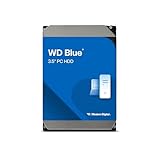
- Reliable everyday computing
- Western Digital quality and reliability
- Free Acronis True Image WD Edition cloning software
- Capacities up to 12TB
- 2-year limited warranty
What do UltraSMR, ePMR and HAMR mean for this announcement?
WD identifies the 40TB milestone as an UltraSMR ePMR drive and HAMR as the technology path for its 100TB target. In its public announcement, the company focuses on capacity, customer qualification and roadmap direction; it does not provide enough engineering detail to explain a step-by-step technical route from today’s drive to 100TB. The HAMR target should therefore be read as a stated destination, not as a published schedule of intermediate models or a consumer buying forecast.
WD says the shared architecture is intended to let customers choose their transition timetable. That is a data-center planning benefit: large operators can qualify equipment and manage deployments on their own schedules rather than treating the roadmap as a retail upgrade cycle.
Rank #2

- Massive capacity, up to 22TB capacity. (1TB = one trillion bytes. Actual user capacity may be less depending on operating environment.).Specific uses: Personal
- Includes software for device management and backup with password protection (Download and installation required. Terms and conditions apply. User account registration may be required.)
- 256-bit AES hardware encryption
- SuperSpeed USB (5 Gbps); USB 2.0 compatible
- Trusted storage built with WD reliability
Why is WD building these drives for data centers?
WD describes hyperscalers, cloud providers and enterprises as the customers for scalable, economical storage capacity. The company’s case is that AI produces persistent data that organizations need to retain economically, creating demand for high-capacity HDDs. That is a capacity-and-cost argument; the figures below do not establish that HDDs outperform SSDs on speed or suit every storage task.
Western Digital’s February 12, 2025 Investor Day release cited its internal estimate that HDD exabyte shipments would grow at a 23% compound annual growth rate from 2024 through 2028. The same WD release cited IDC’s May 2024 Global DataSphere Forecast (2024–2028, document US52076424), which projected threefold growth in worldwide generated data from 2023 to 2028.
Quick wins for a faster PC:
Repair Windows errors before they cause bigger problemsFix Now →Scan for outdated or missing drivers - takes under a minuteDriver Scan →Clear out junk files and repair common Windows errorsFree Scan →Rank #3

- USB-C and USB 3.1 compatible
- Innovative style with refined metal cover
- Password protection with 256-bit AES hardware encryption
- Formatted for Mac
- NOTE : Make sure the Mac computers are upgraded with the latest version of MacOS
A September 15, 2026 WD release cited an IDC white paper sponsored by WD. In that survey, 61% of organizations reported at least 25% AI-related data growth in the prior year, 74% expected at least 25% data growth over the following three years, and 85.4% reported data-lake growth in the preceding 12 months. These survey results indicate demand reported by respondents; they are not a forecast of HDD sales or proof that every organization should choose hard drives.
Is the 40TB drive for consumers?
WD’s announcement points to hyperscale qualification, not a consumer launch. A product aimed at large data centers may be selected, validated and deployed through enterprise procurement rather than sold as a standard internal drive for a home PC. The February 3, 2026 announcement did not identify a consumer SKU, retail price, or sales channel for the 40TB model. It also did not announce consumer products for the 60TB ePMR or 100TB HAMR roadmap targets.
For an individual buyer, the practical answer is that the announced 40TB drive is not confirmed as a retail option. Do not treat the planned second-half 2026 volume-production window as a promise of consumer availability: production for hyperscale customers and a retail launch are separate events.
Rank #4

- Engineered for mainstream surveillance systems.
- WD AllFrame technology delivers optimizations for write-intensive, low bit-rate, high stream-count workloads typical to mainstream surveillance applications
- Supports up to 180 TB/yr workload rate
- Capacity up to 8TB
- Support for up to 16 bays
What is confirmed—and what remains a target?
- Announced: WD said its 40TB UltraSMR ePMR HDD was in qualification with two hyperscale customers.
- Planned, not guaranteed: WD planned volume production in the second half of 2026.
- Roadmap targets: WD said it aims to extend ePMR toward 60TB and scale HAMR to 100TB by 2029.
- Not announced: The cited releases do not provide retail SKUs, prices or consumer availability for those roadmap drives.
Western Digital’s capacity push is therefore best understood as a data-center roadmap: 40TB is the nearer qualification milestone, while 60TB ePMR and 100TB HAMR remain longer-term company targets.
Quick Recap
Best Value

- Available in capacities ranging from 2TB to 12TB
- For RAID-optimized NAS systems with up to 8 bays
- Designed for Continuous Operation
- Backed by World-Class Support and Warranty
- Tuned for NAS with NASware
Product prices and availability are accurate as of the date/time indicated and are subject to change. Any price and availability information displayed on Amazon at the time of purchase will apply.

