
Do these 3 things before closing this tab:
1Fix the driver behind crashes, sound loss and screen glitches2Clear out junk files and repair common Windows errors3Scan for outdated or missing drivers - takes under a minuteFor a new NAS, neither WD Blue nor legacy WD Green is the normal choice. Western Digital positions Blue as a desktop-performance HDD family and Red Plus and Red Pro as its NAS families. Start with a WD Red Plus model that appears on your NAS manufacturer’s compatibility list. Use a Blue or Green drive only when the exact model, capacity and firmware are explicitly supported by your enclosure maker.
Why WD Red Plus is the usual WD NAS choice
WD’s current portfolio separates its desktop and NAS products. Blue 3.5-inch hard drives are marketed for performance-oriented desktop use, while Red Plus is designed for RAID-optimized NAS systems. Red Pro is aimed at more demanding, continuously active and multi-bay environments.
WD describes Red Plus for home offices, power users, small-to-medium businesses and consumer or commercial NAS systems with up to eight bays. Its cited Red Plus product range specifies a 180TB-per-year workload rating, 1 million-hour MTBF, capacities from 2TB to 12TB, and a three-year limited warranty. These are manufacturer specifications for the described range, not a guarantee that any individual drive will last that long or perform identically in every enclosure.
WD Blue versus WD Green in a NAS
| Drive family | WD’s positioning | NAS decision |
|---|---|---|
| WD Blue | Current desktop-performance HDD family | Use only if your NAS maker lists the exact Blue model and capacity. Do not treat the family name as NAS approval. |
| WD Green | Legacy consumer family | Usually an unsuitable starting point for a new NAS purchase. Compatibility with an older My Cloud product does not establish compatibility with other NAS devices. |
| WD Red Plus | NAS family for RAID-optimized systems up to eight bays | Normal WD family to investigate for home and small-business NAS use, subject to the enclosure maker’s list. |
| WD Red Pro | Higher-intensity, 24×7 and multi-bay NAS use | Consider when the NAS is heavily active, has many bays, or uses a demanding storage workload, provided the NAS vendor supports the model. |
Can a WD Blue work in a NAS?
It can, but only as a model-specific decision. A desktop HDD may operate in a NAS, yet the NAS maker may exclude it from support, RAID recommendations or warranty assistance. Some older WD My Cloud compatibility documents list particular Blue models, such as WD10EZEX, for particular My Cloud products. That is a device-specific exception, not a general endorsement for Synology, QNAP, ASUSTOR or other current NAS systems.
#1 Best Overall
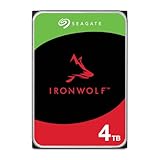
- IronWolf internal hard drives are the ideal solution for up to 8-bay, multi-user NAS environments craving powerhouse performance
- Store more and work faster with a NAS-optimized hard drive providing ultra-high capacity up to 16TB and cache of up to 256MB
- Purpose built for NAS enclosures, IronWolf delivers less wear and tear, little to no noise/vibration, no lags or down time, increased file-sharing performance, and much more
- Easily monitor the health of drives using the integrated IronWolf Health Management system and enjoy long-term reliability with 1M hours MTBF
- Three-year limited warranty protection plan included and three year Rescue Data Recovery Services included
Is WD Green good for a NAS?
Green is a legacy line, so it is a poor default for a new build. An old Green model may appear on a compatibility matrix for a particular My Cloud device—for example, WD20EZRX or WD30EZRX—but that evidence applies only to the named device and SKU. It does not prove that every Green drive, or that drive in another NAS, is supported.
Check compatibility before buying any drive
NAS support is determined by the exact drive identifier, not simply by the color on the label. Use this process:
Rank #2

- Store more, compute faster, and do it confidently with the proven reliability of BarraCuda internal hard drives
- Build a power house gaming computer or desktop setup with a variety of capacities and form factors
- The go to SATA hard drive solution for nearly every PC application from music to video to photo editing to PC gaming. Ax. Sustained transfer rate OD: 190MB/s
- Confidently rely on internal hard drive technology backed by 20 years of innovation
- Frustration Free Packaging - This is just an anti-static bag. No cables, no box.
- Record the NAS manufacturer, exact model, firmware or DSM/QTS version where applicable, and bay count.
- Open the manufacturer’s current drive compatibility list and search the complete HDD model number and capacity.
- Check whether the listing covers the intended RAID level, hot-swap use, drive-health monitoring and support policy.
- Confirm the drive’s recording technology. Do not infer CMR or SMR from Blue, Green or another color name; verify the exact model in WD’s recording-technology information and the NAS maker’s list.
- If the model is absent, ask the NAS manufacturer whether it is supported. A drive that spins up is not necessarily a supported drive.
WD’s compatibility guidance directs users to the NAS or device manufacturer and advises contacting that manufacturer when a drive is not listed. Follow that policy even when a retailer describes the drive as “NAS compatible.”
Match the drive to the workload
Home file storage and backups
For a lightly to moderately active one- to eight-bay home NAS, a supported Red Plus model is the straightforward WD option. Choose capacity and quantity based on usable RAID or storage-pool capacity, not the raw total printed on the boxes.
Rank #3

- IronWolf internal hard drives are the ideal solution for up to 8-bay, multi-user NAS environments craving powerhouse performance.date transfer rate:6.0 gigabits_per_second
- Store more and work faster with a NAS-optimized hard drive providing 8TB and cache of up to 256MB
- Purpose built for NAS enclosures, IronWolf delivers less wear and tear, little to no noise/vibration, no lags or down time, increased file-sharing performance, and much more
- Easily monitor the health of drives using the integrated IronWolf Health Management system and enjoy long-term reliability with 1M hours MTBF
- Three-year limited product warranty protection plan and three year Rescue Data Recovery Services included
Small business and frequent activity
Shared files, virtual machines, surveillance recording and repeated synchronization create more sustained work than occasional backups. Compare the NAS vendor’s approved Red Plus models with the workload limits stated for the drive. The 180TB-per-year figure is a manufacturer workload rating for the cited Red Plus range; it is not a prediction of your own annual writes or drive life.
High-intensity, 24×7 or larger arrays
For a heavily active NAS, a chassis with many bays, or demanding ZFS use, evaluate WD Red Pro and other NAS-class models listed by the enclosure vendor. Red Pro’s positioning is for higher-intensity 24×7 and multi-bay operation, but the NAS maker’s compatibility list remains decisive.
Rank #4

- Available in capacities ranging from 2 to 22TB(1) | (1) 1GB = 1 billion bytes and 1TB = 1 trillion bytes. Actual user capacity may be less depending on operating environment.
- For RAID-optimized NAS systems with unlimited number of bays
- Rated for 550TB/yr workload rate(2) | (2) Annualized Workload Rate = TB transferred x (8760 / recorded power-on hours). The maximum rated workload is specified for operating at typical temperature of 40C. Workload Rate will vary depending on your hardware and software components and configurations.
- Designed to handle the demands of high-intensity 24x7 multi-user NAS environments
- Western Digital partners with a wide range of NAS system vendors for extensive testing to ensure compatibility with most NAS enclosures
Warranty and reliability details are model-specific
Do not assign one warranty term to an entire color family. WD’s Red Plus data sheet specifies a three-year limited warranty for the described range, while Blue and legacy Green warranty terms vary by exact model, generation and purchase region. Check the SKU and your market in WD’s warranty lookup before buying.
There is no independent Blue-versus-Green NAS failure-rate study established here. NAS branding can indicate intended workload and support, but it cannot guarantee reliability, and a desktop drive does not automatically fail the moment it is installed in a NAS. Backups, cooling, vibration control and a tested recovery plan still matter.
A practical buying decision
- Building a new home or small-business NAS: begin with a supported WD Red Plus model.
- Already own a WD Blue: check the exact model and capacity on the NAS vendor’s list before reusing it; expect limited support if it is not listed.
- Already own a WD Green: treat it as legacy hardware and verify support for that precise SKU and device. Replace it rather than designing a new NAS around it unless compatibility is confirmed.
- Running a busy, always-on or multi-bay system: compare supported Red Pro models or other NAS-class drives.
- Choosing between two capacities: verify the exact model’s CMR/SMR technology, workload rating, warranty and compatibility entry—not just the capacity or color.
Bottom line
For a new WD-based NAS, choose a NAS-listed WD Red Plus drive in the required capacity. Blue is a desktop family and Green is legacy; either may work in a particular older device, but only exact-model compatibility makes that a defensible choice. Move to Red Pro when the NAS workload and bay count justify the higher tier.
Quick Recap
Product prices and availability are accurate as of the date/time indicated and are subject to change. Any price and availability information displayed on Amazon at the time of purchase will apply.

