
Ultra-low-latency streaming is an end-to-end goal: getting live audio and video from capture to playback in under one second. Achieving it depends on the whole path—not just a codec, protocol, or fast internet connection—and the shorter the delay, the less time the system has to smooth out network problems. It is most useful when viewers need to react to what is happening now.
What is ultra-low-latency streaming?
It means aiming to keep the delay between a live event being captured and appearing on a viewer’s screen below one second. The Internet Engineering Task Force (IETF) defines ultra-low-latency delivery in RFC 9317 as a glass-to-glass delay target under one second. “Glass to glass” refers to the complete journey from the capture device to the viewer’s display, not just the time a packet takes to cross the network.
That target is not a guarantee that every viewer, device, or network will see the stream within one second. It is also not the only published way of classifying latency. RFC 9317 calls live delivery under 10 seconds “low-latency,” and describes non-low-latency live delivery as 10 seconds to a few minutes. ITU-T Recommendation H.705.2 (September 2023) instead classifies high latency as above 5 seconds, low latency as 1–5 seconds, and ultra-low latency as below 1 second. These are each document’s categories, not universal service-level promises.
For the rest of this article, “ultra-low latency” means the shared sub-one-second end-to-end target. A stream that starts quickly, has a low ping, or uses a protocol associated with real-time media does not necessarily meet that target at playback.
Free tools Windows power users keep installed
One-click scans. No signup required.
#1 Best Overall

- 4K & 64MP Video Camera Camcorder: Capture life in breathtaking detail with 4K Ultra HD recording and vibrant 64MP photos, powered by an advanced high-sensitivity CMOS sensor. Equipped for exploring the beautiful world, this video camera is your perfect companion! Ideal for video recording, travel vlogs, family activities, interviews, studying, and cherishing precious moments
- 18X Digital Zoom & Infrared Night Vision: This 4K camcorder powerful 18x digital zoom brings distant action right to you. Capture clear details of people and landscapes. With the push of “OK” button, activate the IR cut filter. This night vision camcorder delivers high-contrast black & white video in total darkness, providing a clearer image than standard low-light color mode
- 3.0 Inches Touchscreen with 270° Rotation: This camcorder features a brilliant 3-inch touchscreen that puts complete control in your hands. The screen rotates a full 270 degrees, making it a game-changer for vloggers. Easily frame yourself for solo shots, capture high-angle overhead videos, or get creative low-angle perspectives
- Webcam & Remote Control: Instantly transform your camcorder into webcam with a single USB cable. No complex drivers needed. Just connect and ready to go. Elevate your live streams and professional presentations with stunning 4K clarity. This video camera comes with a handy wireless remote to start/stop recording, and take photos without ever touching the device—ideal for solo creators, vloggers, and group shots
- Multifunctional Camcorder: This 4K camcorder is loaded with pro features. Like face detection, video pause, slow motion, continuous shooting, time-lapse, self-timer, recording while charging, date stamp. Resulting in consistently smooth, sharp, and stunning footage in every scene. The two high-capacity batteries and 32GB micro SD card ensure that you won't miss a single beautiful moment in life
How does low-latency live streaming work?
Latency accumulates across a chain of operations. A typical live workflow captures and encodes media locally, sends it to a platform, may transcode and package it, distributes it through delivery infrastructure, then buffers, decodes, and renders it on the viewer’s device. Any of those stages can add delay.
- Capture: A camera, microphone, screen, or rendered scene produces the audio and video. WebRTC can carry tracks from device sources such as cameras and microphones, as well as mixes or other compositions.
- Encode: The producer turns captured media into a format that can be sent. Encoding and any waiting or buffering around it affect both delay and the resources or bitrate needed to maintain quality.
- Ingest: The source uploads media to a live platform or media server. ITU-T H.705.2 describes low-latency examples using protocols such as RTMP or WebRTC for this stage.
- Process and package: A service may transcode or package incoming media for delivery. For HTTP-based live streaming, CMAF can divide media into chunks smaller than full segments. LL-HLS and LL-DASH can make chunks available as they arrive instead of waiting for an entire segment.
- Distribute: An origin, CDN, or other delivery infrastructure carries the packaged media toward viewers. Reaching a large audience across regions can introduce operational and cost trade-offs.
- Receive and render: The player receives data, holds enough to cope with variation, decodes it, and displays the result. This buffer protects playback, but the time spent buffering is part of the end-to-end delay.
The central tension is between buffering for stability and buffering for speed. More buffer gives a player room to absorb jitter, packet reordering, loss, and changing network conditions. Less buffer can bring playback closer to the live edge, but makes interruptions or visible artifacts more likely when delivery varies. Wi-Fi retransmissions and bufferbloat can also consume a tight latency budget.
Consequently, changing only the delivery protocol cannot remove delay already added by capture, encoding, ingest, processing, or playback. Nor is a network ping test a substitute for measuring glass-to-glass performance: it does not include the complete media pipeline.
Rank #2
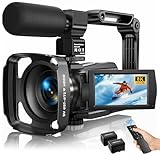
- Latest 8K Video Camera with Remote Control : This Video camera features 8K video resolution at 15FPS, with additional options for 6K at 30FPS, 5K at 30FPS, 4K at 30FPS, 1080P at 60FPS/30FPS, 720P at 60FPS/30FPS. With an impressive 88MP image resolution and 18X digital zoom, this camcorder delivers exceptional visuals. The included remote control allows for effortless self-recording and photography from any angle, making it an ideal 8K vlogging camera for bloggers and content creators.
- Experience Smooth and Stable Footage with Our 8K Camcorder : Featuring advanced 6-Axis anti-shake technology for high-precision stabilization. The 3-inch, 270-degree rotatable touch screen allows for effortless self-recording and framing, making it perfect for vlogging and self-blogging. Additionally, the digital video camera's intuitive interface and user-friendly navigation ensure easy operation, so you can focus on capturing stunning 8K video and photos.
- Infrared Night Vision Video Camera with WiFi : Stay connected and share your moments instantly with our 8K Camera's built-in Wi-Fi and companion app "iSmart DV2". Download the app on your Android/iOS device to easily transfer photos/videos, and share them directly to social media platforms like Facebook and YouTube. Additionally, this camera features infrared night vision, allowing you to capture footage in low-light environments, producing clear black and white images even in complete darkness.
- Dual-Functionality and Enhanced Audio : This 8K video camera for YouTube doubles as a high-quality webcam, simply connect via USB and switch to "Webcam" mode for seamless video calling, live streaming, vlogging, and online teaching. The included external X-Y stereo microphone reduces ambient noise and captures clear, stable audio, ensuring professional-grade sound quality for your recordings.
- Versatile camcorders video camera 8k for Every Adventure: This multifunctional camera features a range of creative modes, including continuous shooting, time-lapse, slow motion, and recording while charging. Perfect for capturing life's adventures, whether you're traveling, camping, hiking, or enjoying your favorite sports. Plus, our dedicated team is available to provide technical support, troubleshooting, and answers to any questions you may have after your purchase.
Which delivery approach should you use?
WebRTC, LL-HLS, and LL-DASH solve related but different delivery problems. The right choice depends on whether the experience is interactive, the audience and player environment, and the degree of delay the use case can tolerate.
| Approach | Best fit | How it delivers | Main caveat |
|---|---|---|---|
| WebRTC with RTP | Two-way or strongly interactive audio and video, such as collaboration, games, or control feedback. | WebRTC is a real-time communication framework; IETF RFC 8834 specifies RTP media transport in that context. | It requires a real-time media architecture and appropriate network handling. It does not promise a fixed glass-to-glass delay on arbitrary networks. |
| LL-HLS | Live playback where HTTP-based delivery and established HLS workflows matter, with less delay than conventional segmented delivery. | RFC 9317 describes LL-HLS using CMAF chunks that can be retrieved as they become available. | Low-latency operation has additional transport and client requirements and can be more sensitive to disruption. |
| LL-DASH | HTTP-based adaptive streaming when DASH packaging and the intended players support it. | RFC 9317 describes LL-DASH using CMAF chunked transfer so chunks can be sent as they arrive. | Verify support across the actual players, devices, and delivery infrastructure; test the complete path. |
| WebTransport | Some client-server applications needing bidirectional streams or datagrams, including designs for gaming or state synchronization. | The W3C WebTransport explainer describes reliable streams and unreliable datagrams over a QUIC-oriented web API, and distinguishes client-server WebTransport from peer-to-peer WebRTC. | The explainer is a living document, not evidence of universal browser support or production readiness. Check current standards, deployed clients, servers, and fallback behavior. |
Do not treat this as a ranking. WebRTC is commonly used for interactive real-time media; LL-HLS and LL-DASH can retain HTTP-based delivery patterns while reducing delay through chunked media delivery. Neither category is automatically best at every audience size or deployment. Likewise, WebTransport may suit particular client-server designs, but its presence in an explainer does not establish that it is ready for every production environment.
When evaluating an implementation, compare the same requirements across options:
Rank #3

- 4K & 96MP Video Camera Camcorder: This 4K video camera is capable of capturing precious moments with 4K Ultra HD video and 96MP still photos. Equipped with a high-sensitivity CMOS sensor, this camcorder ensures vivid colour reproduction and crisp, sharp image detail. Suitable for a wide range of scenarios—from capturing travel scenery and family gatherings to everyday snapshots—this vlogging camera meets all your filming needs.
- 18X Digital Zoom & Infrared Night Vision: This 4K camcorder features 18X digital zoom, allowing you to easily zoom in on distant scenes and capture clear details from afar. Activate the IR cut filter with one click via the OK button. This 4K video camcorder’s professional infrared night vision mode allows it to record high-contrast black-and-white footage even in pitch-black conditions.
- 3.0 Inch Touchscreen & 270° Rotatable Design: This 4K camcorder is equipped with a 3.0-inch HD touchscreen, delivering sensitive response and intuitive operation for effortless setting adjustment. Featured with a 270° flip screen, this vlogging camcorder allows real-time scene preview anytime you record. Perfect for vlogging, selfie shooting and video blogging, it supports portrait close-up, high-angle overhead recording and low-angle creative framing.
- Webcam Function & Wireless Remote Control: This video camera camcorder can be used as a computer webcam by simply connecting with USB cable, no complicated driver installation required. This digital video camera supports 4K clear image quality for live streaming, online meetings and video calls. Equipped with wireless remote control, you can start or stop recording and take photos remotely, great for solo shooting, vlog creation and group photo taking.
- Multifunctional Camcorder with Full Accessories: Packed with practical professional functions: face detection, video pause, slow motion, time-lapse shooting, self-timer, recording while charging and date stamp. This 4K video recorder camera produces smooth, sharp and cinematic footage in various scenes. It comes with a full set of supporting accessories out of the box, including 2 rechargeable batteries and a 32G memory card, ready for you to start shooting right away.
- Glass-to-glass delay under expected conditions, measured with the actual workflow.
- Whether the interaction is one-way or two-way, and how quickly participants must respond.
- Audience size, geographic reach, and the delivery infrastructure required to serve it.
- Required quality and bitrate, including whether adaptive renditions and resolution changes are important.
- Resilience to jitter, loss, reordering, and short-lived network disruptions.
- Compatibility with the browsers, devices, players, and CDNs in the intended audience.
- Operational complexity and total service cost. RFC 9317 notes that low-latency delivery at scale can require premium service and involve trade-offs in cost, media quality, bitrate or resolution flexibility, and robustness.
When should you use WebRTC instead of LL-HLS?
Prefer WebRTC when the product depends on timely, interactive exchange—for example, participants talking to each other, game or control feedback, or a live session in which a long playback delay would undermine the interaction. Its real-time communication model and RTP media transport make it a natural option to evaluate for that kind of workflow.
Consider LL-HLS when the priority is live playback through HTTP-based HLS workflows and the target is lower delay than conventional segmented delivery, rather than a guaranteed sub-second conversation. CMAF chunking can let a player receive parts of a segment before the whole segment is ready; it does not eliminate network delay or the need for a playback buffer.
Do these 3 things before closing this tab:
1Clear out junk files and repair common Windows errors2Scan for outdated or missing drivers - takes under a minute3Repair Windows errors before they cause bigger problemsMake the decision with the intended devices, geography, ingest, packaging, delivery service, and player—not protocol labels alone. The cited standards do not establish a universal latency figure or a universal scaling advantage for either approach. A prototype under representative conditions is necessary before promising a target.
Rank #4

- 4K sensor and DIGIC DV6 image processor deliver crisp, sharp 4K UHD images, while an 8-blade aperture achieves cinema-style out-of-focus highlights.
- On-Screen Display (OSD) “Time Stamp” Recording embeds date, time, timecode and other data in your original camera files.
- UVC Livestreaming - Stream HD video directly from the camera via UVC1 to a PC or Mac computer.
- Powerful 20x optical zoom and advanced image stabilization.
- Adjustable focusing speeds and advanced Hybrid AF system provide fast and precise focusing with face detection.
When is an ultra-low-latency target worth the trade-off?
Use a sub-one-second target when the value of the experience depends on a viewer seeing or responding to an event close to when it happens. ITU-T H.705.2 identifies interactive commerce, online education, live sports, and live shows as low-latency scenarios, and discusses viewport-dependent VR and cloud gaming in its ultra-low-latency context. These examples do not mean every stream in those categories needs the same target; the interaction requirement should decide.
For passive viewing—such as news where viewers do not need to respond in real time—a longer delay may be acceptable and can leave more room for buffering, compatibility, scale, and encoding choices. RFC 9317 notes that conventional HLS or DASH latency of 10 seconds or more has historically been common and is often adequate for news. The useful target is the least aggressive one that still serves the audience’s actual need.
Independent reader supportYour contribution helps us test, update, and keep practical guides available for everyone.How can you reduce live stream delay?
- Set a measurable target from the use case. Decide how quickly a viewer must see the event or respond to it. Keep the target end-to-end; do not substitute a ping or round-trip-time figure.
- Measure capture to playback. Test the complete path, including capture, local encoding, ingest, processing, packaging, distribution, player buffering, decoding, and display. Measurements should reflect the expected network conditions rather than a single ideal connection.
- Choose a delivery model that fits the interaction. Evaluate WebRTC for interactive real-time communication. Evaluate LL-HLS or LL-DASH when HTTP-based delivery and chunked live playback fit the workflow. Consider WebTransport only after checking current standards and support across the actual deployment.
- Use the real client and delivery setup in a prototype. Include the intended ingest, packager, CDN or other delivery service, player, browser and device mix, and viewer geographies. Confirm how the setup behaves during network variation, not just under a clean local test.
- Test the quality and resilience trade-off. Check whether a shorter delay remains acceptable when jitter, loss, or temporary delivery changes occur. A target that can only be maintained by unacceptable quality loss or fragile playback may not be the right target.
- Reassess the target against the benefit. If the audience does not need to interact near the live moment, allow more delay rather than paying for or operating a more demanding low-latency path without a user benefit.
The available standards describe architectures and trade-offs, not a guaranteed configuration for an unspecified service. There is no universal bitrate, keyframe interval, player setting, or protocol switch that can be prescribed here for every encoder, platform, and network. Validate settings against the actual system and its measured end-to-end behavior.
Crashes, No Sound, or Screen Glitches?
Random freezes, missing sound and display glitches usually trace back to one bad driver. Find and replace yours safely.Free scan · under a minuteWindows Errors? Fix Them Before They Spread
Repair common Windows errors and clear accumulated junk for a smoother, more stable PC - no reinstall needed.Free scan · no reinstallBest Value

- Capture Stunning Footage - Osmo Pocket 3 vlogging camera features a 1-inch CMOS sensor and records in 4K resolution at an impressive 120fps. Capture breathtaking night views and sunsets with enhanced clarity.
- Effortlessly Frame Your Shots - Get the ideal composition with Osmo Pocket 3's expansive 2-inch touch screen that rotates for both horizontal and vertical shooting.
- Ultra-Steady Footage - Say goodbye to shaky videos! Osmo Pocket 3's advanced 3-axis mechanical stabilization delivers superb stability. Enjoy smooth footage while dancing, chasing pets, or hiking.
- Create Captivating Vlogs With ActiveTrack 6.0 - Stay effortlessly in focus as you record on the go. Set Osmo Pocket 3 up on a tripod and jump, dance, or spin, but remain center-frame.
- Fast and Accurate Focusing - Osmo Pocket 3 digital camera locks onto your subject for sharp, clear footage. Whether filming action-packed scenes or still shots, it ensures every detail is captured.
Common problems when targeting very low latency
| Symptom | Likely explanation | What to check |
|---|---|---|
| The stream has low ping but appears several seconds behind. | Ping does not measure the whole capture-to-render pipeline; encoding, ingest, processing, packaging, and player buffering can add delay. | Measure glass to glass and inspect each stage rather than assuming the network round trip is the stream delay. |
| Playback stutters or drops out after reducing the buffer. | The player has less room to absorb jitter, reordering, loss, Wi-Fi correction, or changing path conditions. | Test under representative network variation and decide whether a slightly longer delay provides a better viewer experience. |
| Changing to LL-HLS or LL-DASH does not deliver the expected end-to-end result. | Chunked delivery addresses packaging and segment availability, not every other source of delay; the transport and client also need to support the low-latency workflow. | Verify the entire ingest-to-player path, CMAF chunk handling, player behavior, and delivery support. |
| A setup works in one browser or region but not another. | Device, player, browser, CDN, and network support or behavior can differ. | Test the actual audience’s browser and device mix and geographic routes before committing to a target. |
| A sub-second target is too costly or compromises quality. | Lower-latency delivery at scale can require premium services and may constrain cost, media quality, bitrate or resolution flexibility, or robustness. | Revisit whether interaction truly requires the target; compare total cost and quality under the same audience and delivery assumptions. |
Where StreamNeo fits—and where it does not
StreamNeo is a cloud service for keeping an uploaded video or playlist live on YouTube 24/7. It is not a method for making an interactive camera stream ultra-low-latency: it plays uploaded videos, not a live camera feed, and no sub-second glass-to-glass performance is claimed. If your goal is instead to keep a prerecorded YouTube channel running without leaving a computer on, StreamNeo handles looping in the cloud.
For that continuous prerecorded-stream use case, upload a recording or build a playlist, add your YouTube stream key once, and go live. Your computer and home connection do not have to stay on. Each slot includes one always-on stream, looping and playlists, 10 GB storage per slot pooled across active slots, automatic recovery if YouTube drops the stream, and support from the StreamNeo team. Uploaded video streams as made, up to 4K 60fps, with no re-encode and one flat price per slot; every plan has the same product, with only the billing duration changing. The service is for YouTube only.
There is a free first day with no card, once per account. After that, Monthly is $9.99 per month. UPI and cards are available in India; card checkout is available worldwide. The first day and monthly price apply to this use case, not to an ultra-low-latency delivery guarantee. Start the free first day on StreamNeo.
Quick Recap
Product prices and availability are accurate as of the date/time indicated and are subject to change. Any price and availability information displayed on Amazon at the time of purchase will apply.
Recommended Free Tools

