
iTechGuides is reader-supported. When you buy through links on our site, we may earn an affiliate commission. As an Amazon Associate I earn from qualifying purchases. Learn more
The best tire monitoring system depends on what you tow and how many tires you need to watch. The TST 507 Series is the best overall dedicated-monitor platform for most RVs and trailers; TireMinder i10 suits large combinations, TireMinder Smart suits phone users, TireTraker TT-600 emphasizes warranty value, and TireMinder Trailer TPMS fits small trailers rated at 70 psi or less.
Aftermarket tire-pressure monitoring systems (TPMS) are especially useful when a factory-equipped tow vehicle does not monitor the trailer, when one system must cover multiple vehicles, or when the application involves high-pressure tires, long trailers, motorhomes, or fifth wheels.
The rankings below are use-case recommendations, not laboratory test results. Current independent testing is not sufficient to claim that one system has the best real-world accuracy, battery life, or radio reliability.
The Tool Desk
Outbyte PC Repair FREEClear out junk files and repair common Windows errorsFree Scan →Outbyte Driver Updater FREEScan for outdated or missing drivers - takes under a minuteDriver Scan →Key takeaways
- TST 507 Series is the strongest all-around choice for RVs, fifth wheels, trailers, and multi-vehicle setups because its published configurations support dedicated monitoring, multiple vehicles, and broad pressure ranges.
- TireMinder i10 monitors up to 20 tires in a selected vehicle configuration, supports up to four vehicle profiles and 40 total tires across those profiles, and has a stated pressure range of 0–199 psi.
- TireMinder Smart TPMS is the best fit for drivers who deliberately prefer smartphone, Apple CarPlay, or Android Auto integration over a separate monitor.
- TireTraker TT-600 is a strong warranty/value alternative with a manufacturer-stated pressure limit of up to 232 psi, replaceable sensor batteries, and a claimed lifetime warranty.
- TireMinder Trailer TPMS is a specialized small-trailer system for single- or dual-axle trailers at 70 psi or less and approximately 25 feet or less.
Top 5 tire monitoring systems at a glance
Each system below is aimed at a different buyer. Pressure range, tire count, display type, sensor style, and trailer length matter more than a generic “best TPMS” label.
Popular on Amazon

- [Discover Five Alarm Modes and Simple Setup for Alarm Thresholds]: With the Tymate Tire Pressure Monitoring System TM2, you'll access six distinct alarm modes, covering fast leak detection, high/low-pressure alerts, high-temperature warnings, and sensor low voltage/signal loss notifications. Upon pairing, the system seamlessly configures the current pressure as the reference point, allowing for easy setup of alarm thresholds (with an Alarming Range from +25% PSI to -15% PSI of Reference Pressure)
- [Efficient Power Usage and Precise Data Reading Sensors]: The Tymate TM2 tpms sensors set of 4 boasts four advanced external sensors known for their low power consumption (operating for up to six months on a single CR1632 battery) and extended lifespan (with a maximum of two years). These sensors are waterproof (IP67), compact, lightweight, and offer high accuracy in tire pressure readings, with minimal margin for error (approximately 3psi). Their easy installation and resilience make them suitable for use in challenging environments. All sensors included in the package are pre-labeled and paired with the monitor at the factory, there is no need to pair each sensor before use
- [Versatile Charging Options]: The Tymate Tire Pressure Monitoring System TM2 features solar automatic charging capabilities, ensuring continuous power supply. Additionally, it offers flexibility by supporting charging via USB port or cigarette lighter socket (adapter not included) when sunlight is unavailable. This ensures you can stay focused on driving without worrying about TPMS battery levels
- [Adaptive Backlight and Enhanced Color LCD Display]: The Tymate Tire Pressure Monitoring System TM2 features automatic backlight adjustment, optimizing visibility in varying light conditions for effortless reading. Furthermore, its newly updated vibrant color LCD display ensures brighter and clearer readings, even during nighttime driving, safeguarding your tires at all times
- [Extensive Pressure Range Detection & Extended Signal Transmission]: Tymate tpms sensor TM2 provides precise tire pressure detection ranging from 0 to 87 PSI, catering to various vehicles such as sedans, SUVs, MPVs, pickup trucks, RVs, and travel trailers. Operating at a frequency of 433.92MHz, this tire pressure monitoring system offers robust signal transmission, guaranteeing consistent and reliable communication between sensors and the display unit
| System | Best for | Published capacity or range | Display | Warranty or price signal | Main limitation |
|---|---|---|---|---|---|
| TST 507 Series | Most RV, trailer, and multi-vehicle applications | 507 color display: up to five vehicles and 115 tires; 1–218 psi; claimed ±1.5 psi | Dedicated display | Three-year warranty; current official retail price not verified | Many display and sensor combinations require careful kit selection |
| TireMinder i10 | Large RV and tow combinations | Up to 20 tires in one setup; four vehicle profiles; 40 total tires across profiles; 0–199 psi; claimed ±1 psi | 3.15-inch color display | Three-year warranty; starting figures differed by official page | Not intended for applications above its 199-psi range |
| TireMinder Smart TPMS | Phone-first drivers | Four-, six-, and ten-sensor configurations; external and optional flow-through sensors | Smartphone, with marketed CarPlay and Android Auto compatibility | Three-year warranty; price varies by kit | Depends on a compatible, charged, correctly configured phone |
| TireTraker TT-600 | Warranty and value priorities | Two- to 22-wheel systems; up to 232 psi; simultaneous pressure and temperature monitoring | Dedicated monitor | Manufacturer advertises lifetime warranty; price depends on wheel count | Warranty length does not independently prove accuracy or signal reliability |
| TireMinder Trailer TPMS | Small utility, boat, and cargo trailers | Up to four tires; 0–70 psi; recommended trailer length of 25 feet or less | Solar-powered color display | Current price not verified in the research pass | 70-psi ceiling and limited expansion make it unsuitable for large RVs |
Specifications in this table come from manufacturer materials and should not be treated as cross-brand laboratory comparisons. See the TST specifications and operating overview, TireMinder i10 specifications, TireTraker product information, and TireMinder Trailer TPMS specifications.
1. TST 507 Series: best overall dedicated-monitor platform
The TST 507 Series is the best overall choice when one dedicated monitor must cover an RV, tow vehicle, trailer, or several vehicle combinations. The platform is unusually flexible: published configurations support cap, flow-through, and internal sensors, and TST says its displays can monitor multiple vehicles and large numbers of tires.
The 507 color display is specified for up to five vehicles and as many as 115 tires, with a 1–218 psi reading range and claimed accuracy of ±1.5 psi. Published alerts include low pressure, high pressure, fast leakage, and high temperature. A dedicated display means the system does not require a smartphone to show readings or issue its primary alerts. TST lists a three-year warranty in its comparison material. The manufacturer’s 507 comparison chart explains the differences among its display and sensor configurations.
Who should choose the TST 507?
- Fifth-wheel owners with a truck and trailer to monitor.
- Motorhome owners towing a car.
- RVers who change trailers or maintain several vehicle profiles.
- Owners of high-pressure tires that require more headroom than a 70- or 199-psi system provides.
- Drivers who want an independent monitor rather than a phone app.
What are the TST 507 trade-offs?
The TST 507 is a platform rather than one identical package. Buyers must confirm the display model, number of sensors, sensor type, repeater inclusion, and compatibility before ordering. TST also says the 770 display is compatible with TST components bearing product date code 4519 and later, so older components should not automatically be assumed compatible. Consult TST’s current compatibility and product information.
Cap sensors are simple to install but generally must be removed before checking or adding air. Flow-through sensors permit more convenient inflation but are longer and heavier. Internal sensors are protected inside the tire but require tire removal and professional installation. TST’s current official retail price was not verified in the research pass, so a current price should not be inferred from older RV coverage or from a different kit.
2. TireMinder i10: best for large RV combinations
The TireMinder i10 is the best fit for RV owners who want a compact dedicated color display and several vehicle profiles. TireMinder specifies up to 20 tires in a selected setup, up to four vehicles, and up to 40 total tires across those profiles. The 3.15-inch color display can show up to 10 tires simultaneously.
The i10 has a stated 0–199 psi range and claimed accuracy of ±1 psi. TireMinder also says the system can automatically switch between the front towing vehicle and the rear towed vehicle. A three-year warranty is listed on the product page. These are manufacturer-published figures, not independent measurements; the i10 product page is the appropriate source for the selected kit’s details.
Free tools Windows power users keep installed
One-click scans. No signup required.
When does the i10 make more sense than a basic TPMS?
The i10 makes sense when a motorhome, truck, towed car, or trailer creates more tire positions than a small consumer kit can handle. Multiple profiles also help owners who alternate between a tow vehicle and different trailers. The system is less compelling for a simple two-axle utility trailer whose tires are comfortably below 70 psi.
How much does the TireMinder i10 cost?
Official TireMinder pages showed conflicting starting figures: one product listing showed the i10 starting at $309, while a dealer-resource page showed $249. The difference may reflect kit size, sensor type, dealer pricing, or page maintenance. Treat the i10 price as kit-dependent, not as one universal amount, and verify the exact sensor count and configuration at the manufacturer’s product listings before buying.
Also popular on Amazon

- [Accurate Real-time Monitoring & Multi-Alert System]: Tymate TM7 tpms sensor can be used to monitor your tires’ pressure and temperature data within robust accuracy of ±1.5 PSI or ±3°F (The units can be displayed as ℃ or ℉ & BAR or PSI). Designed with six distinct alarm modes: high/low pressure, fast leakage, high temperature, sensor low battery, and sensor signal lost. This system is a reliable tool for maintaining tire health, and it is especially beneficial for DIY enthusiasts and pre-owned vehicle markets, where constant vigilance on tire conditions is paramount for safety and vehicle longevity
- [Easy Plug-in Power & Dual USB Charging]: Tymate TM7 tpms sensors set of 4 effortlessly powers up by plugging directly into your vehicle's cigarette lighter socket, eliminating the need for complex wiring or professional installation. Ideal for older vehicles lacking factory-installed TPMS, providing a quick and efficient safety upgrade for drivers. Also, This innovative tire pressure monitor not only ensures your safety on the road but also features two USB outlets, allowing you to charge mobile devices like smartphones and tablets. A perfect solution for commercial vehicle operators and budget-conscious drivers seeking added functionality without sacrificing vehicle space or convenience
- [Color LCD with Adjustable Backlight]: This device provides clear, easy-to-read tire pressure and temperature data in any light condition, thanks to the vibrant color LCD screen with adjustable backlight. This feature caters to all drivers, particularly those who commute daily or embark on long trips, ensuring visibility and readability at all times
- [Wide Pressure Range Detection & Long Signal Transmission]: Tymate's TM7 TPMS accurately detects tire pressures from 0 to 144 PSI, offering versatility for a variety of vehicles such as sedan car, suv, mpv, pickup truck, rv, and travel trailer (The system automatically calibrates to the center tire pressure, using sensor installation pairing for reference values). This tire pressure monitoring system boasts a robust transmission range, and it ensures consistent, reliable connection between sensors and monitor. Note: We highly suggest to utilize this system with Tymate repeater for towing longer trailer(total length≥36ft), after pairing with repeater the monitor will display "RV" mode
- [Easy to Use & Professional After-sale Service]: This Tymate TM7 TPMS is easy to setup in 5 minutes. The package box comes with comprehensive user’s manual and there are guide video available from the product page for you to follow steps by steps in the sensor pairing process. The sensors' battery replacing guide video is also available from listing, and the replacement sensor battery is CR1632 coin battery (4 coin batteries are included in the original package). If you still have any questions about the product, please contact us for further assists
The i10’s 199-psi ceiling is sufficient for many RV and towing applications but may not suit specialized commercial or very-high-pressure tires. External transmitters also need battery maintenance and remain exposed to weather, theft, and physical damage.
3. TireMinder Smart TPMS: best smartphone and vehicle-integration option
TireMinder Smart TPMS is the best choice for drivers who prefer to see tire data on a phone, Apple CarPlay, or Android Auto. The system uses a Bluetooth adapter to pass sensor information to a compatible smartphone, and TireMinder says the Smart system supports iPhone, iPad, and Android devices. The product is marketed with Apple CarPlay and Android Auto compatibility.
Smart configurations include multiple sensor-count options, external sensors, a signal booster, and optional flow-through sensor kits. TireMinder lists a three-year warranty. The TireMinder Smart TPMS page should be checked for current app, phone, vehicle, and kit compatibility before purchase.
Is a smartphone TPMS better than a dedicated monitor?
A smartphone TPMS is better when integration and fewer dashboard devices matter most. A dedicated monitor is better when independent operation, an always-available screen, and separation from navigation, calls, and app notifications matter most.
TireMinder Smart depends on more components than a standalone display: a compatible phone, Bluetooth, the app, permissions, a charged device, and an appropriate mount. CarPlay or Android Auto compatibility should be verified for the specific phone and vehicle. The system should not be described as dependent on cellular service unless the manufacturer explicitly says so; Bluetooth communication and internet access are separate issues.
The research confirmed four-, six-, and ten-sensor configurations, including flow-through versions, but did not establish one reliable current retail price for every package. Avoid comparing a price for one sensor count with a complete large-RV kit.
What’s actually slowing this PC down?
Pick the symptom - the matching free tool is one click away.
4. TireTraker TT-600: best warranty/value alternative
The TireTraker TT-600 is the best alternative for buyers who prioritize a broad pressure range, replaceable sensor batteries, and warranty coverage. TireTraker says the TT-600 monitors pressure and temperature simultaneously, supports systems from two to 22 wheels, reaches pressures up to 232 psi, uses rechargeable monitor hardware, and allows users to replace sensor batteries.
TireTraker advertises a lifetime warranty for the TT-600, visual and audible alarms, low- and high-pressure alerts, high-temperature and rapid-loss alerts, interchangeable sensors, and up to 30 days of monitor battery life on a charge. The TireTraker official site presents these as company specifications and claims. A long warranty is useful, but warranty duration alone does not establish superior accuracy, durability, or radio performance.
What did the TT-600 cost in the supplied price snapshot?
The supplied commercial snapshot, dated August 16, 2026, recorded the following prices on TireTraker’s product pages. Prices and stock may change, so these figures are observations rather than guaranteed current prices.
Also popular on Amazon

- [Real-Time Monitoring & Multi-Alert System for Enhanced Tire Safety]: The Tymate TM8 TPMS provides accurate real-time monitoring of tire pressure and temperature, with precision up to ±1.5 PSI or ±3°F. It allows users to choose between temperature units (℃ or ℉) and pressure units (BAR or PSI). Equipped with six distinct alarm modes—high/low pressure, rapid air loss, high temperature, low sensor battery, and lost sensor signal—this system ensures reliable tire health monitoring. Ideal for road trip enthusiasts and the pre-owned vehicle market, it offers peace of mind by maintaining constant awareness of tire conditions, helping to enhance safety and prolong vehicle lifespan
- [Flexible Charging Solutions]: The Tymate TM8 TPMS comes with solar-powered automatic charging, providing a consistent power source. It also supports charging via USB port or cigarette lighter (adapter not included), offering flexibility when sunlight isn’t available. This ensures you can focus on the road without concern for TPMS battery life
- [Color LCD Display & Convenient Windshield Mounting]: The Tymate TM8 features a vibrant color LCD screen, ensuring clear and easy-to-read tire pressure and temperature data in any lighting condition. The monitor can be conveniently mounted on the windshield, offering a safer, hands-free viewing experience without obstructing your line of sight or taking up dashboard space. Ideal for daily commuters and long-distance travelers, this setup guarantees optimal visibility and readability at all times
- [Wide Pressure Range & Extended Signal Transmission]: The Tymate TM8 accurately monitors tire pressures ranging from 0 to 87 PSI, making it suitable for a wide range of vehicles, including sedans, SUVs, MPVs, pickup trucks, RVs. The system automatically calibrates to the center tire pressure using sensor pairing for precise reference values. Operating at a frequency of 433.92MHz, it ensures a strong and stable signal transmission between the sensors and the display unit. Warm Note: This TM8 system is not compatible with Tymate Repeater, and we suggest to use this model for total vehicle length less than 20ft
- [User-Friendly Setup & Professional After-Sale Support]: The Tymate TM8 TPMS is quick and easy to set up in just 5 minutes. The package includes a detailed user manual, and step-by-step video guides are available on the product page to assist with the sensor pairing process. If you have any further questions or need assistance, our professional customer support team is always available to help. Warm Note: This TM8 system can only be paired uniquely with Tymate TS3 TPMS sensor which is also listed on Amazon for spare sensor and replacement needs
| TT-600 configuration | Price observed |
|---|---|
| Four-wheel system | $199 |
| Six-wheel system | $269 |
| Eight-wheel system | $339 |
| Ten-wheel system | $409 |
| Twelve-wheel system | $479 |
| Fourteen-wheel system | $549 |
| Replacement sensor | $38 |
| Signal booster | $65 |
The prices came from the TireTraker product catalog and its expanded catalog. The same research noted that some TT-500 products were marked out of stock, so buyers should check availability rather than assume every accessory is immediately supplied.
Recommended Free Tools
5. TireMinder Trailer TPMS: best for a small trailer
TireMinder Trailer TPMS is the best specialized option for a short single- or dual-axle trailer whose tires require 70 psi or less. TireMinder specifies up to four tires, a 0–70 psi operating range, and a recommended trailer length of 25 feet or less.
The system includes a solar-powered color display, a lithium iron phosphate backup battery, simultaneous pressure and temperature display, lightweight 0.3-ounce transmitters, replaceable transmitter batteries, and a hard-wired signal booster. See the official Trailer TPMS specifications for the current configuration.
The 70-psi ceiling is a hard buying constraint, not a suggestion. Check the tire sidewall, tire-and-wheel documentation, and vehicle or trailer requirements before selecting this system. The TireMinder Trailer TPMS is a poor fit for fifth wheels, high-pressure trailers, long RV combinations, or buyers who also want to monitor the tow vehicle.
Which tire monitoring system should you buy?
The correct tire monitoring system follows the vehicle and tire requirements, not the largest number printed on the box.
| Your situation | Most suitable starting point | Why |
|---|---|---|
| Small utility, boat, or cargo trailer at 70 psi or less | TireMinder Trailer TPMS | Designed for up to four tires with a dedicated solar display |
| Large RV, fifth wheel, or several trailers | TST 507 Series | Broad published capacity, multiple sensor types, dedicated monitor, and high pressure range |
| Motorhome towing a car or several vehicle combinations | TireMinder i10 | Multiple profiles and a color display for large combinations |
| Phone-first driver using CarPlay or Android Auto | TireMinder Smart TPMS | Designed around Bluetooth smartphone monitoring and vehicle integration |
| Warranty and high pressure range are priorities | TireTraker TT-600 | Manufacturer-stated 232-psi limit, replaceable batteries, and advertised lifetime warranty |
| Truck already has factory TPMS but the trailer does not | A compatible aftermarket trailer system | Keep the factory system for the truck and add coverage for the unmonitored trailer |
What is the difference between cap, flow-through, and internal sensors?
Cap sensors screw onto the valve stems and are the easiest to install and transfer. Cap sensors usually must be removed before checking or adding air, and cap sensors are exposed to theft, weather, impact, and accidental damage. Cap sensors also add weight to the valve stem, so valve-stem suitability matters.
Flow-through sensors can generally remain fitted while air is added, making flow-through sensors convenient for RV and trailer owners who adjust pressure frequently. Flow-through sensors are longer, heavier, and usually more expensive than cap sensors. Flow-through sensors may be awkward with wheel covers or short valve stems and can place extra stress on rubber valve stems.
Internal sensors sit inside the tire and are protected from many external hazards. Internal sensors require tire removal for installation or replacement, cost more to install, and are inconvenient for owners who transfer one TPMS between vehicles.
External sensors should not automatically be considered less accurate. Accuracy depends on the sensor design, calibration, valve-stem fit, mounting quality, and measurement method. Manufacturer accuracy specifications from different brands should not be treated as results from one independent test.
Also popular on Amazon
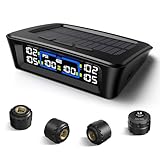
- [Upgraded Six-Wheel Simultaneous Display & 12-Wheel Split-Screen Cycling]: The 2026 Tymate TM12 TPMS introduces a fully upgraded display system supporting up to 12 tires across four zones: vehicle front, front spare, trailer rear, and trailer spare. The front vehicle area can simultaneously show up to six tire readings, allowing you to check key tire pressure and temperature data at a glance—enhancing long-distance driving safety without distraction
- [Real-Time Monitoring with Six Advanced Alarm Modes]: Built with high-precision, IP67 waterproof external sensors and a stable 433Hz color display receiver, this TPMS delivers true real-time pressure and temperature monitoring. It features six alarm modes: high pressure, low pressure, high temperature, rapid air leakage, sensor low battery, and sensor signal loss—providing comprehensive protection for your travels
- [Dual Power Supply of USB-C Charging & Solar Recharging]: The display supports two power options: USB-C connection to any 12V DC vehicle power source, or solar charging via the integrated solar panel. Flexible recharging ensures excellent endurance for daily driving or RV trips. (Note: Please fully charge the unit with USB-C before first use. Solar charging output varies with light conditions—use USB charging when battery or sunlight is insufficient. The monitor device can only be manually turned off while it is not charging by cable.)
- [Quick DIY Installation & Intelligent Auto-Calibration]: Installation takes just minutes—no need for tire shops or professional assistance. All sensors are pre-programmed to their tire positions, allowing true plug-and-play use. Just match each sensor to the labeled wheel position. Automatic pressure calibration eliminates manual settings: pressures +25% above the reference value trigger high-pressure alerts; values −15% below trigger low-pressure alerts
- [Long-Distance Signal Transmission & Wide Monitoring Range]: The TM12 offers strong signal penetration with a stable 50 ft transmission range, extendable to 100+ ft using the Tymate Repeater. Supports a wide 0–144 PSI pressure range suitable for cars, SUVs, MPVs, pickups, RVs, and most towable trailers. Ideal for upgrading older TPMS systems or adding tire monitoring to RVs and trailers for safer, more fuel-efficient travel. (Recommendation: Add a repeater when towing large RVs or when signal blockage is expected.)
How should pressure range and accuracy affect your choice?
Choose a TPMS whose usable pressure range covers the tire’s required cold inflation pressure and the vehicle application. Maximum pressure alone does not make one system better: a 232-psi system offers no practical advantage over a 199-psi system for tires that require 80 psi, while a 70-psi system is unsuitable for tires that require more than 70 psi.
| System | Published pressure range or limit | Published accuracy | How to interpret it |
|---|---|---|---|
| TST 507 | 1–218 psi | Claimed ±1.5 psi | Broad range for many RV and high-pressure applications |
| TireMinder i10 | 0–199 psi | Claimed ±1 psi | Suitable for many RV combinations, but not every specialized high-pressure application |
| TireTraker TT-600 | Up to 232 psi | Not independently established in the dossier | Broad manufacturer-stated ceiling |
| TireMinder Trailer TPMS | 0–70 psi | Not independently established in the dossier | For small trailers that remain below the product limit |
According to the TST product overview, TST publishes the 507’s 1–218 psi range and ±1.5 psi claimed accuracy. According to the TireMinder i10 page, TireMinder publishes a 0–199 psi range and ±1 psi claimed accuracy. These figures use different manufacturer specifications and should not be presented as a controlled head-to-head accuracy result.
Do you need an aftermarket TPMS if your truck already has factory TPMS?
Usually, yes, if the trailer is outside the factory system’s coverage. A factory TPMS commonly monitors the vehicle on which it was installed, while an aftermarket trailer system can monitor the trailer’s tires and, depending on the product, the tow vehicle as well.
NHTSA’s TPMS final rule established requirements for factory-equipped light vehicles. The rule does not make an aftermarket trailer-monitoring system unnecessary. Check the specific vehicle manual because factory TPMS behavior, trailer integration, spare-tire coverage, and supported tire positions vary by vehicle.
Do these 3 things before closing this tab:
1Repair Windows errors before they cause bigger problems2Fix the driver behind crashes, sound loss and screen glitches3Clear out junk files and repair common Windows errors- Passenger car: Factory TPMS may be enough for the car, but an aftermarket system can add trailer, spare-tire, temperature, or continuous monitoring.
- Pickup towing a trailer: The most important question is whether the aftermarket system covers the truck, trailer, spare, and required pressure range.
- Motorhome towing a vehicle: Count the motorhome steer, drive, and tag tires, plus the towed vehicle, dolly, or trailer.
- Fifth wheel or large travel trailer: Plan for high pressure, long sensor-to-display distance, a booster or repeater, and at least six tires once the truck is included.
How important are temperature monitoring and signal boosters?
Temperature monitoring is valuable when loads, braking, weather, bearings, or tire pressure can create abnormal heat. A normal pressure reading does not rule out a hot brake, failing wheel bearing, or another mechanical problem. A temperature alarm should prompt a safe slowdown and inspection.
Temperature naturally rises while tires are operating. The useful warning is an abnormal value, a rapid increase, or a meaningful difference between comparable tires—not simply a reading higher than the cold ambient temperature. Heavy loads, long downhill braking, hot weather, underinflation, unequal dual-tire loading, and trailer mechanical problems all make temperature data more useful.
A repeater or booster becomes more important as the distance and obstruction between sensors and display increase. Long fifth wheels, motorhomes, and trailers can challenge radio communication, especially when the signal crosses a vehicle body or trailer frame. TST and TireMinder emphasize repeaters or boosters in their RV-oriented systems, and TireTraker lists a separate booster. See the TST operating overview, TireMinder Smart information, and TireTraker catalog.
A booster cannot repair a dead sensor battery, incorrect pairing, a damaged valve stem, a sensor fitted to the wrong wheel position, or an incompatible display and sensor combination. Install and power the booster according to the product’s instructions rather than assuming that any location will work equally well.
Quick wins for a faster PC:
Clear out junk files and repair common Windows errorsFree Scan →Fix the driver behind crashes, sound loss and screen glitchesFind Drivers →How do you install and configure an aftermarket TPMS?
- Count every tire that matters. Include truck, motorhome, trailer, towed vehicle, dolly, and spare tires if the system supports them.
- Confirm cold-pressure requirements. Use the tire, vehicle, and trailer documentation; do not copy alert settings from another RV.
- Choose the sensor type. Use cap sensors for simple transfer, flow-through sensors for frequent inflation, or internal sensors when protection and permanent installation matter most.
- Check valve-stem compatibility. External sensors add weight, particularly important with rubber valve stems and high-pressure applications.
- Install the repeater or booster. Follow the manufacturer’s location and power instructions before troubleshooting signal loss.
- Pair every sensor. Record each sensor ID and verify that the displayed wheel position matches the physical tire.
- Set alert thresholds deliberately. Use the actual tire and vehicle requirements, leaving enough margin to avoid unnecessary alarms from normal operating changes.
- Test for leaks. After fitting an external sensor, inspect the valve, O-ring, and sensor connection with an approved leak-detection solution. Bubbles indicate a problem that must be corrected.
- Compare readings with a calibrated gauge. A TPMS supplements, rather than replaces, a manual pressure check.
- Test the alarm before departure. Confirm that the display, audible alert, phone permissions, and booster operate as expected.
- Recheck after a short drive. Confirm that every sensor remains visible and that no sensor connection or valve leak developed.
A TST factory-installed TPMS manual provides an example of model-specific sensor programming and display-handling instructions. The NHTSA-hosted TST manual discusses programming sensors to the display and warns, for that applicable model, against leaving the display charging when not in use or leaving it in direct sunlight. Treat those as model-specific instructions, not universal rules for every TPMS.
Also popular on Amazon

- 【Solar and USB Charging】Masoll Tire Pressure Monitoring System support Two power charging methods,Solar Power Charging and USB Charging.By using higher quality and more durable solar lithium battery panels,the monitor has excellent automatic charging and storage capabilities,which can extend the use time,ensure that drivers no need to worry about continuity of product working.Supports USB charging and thoughtful equipped with USB charging cable,double insurance to ensure normal use in all weathers.When the power icon of monitor is flashing and the sun isn't shining, please use the provided USB cable to charge the monitor.
- 【Six Alarm Mode and Auto Setup Alarm values】Masoll TPMS tire pressure monitor system can monitor the real-time pressure and temperature of 4 tires at the same time. Six alarm modes to guard the safety, including high/low pressure alarm, high temperature alarm, fast leakage alarm,sensor low voltage alarm and sensor lost signal alert.The monitor will automatically configures the current pressure as reference point when tire sensors installed,No need manual set the high and low pressure alert value ,Smart and Convenient(Alarming Range is from +25% PSI to -15% PSI of Reference Pressure).Note:Pls set the tires to standard pressure before sensors installed.
- 【Features for Monitor and Sensors】 Masoll TPMS Tire Pressure Monitoring Systems are with advanced features. Monitor: pressure PSI/Bar and temperature C/F are selectable/Auto sleep and wake-up depending on the vibration. Sensors: 2 years battery life with replaceable CR1632 battery/±1.5psi high pressure accuracy/anti-theft and waterproof design.
- 【Easy installation】The Masoll TPMS sensors of 4 come with one tire pressure monitor, 4 tire pressure sensors and accessories.The TPMS sensors were programmed with monitor before leaving the factory, user just need to install the sensors following by the position markings on them. Please make sure the monitor is turned ON before sensors installation. All pressure and temperature data will appear on the screen after sensors installed, if not, drive the car for 5~10 minutes to activate the sensors then monitor will show all data.
- 【Applicable types of vehicle】Masoll Solar Tire Pressure Monitoring System fits for most 4 wheels vehicle Sedan, SUV, MPV, VAN, Pickup Truck, RV etc. Great rv accessories for your RV road trip. The maximum tire pressure is 99psi. Pls Note: For the trailer which is longer than 38ft, a Masoll signal booster will be required.
What maintenance does a tire monitoring system require?
External TPMS sensors are not install-and-forget accessories. Before long trips and after storage, check sensor batteries, O-rings, valve cores, physical damage, theft-resistant hardware, and the displayed wheel positions. Replaceable batteries can reduce long-term ownership cost, but battery life varies with model, transmission frequency, temperature, storage, and battery quality.
Check spare tires manually unless the selected system and sensor count explicitly support spare-tire monitoring. Protect external sensors during winter or long-term storage if the manufacturer recommends removal. Solar charging can be convenient, but solar power is not unlimited during prolonged shade, storage, or poor weather.
How do you troubleshoot a TPMS alarm or missing reading?
| Symptom | Likely causes | What to check first |
|---|---|---|
| Low-pressure alert | Actual leak, incorrect cold setting, temperature-related pressure change, leaking sensor connection | Stop safely, inspect the tire, verify with a gauge, and check the valve and sensor for leaks |
| Pressure reading disappears | Weak battery, signal obstruction, unpowered booster, incorrect pairing | Check sensor battery, booster power and placement, then re-pair the sensor |
| Reading belongs to the wrong wheel | Sensor positions were programmed incorrectly | Compare each displayed ID and pressure with its physical wheel position |
| Temperature rises sharply | Underinflation, heavy loading, braking heat, hot bearing, or another mechanical fault | Slow down safely and inspect; normal pressure does not eliminate a heat-related fault |
| Phone app does not alert | Bluetooth disabled, app closed, permissions restricted, phone connected elsewhere, low battery | Confirm Bluetooth, app permissions, active monitoring, phone charge, and mount position |
| Repeated false alarms | Threshold too close to normal, sensor battery weakening, ambient or brake heat, intermittent signal | Compare with a gauge, review thresholds, inspect batteries and booster, and investigate abnormal temperature |
Never continue driving simply because pressure appears normal after a temperature alarm. A hot brake, bearing, or tire can be a serious mechanical problem. Likewise, do not assume every missing reading means a flat tire: a low sensor battery, incorrect pairing, or signal interruption can produce stale data. Verify the tire physically and follow the manufacturer’s troubleshooting procedure.
PC Slower Than It Used to Be?
A free scan shows the junk files, broken settings and background clutter dragging Windows down - then fixes them in one click.Free scan · Windows 10 & 11Outdated Drivers Are Slowing You Down
One free scan finds every outdated or missing driver and matches the right update for your exact hardware.Free scan · exact hardware matchWhat should you check before buying?
- Pressure range: Does the system cover the required cold inflation pressure?
- Tire count: Are there enough transmitters for the truck, trailer, motorhome, towed car, and spare?
- Vehicle profiles: Can the system store the combinations you actually use?
- Signal path: Is a booster included, optional, or unavailable?
- Sensor fit: Will the sensors work with the valve stems, wheel covers, and tire pressures?
- Display choice: Do you want a dedicated monitor or a phone-based system?
- Inflation convenience: Will removing cap sensors every time be frustrating, or are flow-through sensors worth the extra size and cost?
- Ongoing costs: Compare replacement sensors, batteries, boosters, displays, and internal-sensor installation.
- Warranty terms: Check what the warranty covers, how claims are handled, and whether replacement parts remain available.
- Price date and kit: Compare complete configurations, not a four-sensor starting price with a ten-sensor purchase.
Bottom line
The TST 507 Series is the best overall recommendation for most RV, fifth-wheel, trailer, and multi-vehicle buyers who want a dedicated monitor and broad expansion options. Choose the TireMinder i10 when multiple vehicle profiles and a compact color screen are the priority. Choose TireMinder Smart when phone, CarPlay, or Android Auto integration is intentional. Choose TireTraker TT-600 when the manufacturer-advertised lifetime warranty, replaceable batteries, and broad pressure range matter most. Choose TireMinder Trailer TPMS only for a short, small trailer whose tires remain at 70 psi or less.
Whichever system you choose, set it up around the actual tire count and cold-pressure requirements, verify every wheel position, check for leaks, and test the alarms. TPMS can warn about pressure, temperature, and communication problems; TPMS does not replace a calibrated gauge, tire inspection, correct loading, or stopping safely when an alarm occurs.
Frequently Asked Questions
Can a factory TPMS monitor my trailer tires?
A factory TPMS often monitors the vehicle on which it was installed, but trailer and spare-tire coverage varies by vehicle. If the factory system does not explicitly support the trailer, use a compatible aftermarket trailer TPMS or a system configured for both tow vehicle and trailer.
Are flow-through TPMS sensors worth the extra cost?
Flow-through sensors can be worth the extra cost for RV and trailer owners who frequently add air because the sensors can generally remain installed during inflation. Flow-through sensors are heavier, longer, and usually more expensive than cap sensors, so confirm valve-stem and wheel-cover compatibility first.
Do these 3 things before closing this tab:
1Repair Windows errors before they cause bigger problems2Scan for outdated or missing drivers - takes under a minute3Clear out junk files and repair common Windows errorsDo TPMS sensors measure tire temperature accurately enough to diagnose a problem?
TPMS temperature readings can identify an abnormal rise or difference between comparable tires, but the readings are not a substitute for mechanical inspection. A temperature alarm can indicate underinflation, braking heat, a hot wheel bearing, or another fault even when pressure appears normal.
How many TPMS sensors should I buy?
Buy enough sensors for every tire position you want to monitor, including the tow vehicle, trailer, motorhome, towed car, dolly, and supported spare tires. Confirm that the display supports the total number of sensors and vehicle profiles before ordering.

