
The Tool Desk
Outbyte Driver Updater FREEFix the driver behind crashes, sound loss and screen glitchesFind Drivers →Outbyte PC Repair FREERepair Windows errors before they cause bigger problemsFix Now →A tight bend, kink, or cable pulled taut against its plug can put unnecessary stress on an Ethernet run. Support the cable near the device, keep the route smooth, and follow the cable maker’s bend and pulling limits. These mistakes can damage a cable or impair its connection, but the available guidance does not show that any one routing error makes a connector fail every time.
Why the way you route a cable matters
The connector is only one possible point of trouble. A cable bent sharply, twisted, crushed, or pulled under excessive tension can be stressed or deformed; the plug can also be levered sideways or made to carry the cable’s weight. Installation guidance recommends protecting connectors along the route and using strain relief where a cable is subject to tensile force. ODVA’s EtherNet/IP Media Planning and Installation Manual and Siemens installation guidance both emphasize planning routes and observing cable-specific requirements.
That is a reason to route carefully, not proof that every network dropout comes from cable routing. Visible cable damage and a plug that will not stay seated are useful signs to check; symptoms alone do not establish the cause.
Routing mistakes to avoid
Forcing a sharp turn or tight loop
Do not force an Ethernet cable around a sharp corner, fold it into a kink, or coil it into a tight loop. Use a gradual curve with room for the cable to turn without being pressed against an edge. Required bend radius varies by cable type and installation condition, so use the manufacturer’s specification for the cable in hand.
#1 Best Overall

- High-Quality Floor Cable Protectors, made from flexible pvc, supplied coiled - uncoils to lay flat (no need to add to boiling water to uncoil). Can be easily cut to size if shorter wire cover lengths are required, cut using sharp utility knife or heavy duty scissors.
- Use D-Line Floor Cord Covers to protect trailing cords and address a cable-trip hazard. Popular for use in offices, warehouses, events, exhibitions, classrooms, gymnasiums, retail, hospitality, gaming set-ups or anywhere trailing wires need to be covered.
- D-Line Floor Cable Cover profile can be used to protect up to 2x 0.31" diameter cables
- All D-Line Floor Cable Protectors have a ribbed non-slip base & pre-split rear for ease of use... no need to apply adhesive tapes to secure to floor
- D-Line Black Floor Cable Cover Dimensions: 2.4" (W) x 0.44" (H) x 6ft Length - Inner Channel = 0.63" (W) x 0.31" (H)
Pulling or hanging the cable from the plug
Do not pull a run taut so the connector is under constant tension, or leave a heavy or moving cable suspended from the plug. Secure and support the run close enough to the device that its weight and movement do not work against the connection. Leave room to insert or remove the plug without levering it sideways. Siemens recommends strain relief where cables are subject to tensile force; ODVA advises planning the route to protect connectors.
Twisting, crushing, or cinching the jacket
Avoid twisting the cable while laying it, routing it through pinch points, or tightening a tie until the outer sheath changes shape. The retrieved TIA/EIA-568-B.1 text says cable stress and sheath deformation should be minimized. Use a looser tie or a clip or raceway sized for the cable, and keep it clear of sharp edges.
Rank #2
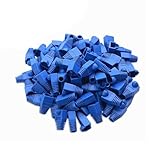
- Durable RJ45 Strain Relief Boots Design : RJ45 connectors from dust, , and bending stress while extending patch cable life. Soft PVC material offers flexible fit for Cat5/5e/6 cables with outer diameters up to 6.5mm, keeping connections tidy and reliable rj45 strain relief boots
- Color-Coded Organization for Easy Maintenance :Multiple color options help you quickly identify cables in server rooms or home offices, reducing mix-ups during routine maintenance. Color variety supports consistent labeling and efficient troubleshooting blue rj45 boots
- Easy Fit, Wide Compatibility :Plug covers compatible with Cat5, Cat5e, Cat6, and Cat6a pass-through connectors, providing protective coverage for crimped RJ45 ends without hindering plug insertion or removal cat6 pass through connectors
- Value-Pack Convenience for Large Setups :Bulk packs deliver ample boots for constructing numerous custom-length cables, enabling tidy cable management across multiple workstations and network racks without frequent reorders cat6 ethernet cable
- Secure Fit and Reliable Shielding Support :Rugged boot construction adds reinforcement at the connector interface, reducing strain on the RJ45 plug and improving durability in daily network operations across various environments cat6 shielded rj45 connectors
How much bend is too much?
There is no single bend-radius number that applies to every Ethernet cable and situation. An installation figure for horizontal cable should not be treated as a universal rule for a short patch cord. The legacy TIA/EIA-568-B.1 text hosted by the University of Crete gives, in the installed no-load condition, minimum bend radii of four times the cable diameter for four-pair UTP horizontal cable and eight times the diameter for four-pair screened twisted-pair cable. It says the minimum bend radius for four-pair UTP patch cable was still under study in that edition. Read the TIA/EIA-568-B.1 text with those limits in mind: it is a legacy edition, not a blanket patch-cord specification. Siemens also distinguishes bend limits during pulling from those after installation. Follow the cable manufacturer’s current instructions for bend radius and pulling tension.
A practical way to route Ethernet near a device
- Choose a path: Keep the cable away from sharp edges, pinch points, and places where doors, furniture, or equipment can crush it.
- Make gradual turns: Leave space for a smooth curve rather than bending the cable sharply at a wall, desk, or device.
- Support the run: Use suitable clips or a raceway to guide the cable and keep its weight and movement from loading the plug. Do not tighten a tie enough to deform the jacket.
- Leave connection slack: Avoid a taut run at the device and leave enough room to handle the connector without pulling or levering it sideways.
- Check the cable instructions: Confirm the specified bend radius and pulling limits for the exact cable, especially when installing it through a longer route.
What to check if the connection still drops
Look along the run for a kink, a crushed section, or visible jacket damage, and check whether the plug stays seated in the device. If the cable is visibly damaged or its connector no longer seats reliably, replacing that cable is reasonable. If there is no visible damage, routing alone does not prove the cause of an intermittent connection; avoid treating every network problem as a connector failure.
Recommended Free Tools
Quick Recap
Best Value

- Easy To Install - Split design, easy to wrap around cords without any hassle and the cord protector can be easily cut to any desired length.
- Keep Cords & Pets Protected - Ultra-durable and bite-resistant PET material, plus 50% edge overlap, effectively prevents your pets from chewing cords.
- Safe for Kids & Pets - Our cord covers are made from RoHS-compliant, scent-free material, ensuring safety for both your pets and children.
- Complement Your Home Decor - The sleek woven design and classic color blend in nicely with your decor; Also, it is flexible to bend and fit into tight areas.
- Versatile & Durable – Offers excellent resistance to abrasion, chemicals, and heat (withstanding up to 302°F), making it ideal for home, industrial, and automotive use.
Rank #4

- Size: Diameter: 1/2"| Length: 10 Feet | Color: Black. Our wire loom is split and easy to load wires. Once loaded, our cable sleeve will close on itself and perfect wire wrap
- Operating temp (degree F.):-103 to 257|Melt temp: 446. Our cable management sleeve is used for Hifi speaker hdmi automotive wires
- Our cord protector keeps cat from chewing cables. Our cable protector is insulated
- Our wire sleeve: UL Recognized
- Our cable organizer keeps the cords organized with no more messy cables in your home and office
Rank #3

- High-Quality Floor Cable Protectors, made from flexible pvc, supplied coiled - uncoils to lay flat (no need to add to boiling water to uncoil). Can be easily cut to size if shorter wire cover lengths are required, cut using sharp utility knife or heavy duty scissors.
- Use D-Line Floor Cord Covers to protect trailing cords and address a cable-trip hazard. Popular for use in offices, warehouses, events, exhibitions, classrooms, gymnasiums, retail, hospitality, gaming set-ups or anywhere trailing wires need to be covered.
- D-Line Floor Cable Cover profile can be used to protect up to 2x 0.31" diameter cables.
- All D-Line Floor Cable Protectors have a ribbed non-slip base & pre-split rear for ease of use... no need to apply adhesive tapes to secure to floor.
- D-Line Gray Floor Cable Cover Dimensions: 2.4" (W) x 0.44" (H) x 6ft Length - Inner Channel = 0.63" (W) x 0.31" (H)
Product prices and availability are accurate as of the date/time indicated and are subject to change. Any price and availability information displayed on Amazon at the time of purchase will apply.

