
Free tools Windows power users keep installed
One-click scans. No signup required.
iTechGuides is reader-supported. When you buy through links on our site, we may earn an affiliate commission. As an Amazon Associate I earn from qualifying purchases. Learn more
For most practical flying, a quadcopter is the better choice: it normally gives a steadier hover in gusts, simpler mechanics, widely available electronic control systems, and easier maintenance. A single-rotor, helicopter-style aircraft can be more efficient when its large rotor, payload, and mission are matched correctly, but it adds a tail-rotor system and more complicated, asymmetric dynamics. There is no universal efficiency winner; rotor diameter, disk loading, RPM, payload, battery, and flight profile matter more than rotor count alone.
Quick verdict
| Question | Usual advantage | Why | Important qualification |
|---|---|---|---|
| Which is steadier in a gust? | Quadcopter | An equal-weight comparison found less motion from a side-wind gust, and independent motor control lets the flight controller correct attitude quickly. | Frame geometry, controller tuning, wind direction, and payload distribution still matter. |
| Which is easier to control? | Quadcopter for most pilots | Four motors are varied electronically to produce roll, pitch, yaw, and vertical thrust without a complex rotor head. | It is electronically unstable without feedback, so a failed or badly tuned controller can make it difficult to fly. |
| Which is more efficient? | It depends | A large single rotor can have lower disk loading, while a quadcopter avoids a tail rotor and can use efficient, distributed motors. | Published percentages from coaxial systems are configuration-specific, not universal quadcopter results. |
| What happens if a propulsion unit fails? | Potentially more options on a multirotor | Other rotors still produce thrust, creating the possibility of controlled recovery on a vehicle designed and programmed for it. | Control authority after a failure is vehicle-specific; an ordinary four-motor aircraft may still be unable to hold attitude. |
| Which is simpler to maintain? | Quadcopter | Its propulsion units are modular and its mechanical layout is comparatively simple. | Electronic sensors, firmware, batteries, and four motors still require inspection. |
In this comparison, “single-propeller drone” means a helicopter-style unmanned aircraft with one main lifting rotor and an anti-torque tail rotor. It is not a fixed-wing airplane with one forward propeller. Some designs use a coaxial pair of counter-rotating main rotors; those are a separate configuration and should not be treated as a conventional single-rotor aircraft.
Stability in wind and hover
What the equal-weight wind comparison found
A 2014 comparison published in the Journal of the Japan Society for Aeronautical and Space Sciences examined equal-weight quad-rotor and single-rotor aircraft. In a side-wind gust, it found that the gust’s effect on the quad-rotor UAV’s motion was smaller than its effect on the single-rotor helicopter. That is direct evidence for the practical question most pilots ask: under that test’s conditions, the quadcopter moved less when disturbed laterally.
The Tool Desk
Outbyte Driver Updater FREEFix the driver behind crashes, sound loss and screen glitchesFind Drivers →Outbyte PC Repair FREERepair Windows errors before they cause bigger problemsFix Now →The result does not mean every quadcopter is inherently more stable in every wind. The aircraft were equal in weight, and real products differ in rotor diameter, body area, center of gravity, software, and payload. A large, well-tuned single rotor may handle a particular wind better than a small, overloaded quadcopter. The study supports a tendency, not a guarantee.
Popular on Amazon

- No Registration Needed - Under 249 g, FAA Registration, and Remote ID are not required if you fly for recreational purposes.
- 4K UHD Stunning Imagery- Film in 4K HDR Video for crystal clear aerial shots. With Dual Native ISO Fusion, Mini 3 enables the capture of details in highlights and shadows, both day and night. [3]
- Striking Vertical Videos are Ready to Share - With True Vertical Shooting, you can easily capture tall landmarks like skyscrapers and waterfalls.
- Extended Battery Life - Its flight time can be extended up to 51 minutes with the Intelligent Flight Battery Plus (sold separately), but the aircraft will weigh more than 249 g. Fly More combo offers up to 114 minutes of total flight time.[2]
- 38kph (Level 5) Wind Resistant and 3-Axis Gimbal for Stable - With its Level 5 wind resistant and 3-axis mechanical gimbal, Mini 3 can capture consistently smooth 4K imagery. Brushless motors enhance power and allow takeoff at altitudes up to 4,000 meters.
Why a quadcopter corrects disturbances quickly
A quadcopter has four independently driven propellers. If a gust rolls or pitches the frame, the flight controller can speed up some motors and slow down others, creating a corrective torque while maintaining enough total thrust to stay aloft. The same actuators provide lift and attitude control, so corrections can be made many times per second.
That convenience is active rather than passive stability. The 2022 Annual Review of Control, Robotics, and Autonomous Systems describes multicopters as vehicles that vary the speeds of multiple rigid propellers. It notes that a quadcopter has only four moving parts and can hover and maneuver with high agility, but also explains that modern electronics are needed because multicopters lack the passive stability of some conventional aircraft. A flight controller, inertial sensors, software filters, and tuned control loops are therefore part of the aircraft’s stability system.
Why a single rotor feels asymmetric
A conventional helicopter-style drone produces lift with a large main rotor and counters the main rotor’s reaction torque with a tail rotor. The tail boom, tail rotor thrust, and main-rotor wake make the aircraft’s dynamics different along different axes. Robinson, Ryan, and Chung reported non-axis-symmetric dynamics in a single-rotor testbed caused by its tail boom. In practice, a disturbance that pushes the aircraft toward one side does not necessarily produce the same response as an equal disturbance in the opposite direction.
Do these 3 things before closing this tab:
1Clear out junk files and repair common Windows errors2Scan for outdated or missing drivers - takes under a minute3Repair Windows errors before they cause bigger problemsThe main rotor also creates coupled effects: changing collective pitch changes total lift and torque, while cyclic inputs tilt the rotor disk and alter the force direction. A good controller can compensate, but the underlying aircraft is mechanically and aerodynamically more coupled than a simple four-motor layout.
Hover stability is not the same as wind penetration
A quadcopter can hold a precise position in light or moderate wind by tilting into the airflow. That tilt spends some thrust on horizontal force, leaving less vertical margin. A heavily loaded aircraft, a small battery, or a controller configured for a different propeller can therefore lose altitude while still appearing to maintain attitude. A single rotor with a larger disk may generate useful lift at lower disk loading, but its tail boom and anti-torque system introduce their own responses to the same gust.
For either type, judge wind performance by the complete aircraft rather than by the rotor count. Check the manufacturer’s operating limit, fly with the center of gravity where the manual specifies, and leave battery reserve for the return leg. Do not treat a stable indoor hover as proof that the aircraft is suitable for open-air gusts.
Also popular on Amazon
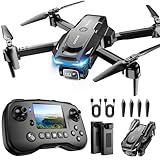
- The PK01 drone's remote comes with a super handy built-in screen—no phone needed—so you can watch live HD footage and check flight stats right in your hands. (An SD card is required to save images and videos; not included) Powered by tough brushless motors, this little flyer is strong, smooth, and built to last. With one-key takeoff/landing, headless mode, and even 360° flips, you’ll look like a pro in no time. Ready for takeoff?🤩
- 📷【Drone with Camera】 Equipped with a 1080P HD 80°adjustable lens, the drone not only assists you in catching every wonderful moment from a bird's-eye perspective but is also perfect for selfies. It can even be used to check the roof of a house or other hard-to-reach areas. You can enjoy the real-time HD pictures and videos via the remote screen & APP. Automatically take photos/videos with gestures. First flight tip: choose a windless indoor space, keep the altitude below 6 meters and the distance below 30 meters to help better practice and control the drone.
- 🕹️【More Fun to Fly】 This foldable drone has 2 control modes: remote control, APP control. You can enjoy exciting features such as one-click 360° flips, 3D flip, waypoint flyflight, gravity control, circle fly, rotation fly, 3 speed gear, gravity sensing and Emergency Stop. (Some functions should be controlled by the app) You can also effortlessly command the remote control drone with simple voice instructions like "Take off"and more.
- 🔋【Long Flying Time and Safer】 The upgraded FPV drone is equipped with two enhanced batteries, extending the flight time to 25 minutes, providing no-worry flying experience. The controller has built-in battery and comes with 2pcs USB charging cable, enables you to charge it effortlessly. Features with emergency stop, 4 propeller guards, child lock feature and low power alarm to ensure a safe and reliable flight. PK01 is lightweight, portable and No FAA Registration needed, makes it a ideal drone for indoor and outdoor activities.
- 📲【How to Connect Your Phone】1.Power off the remote controller. 2. Turn on the drone. Note: Make sure the tail of the drone is facing towards you. 3. Download and log in to the "PK01 DRONE" app. 4. Connect your phone to the Wi-Fi network named "PK01DRONE_XXXXXX" via the app. 5. Move the left and right joysticks of the remote control to the lower left or lower right 45 degrees at the same time. The drone light flashes and then turns on, completing horizontal calibration. 6. Enter the app control interface, tap the "Control Switch" icon, and then select "Take Off" for a successful launch.
How the control systems differ
Quadcopter: differential motor speed
A quadcopter normally has two propellers turning clockwise and two turning counterclockwise. In a hover, their reaction torques balance. The controller changes motor speeds in combinations:
- Throttle: increasing all four speeds raises total thrust; reducing them lowers it.
- Roll: increasing thrust on one side and reducing it on the other tilts the craft laterally.
- Pitch: the same differential principle acts between the front and rear motors.
- Yaw: changing the relative speeds of clockwise and counterclockwise rotors changes net reaction torque without requiring a tail rotor.
The pilot usually commands an attitude or a horizontal movement, while the flight controller calculates the individual motor speeds. This is why a stabilized quadcopter can feel straightforward even though its raw airframe is not self-stable. The controller must estimate orientation, reject disturbances, and keep the four motors coordinated.
Research presented at IEEE ICRA in 2015 identifies simplicity of control and relatively simple mechanical design as major reasons quadrotors attracted attention. That simplicity is real at the mechanism level: there is no swashplate, long tail-rotor drive, or mechanical anti-torque linkage. It does not eliminate software complexity. Sensor calibration, firmware compatibility, motor timing, and control-loop tuning remain essential.
Single rotor: collective, cyclic, and anti-torque control
A helicopter-style single rotor uses a rotor head to change blade pitch. Collective input changes the pitch of all main-rotor blades together, changing lift. Cyclic input changes blade pitch around the rotation cycle, tilting the rotor disk and directing thrust to pitch or roll the aircraft. The tail rotor supplies anti-torque and controls yaw.
This arrangement gives the pilot direct helicopter-like control, but the mechanical path is more involved. Bearings, linkages, blade tracking, the rotor head, and the tail-rotor drive all have to remain correctly adjusted. The aircraft’s response also depends on rotor speed, blade pitch, translational airflow, and the interaction between the main rotor and tail rotor. A skilled pilot can use that control authority precisely, but a beginner has more coupled behavior to learn than with a stabilized quadcopter.
Why “easy to control” depends on the flight mode
A stabilized quadcopter is usually easier for a new pilot because the controller can hold attitude when the sticks are released. In an acrobatic or manual mode, the same quadcopter may require constant pilot corrections because its airframe has no passive self-righting behavior. A single rotor with a sophisticated stabilizer can also be approachable, while a mechanically controlled model without assistance demands helicopter-specific skills.
Also popular on Amazon

- No Registration Needed - Under 249 g, FAA Registration, and Remote ID are not required if you fly for recreational purposes.
- 4K UHD Stunning Imagery- Film in 4K HDR Video for crystal clear aerial shots. With Dual Native ISO Fusion, Mini 3 enables the capture of details in highlights and shadows, both day and night. [3]
- Striking Vertical Videos are Ready to Share - With True Vertical Shooting, you can easily capture tall landmarks like skyscrapers and waterfalls.
- Extended Battery Life - Its flight time can be extended up to 51 minutes with the Intelligent Flight Battery Plus (sold separately), but the aircraft will weigh more than 249 g. Fly More combo offers up to 114 minutes of total flight time.[2]
- 38kph (Level 5) Wind Resistant and 3-Axis Gimbal for Stable - With its Level 5 wind resistant and 3-axis mechanical gimbal, Mini 3 can capture consistently smooth 4K imagery. Brushless motors enhance power and allow takeoff at altitudes up to 4,000 meters.
When comparing products, identify the actual control mode, not just the airframe type. Ask whether the aircraft offers attitude hold, position hold, automatic landing, or only rate control; whether those features depend on a particular sensor package; and whether the controller can be recalibrated after changing blades, motors, or payload.
Efficiency: why rotor count is not the answer
Disk loading and rotor diameter
Hover efficiency is strongly related to disk loading: the aircraft’s weight divided by the total area swept by its rotors. A larger rotor disk can move a larger mass of air by a smaller velocity increase, which generally reduces the induced power needed to hover. A single main rotor can therefore be attractive for a heavy aircraft or an endurance mission because one large disk may provide lower disk loading than four small disks fitted inside the same footprint.
That advantage is conditional. A single rotor also needs an anti-torque tail rotor in the conventional layout. Tail-rotor power produces no useful vertical lift, and the tail boom, drive shaft, gearbox, and rotor add mass and mechanical losses. A quadcopter divides the total disk area among four rotors, incurs rotor-to-rotor and body-wake interactions, but eliminates the dedicated tail rotor and can place four efficient electric motors close to the main battery.
What’s actually slowing this PC down?
Pick the symptom - the matching free tool is one click away.
RPM, blade design, and payload change the result
Rotor diameter is only one variable. Tip speed, blade pitch, blade planform, motor efficiency, ESC losses, gearbox losses, air density, and the aircraft’s weight all affect the electrical energy drawn from the battery. A small rotor spinning rapidly may produce the required thrust but lose more energy to profile drag and tip vortices than a slower, larger rotor. Conversely, a very large rotor can become impractical because of structural loads, transport size, response speed, and clearance.
Payload changes the comparison twice: it increases the lift requirement and may force a different battery or propulsion system. A quadcopter designed for a camera and a single rotor designed for a much heavier sensor cannot be compared by flight time alone. Compare the energy used per unit of payload over the same mission, with the same reserve policy and environmental conditions.
What published figures do—and do not—show
Some frequently quoted percentages concern coaxial rotors rather than ordinary quadcopters. Stephen D. Prior’s 2010 discussion reports up to 15% reduced power output for a coaxial arrangement compared with an equivalent single rotor, and up to 20% power saved by eliminating a tail rotor. Those figures apply to the stated coaxial or tail-rotor configurations; they are not a universal efficiency rating for four-rotor drones.
Also popular on Amazon
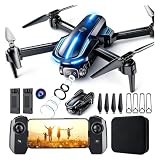
- 【Easy to Fly: Master the Sky Instantly】 No experience? No problem! Equipped with One-Key Takeoff/Landing and Altitude Hold, this beginner friendly drone stays rock-solid in the air. It’s so easy to fly that even kids 8-12 and adults who have never flown can master the controls in seconds. Perfect for stable indoor outdoor play, ensuring a stress-free start for every new pilot.
- 【1080P HD Camera & Real-Time FPV View】 Capture your world from a brand-new perspective! The integrated 1080P HD camera delivers crystal-clear aerial snapshots and smooth FPV live video directly to your phone. Use Gesture Selfie to snap photos with a simple hand movement—making it the ultimate smart gadget for creative family fun, backyard adventures, or park exploration.
- 【Double the Flight for Non-Stop Entertainment】 Enjoy twice the joy with 2 modular batteries, providing up to 24 minutes of total flight time. This foldable mini drone is compact and comes with a premium carrying case, making it a portable lightweight companion. Whether it's a camping trip, a beach day, or a weekend family garden play, your aerial entertainment never has to stop.
- 【Thrilling Smart Features for Exciting Play】 Take your recreational flight to the next level! Master breathtaking 360° 3D Flips, steer by tilting your phone with Gravity Control, or design custom paths with Trajectory Flight via the Smart App. With 3-speed adjustments, this RC quadcopter offers a versatile and exciting pastime that grows with your skills, from casual drifting to high-speed stunts.
- 【Safe, Durable & Worry-Free House Fun】 Safety is our priority for every hobbyist. Featuring Headless Mode for easy orientation and 4 protective propeller guards to withstand accidental bumps. Built with high-toughness materials, this small drone is safe for indoor play and sturdy enough for outdoor exploration. It’s the go-to flying toy for boys and girls seeking a reliable and fun-filled adventure.
A 2023 experiment on a ducted coaxial-rotor UAV reported a best figure of merit of 0.61 for its tested spacing and approximately 5.8% greater power loading than its single-rotor comparison. A figure of merit and a power-loading result describe that duct, rotor geometry, spacing, and test condition. They cannot be transferred directly to a consumer quadcopter with four separate open propellers.
Outdated Drivers Are Slowing You Down
One free scan finds every outdated or missing driver and matches the right update for your exact hardware.Free scan · exact hardware matchWindows Errors? Fix Them Before They Spread
Repair common Windows errors and clear accumulated junk for a smoother, more stable PC - no reinstall needed.Free scan · no reinstallBecause no universal apples-to-apples efficiency number exists, use a mission-specific comparison. Measure or obtain hover power at the same all-up mass, then compare usable battery energy, expected reserve, payload, and the time spent hovering versus moving. A vehicle that is less efficient in a stationary hover may still complete an inspection more efficiently if it accelerates, brakes, and repositions with less wasted time.
Efficiency comparison checklist
- Use the same all-up mass, including battery, payload, landing gear, and safety equipment.
- Compare total rotor disk area, not just the number of motors.
- Record rotor diameter, pitch, RPM or motor speed, and whether a duct or coaxial stack is used.
- Include tail-rotor, gearbox, ESC, and wiring losses where the design has them.
- Use the same air density, wind condition, hover height, and battery reserve.
- Separate hover endurance from forward-flight endurance; the aerodynamic losses are different.
What happens when a motor or rotor fails?
Quadcopter failure behavior
A quadcopter has distributed propulsion, so one failed motor or propeller does not remove every source of thrust. That distribution is a form of redundancy: the remaining rotors can still produce force, and a controller may be able to command a controlled descent or continued flight if the airframe has enough authority and the software supports the failure mode.
However, four rotors are not automatically fail-safe. A failed unit removes both lift and the reaction torque that balanced its opposite rotor. The aircraft may yaw, roll, or descend faster than the remaining motors can correct. Whether it can recover depends on motor thrust margin, the location of the failure, battery voltage, payload, controller algorithms, sensor data, and the aircraft’s structural design. A general-purpose quadcopter should therefore be landed immediately after a propulsion warning rather than treated as guaranteed to fly on three motors.
Typical symptoms include a sudden yaw or roll, a motor-temperature warning, an ESC fault, a propeller that stops, or a current spike. Reduce throttle only as much as needed to prevent an uncontrolled climb, move away from people, and land in the nearest clear area. Afterward, inspect the propeller, motor shaft, wiring, ESC, arm, and battery connector before another flight.
Single-rotor failure behavior
A conventional single rotor depends on the main rotor for lift and on the tail rotor for anti-torque and yaw authority. A tail-rotor or tail-drive failure can therefore leave the aircraft with substantial lift but without normal yaw control. A main-rotor drive or motor failure removes powered lift and changes the aircraft’s dynamics immediately. Recovery options depend on the particular rotor head, controller, pilot input, and approved operating procedure; they should never be assumed from the appearance of another helicopter model.
Also popular on Amazon

- No Registration Needed - Under 249 g, this drone with camera for adults 4K does not require FAA registration or Remote ID for recreational use. Visit the FAA's official website for requirements related to drone registration and Remote ID. [1]
- 4K Ultra HD & 3-Axis Gimbal for Cinematic Quality Shooting - Capture stunning moments in any light—sunrises, sunsets, and night scenes with crystal-clear 4K resolution. Thanks to the 3-axis gimbal, you can achieve cinematic-quality footage with this advanced drone with camera.
- 38kph (Level 5) Wind Resistant - This drone for adults has a stable flight even in Level 5 winds. Brushless motors enhance power and allow takeoff at altitudes up to 4,000 meters.
- 10km Max HD Video Transmission-up to 10 km (32,800 feet) [2] of HD video transmission and has excellent anti-interference capabilities, giving you the ability to freely explore vast landscapes and see clearer.
- Due to platform compatibility issue, the DJI Fly app has been removed from Google Play. To ensure a better product usage experience, please log in to the DJI official website to download the latest version of DJI Fly.
The mechanical system also creates more individual failure points: main-rotor hub and blade retention, pitch links, bearings, tail drive, tail-rotor gearbox, and the power system. More parts do not mean failure is inevitable, but they make inspection and correct adjustment more important.
Redundancy is a design claim, not a rotor-count slogan
NASA’s Advanced Supercomputing work highlights redundancy as one reason to study multiple-rotor aircraft, while also noting that airflow interactions among rotors, fuselage, and surrounding air are significant design challenges. A manufacturer claiming redundancy should specify the tested failure case, payload, wind limit, minimum battery reserve, and the controller mode used. Without those details, “redundant” only means that more than one rotor exists.
Which aircraft fits which mission?
| Mission or priority | More suitable starting point | Reasoning | Trade-off |
|---|---|---|---|
| Stable hovering for inspection or photography | Quadcopter | Independent motors and electronic attitude control make precise stationary positioning practical. | Small rotors can be less efficient for a heavy payload. |
| Frequent short repositioning and agile movement | Quadcopter | Fast differential-thrust corrections and no tail-rotor linkage simplify control. | Rapid maneuvers increase power draw. |
| Large payload on an endurance-focused platform | Single rotor may be appropriate | A large disk can lower disk loading and concentrate lift in one efficient main rotor. | Tail-rotor power, mechanical mass, and asymmetric dynamics must be managed. |
| Learning helicopter flight behavior | Single-rotor RC helicopter | It reproduces collective, cyclic, and anti-torque control rather than hiding them behind four motor outputs. | The rotor head and tail system require more setup and practice. |
| Simple field maintenance and widely available parts | Quadcopter | Propellers, motors, arms, and electronic modules are commonly modular. | Parts remain model-specific, and four propulsion units mean four sets of inspections. |
| Specialized heavy-lift or research configuration | Either, chosen from measured data | NASA research includes multirotors for heavy-lift, delivery, surveillance, and disaster-relief concepts; a single rotor may suit a different payload or endurance envelope. | Mission requirements, not a generic category label, determine the best design. |
How to choose one for personal use
Choose a quadcopter when these priorities dominate
- You need a predictable hover and frequent position corrections.
- You prefer electronic stabilization and a short learning curve.
- You want a simple mechanical layout with replaceable arms, motors, and propellers.
- Your flights involve inspection, mapping, observation, or short agile movements rather than maximum hover endurance.
- You value broad availability of compatible batteries, chargers, propellers, and service parts.
Choose a single-rotor design when these priorities dominate
- You specifically want helicopter-style collective and cyclic control.
- A large rotor and lower disk loading are valuable for a specialized payload or endurance target.
- You accept rotor-head, tail-drive, blade-tracking, and anti-torque maintenance.
- You have a suitable practice area and are prepared to learn asymmetric helicopter dynamics.
- The exact aircraft provides documented performance data for your payload and battery, rather than relying on a generic efficiency claim.
Match every replacement part to the exact model
Use the propeller, motor, battery, charger, and firmware combination specified for the aircraft. A propeller with a different diameter or pitch changes current draw and controller response; a battery with the wrong voltage can damage electronics or prevent the motors from reaching commanded speed. Do not assume that two parts with the same connector or physical size are interchangeable.
Before the first flight, verify motor direction, propeller orientation, sensor calibration, arm and blade fasteners, battery retention, failsafe behavior, and the return or landing action commanded when the signal is lost. Test the aircraft at low altitude in a clear area, then repeat the checks after transporting it or changing payload.
A practical decision framework
- Define the mission. Write down payload mass, hover time, forward-flight time, maximum wind, operating area, and the consequence of a forced landing.
- Set the all-up mass. Include the battery and every accessory. Reject comparisons that quote endurance at a lighter mass than your intended aircraft.
- Compare propulsion geometry. Record total rotor disk area, rotor diameter, RPM, motor count, tail-rotor presence, and whether the system is coaxial or ducted.
- Evaluate control assistance. Confirm the available flight modes, sensor redundancy, calibration procedure, and what the controller does after a motor, sensor, or signal fault.
- Check maintenance access. Identify which parts can be replaced in the field, how blade tracking or motor alignment is adjusted, and which spares the manufacturer lists.
- Test the actual configuration. Measure hover current and temperature with the intended payload and battery, leaving the manufacturer’s reserve. A catalog claim from another rotor size or test setup is not a substitute.
- Choose for the failure you can manage. If a controlled landing after one propulsion fault is essential, select an aircraft with documented failure testing rather than inferring capability from the number of rotors.
Bottom line for most pilots
Buy or build a quadcopter if your priority is a stable hover, straightforward electronic control, agile positioning, and manageable mechanical maintenance. Its advantages are strongest in ordinary inspection, photography, training, and general-purpose flights, especially when the aircraft is correctly tuned and not overloaded.
Choose a single-rotor aircraft when you have a specific reason to use a large main rotor or you want authentic helicopter control and are willing to maintain a more complicated, asymmetric machine. It may deliver an endurance or payload advantage in the right configuration, but rotor count alone cannot prove that advantage. Compare measured power, disk loading, payload, and failure procedures for the exact aircraft you intend to fly.
Quick Recap
Product prices and availability are accurate as of the date/time indicated and are subject to change. Any price and availability information displayed on Amazon at the time of purchase will apply.

