
Recommended Free Tools
The LR1120 is a radio component for asset-tracking designs, not a finished tracker. Its distinguishing feature is the option to combine regional terrestrial LoRa connectivity with a licensed satellite S-band radio path in one device.
What the LR1120 does
Semtech introduced the LR1120 on April 13, 2022. It is a low-power, half-duplex LoRa transceiver that also supports (G)FSK and LR-FHSS. Its terrestrial radio options cover sub-GHz frequencies from 150–960 MHz and the 2.4 GHz ISM band; its satellite capability covers licensed 1.9–2.1 GHz S-band, according to Semtech’s current product specification.
That combination is intended to help one asset-tracking design work across regional terrestrial deployments and satellite-linked routes. It does not mean that every frequency is available for unlicensed use everywhere: ISM band plans and rules vary by region, while S-band satellite operation depends on the relevant licensed service.
Can an LR1120 communicate directly with satellites?
The LR1120 has an S-band radio path that can link to compatible low-Earth-orbit satellite partners. Semtech marketing director Randy Ryder described the S-band capability as enabling links with LEO satellite companies in 2022 Embedded.com interview coverage.
#1 Best Overall

- 【8KM transmission distance】DX-LR30 transmission distance is up to 8KM. Support 850~930Mhz frequency band communication, 22dBm power, support programming, SPI interface, firmware development needs to be done by yourself. 32Mhz crystal frequency, TTL level output, compatible with 3.3~5V IO port voltage.
- 【Original SEMTECH SX1262 & Development Board STM32F103C8T6 Chip】DX-LR30 series adopts SEMTECH chip solution, SX126X series is compatible with SX127X series communication, compared with SX1278/SX1276 solution, it has stronger performance, longer transmission distance, faster speed and lower power consumption. It supports functions such as air wake-up, carrier sense, communication key, and supports packet length setting.
- 【Application Areas】Home security alarm and remote keyless entry; smart home and industrial sensors; wireless alarm security system; building automation solutions; industrial wireless remote control; advanced meter reading architecture (AMI); automotive industry applications.
- 【Rich Information】We provide complete technical support, including technical documents, the AT command set, module package diagrams, reference design schematics, and development/testing tools. To help you quickly verify module functionality and speed up product development, we highly recommend purchasing a development kit with your first order.You can access the user guide for complete product information by clicking on the product guide and document link below.
- 【Multiple Certifications】DX-LR30 has complete certifications, making your product simpler, safer and more reliable. The module has an optional IPEX/Stamp hole dual-hole external antenna, equipped with a RF shielding cover, strong anti-interference, anti-static, and EMC electromagnetic compatibility.
The chip alone does not provide satellite airtime, coverage, or a complete end-to-end service. A deployable system needs a compatible satellite network and service arrangement, as well as a properly designed antenna, host electronics and firmware. A satellite link is therefore a possible part of a tracking system—not a guarantee that a tracker will send data anywhere on Earth.
How an LR1120 tracking design estimates location
Location can be estimated using the LR1120’s multi-constellation GNSS scanner or its passive Wi-Fi MAC scanner. GNSS is useful where satellite signals can be received; Wi-Fi scanning can provide location clues indoors or where GNSS signals are obstructed. The Wi-Fi function scans for access-point identifiers; it is not a substitute for an internet connection.
Rank #2

- XL1276-P01 uses the spread spectrum chip sx1276, which has the advantages of low power consumption, large capacity, long transmission distance, and strong anti-interference ability. The transmission power, working frequency, modulation rate, and other parameters of the module can be configured by the single-chip computer.
- Based on the SPI interface mode, it is very convenient for various MCU connections. It can do all kinds of wireless and two-way data receiving and sending. The single-chip computer controls the wireless module to transmit, receive data or sleep through SPI.
- The wireless module receives data through the NIRQ port to notify the single-chip computer to receive, and the single-chip computer reads the data received by the wireless module through the SPI interface.
- The module can be easily embedded into the design of customers' existing products or systems. The standard SPI interface makes communication easy. Customers only need to compile a simple communication protocol in the original micro-control device to realize two-way communication and data transmission.
- This module applies to any wireless data transmission application with complex environments, such as wireless meter reading, smart home control, automotive electronics, security alarm, industrial monitoring, and control system, remote agricultural irrigation control system, etc.
LoRa Cloud can process scanning results on the cloud side. Offloading the location-solving work can reduce the processing the tracker must do itself, which may help limit device energy use. It also means the design depends on a suitable cloud workflow and connectivity to submit the scan data; location is not produced merely by adding the transceiver.
LR1120 versus LR1121
The LR1121 is the newer third-generation family. Its key stated addition is L-band support, alongside S-band and the terrestrial bands. The bands below reflect Semtech’s current product specifications; they describe radio capability, not guaranteed network availability.
Free tools Windows power users keep installed
One-click scans. No signup required.
Rank #3

- 【Transmission Distance】 DX-LR31/32 can achieve a communication range of up to 5 km in an open, unobstructed environment when used for drone communication (actual communication distance may vary depending on the environment; please refer to actual testing). It supports 433–532 MHz and 850–930 MHz frequency bands, with 22 dBm power, 32 MHz crystal frequency, TTL level output, and is compatible with 3.3–5V IO port voltage.
- 【Original Semtech SX1262 Chip & UART Interface】The DX-LR31/32 series is a low-power LoRa module developed by Loongtrek, based on the original Semtech SX1262 chipset. UART serial communication, enabling transparent data transmission between devices with no firmware development required. Supported baud rates include 1200, 2400, 9600, 19200, 38400, 57600, 115200, and 128000 bps.
- 【Application Areas】Home security alarm and remote keyless entry; smart home and industrial sensors; wireless alarm security system; building automation solutions; industrial wireless remote control; advanced meter reading architecture (AMI); automotive industry applications.
- 【Application Scenarios】The DX-LR31/32 is designed for long-range serial data transmission, such as communication from a living room to a basement, yard, pasture, farm, or industrial park. It can be easily integrated with Android devices, Raspberry Pi, and ESP32 MCUs to develop various DIY applications, including long-distance motor control and data acquisition.
- 【Comprehensive Information】We provide comprehensive technical support, including technical documentation, AT command sets, module packages, reference design schematics, and development/test tools. To help you quickly verify module functionality and accelerate product development, we strongly recommend purchasing a development kit with your initial order. Additionally, click the Product Guides & Documentation link below to access user guides, complete product information, and YouTube product video tutorials.
| Capability | LR1120 | LR1121 |
|---|---|---|
| Sub-GHz terrestrial | 150–960 MHz ISM; Semtech current product specification | 150–960 MHz ISM; Semtech current product specification |
| 2.4 GHz terrestrial | 2.4 GHz ISM; Semtech current product specification | 2.4 GHz ISM; Semtech current product specification |
| Satellite bands | Licensed 1.9–2.1 GHz S-band; Semtech current product specification | Approximately 2 GHz S-band and 1.55 GHz L-band; Semtech current product specification |
| GNSS and passive Wi-Fi scanning | Multi-constellation GNSS and passive Wi-Fi MAC scanner | Geolocation inputs are described for the LR1121 family; confirm support and implementation details for the selected part or module |
| Published transmit power figures in the cited product details | Not stated in the cited Semtech product specification details | Up to +22 dBm in sub-GHz and up to +11.5 dBm in 2.4 GHz; Semtech current product specification |
The LR1121 is the more relevant starting point when the design specifically requires L-band capability. That alone does not establish that it is the better choice: compare the network partners and bands available on the intended routes, regional terrestrial requirements, power budget, antenna and RF integration, host-MCU interface, and service costs before choosing.
LR1121 modules for prototyping and OEM designs
Two concrete LR1121-based options are Seeed’s Wio-LR1121 and Minew Semi’s ME25LS04. They are engineering modules for building a product, not turnkey consumer trackers.
Rank #4
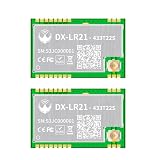
- 【Transmission Distance】 DX-LR21/22 can achieve a communication range of up to 5 km in an open, unobstructed environment when used for drone communication (actual communication distance may vary depending on the environment; please refer to actual testing). It supports 433–532 MHz and 850–930 MHz frequency bands, with 22 dBm power, 32 MHz crystal frequency, TTL level output, and is compatible with 3.3–5V IO port voltage.
- 【Original Semtech LLCC68 Chip & UART Interface】The DX-LR21/22 series is a low-power LoRa module developed by Loongtrek, based on the original Semtech SX1262 chipset. UART serial communication, enabling transparent data transmission between devices with no firmware development required. Supported baud rates include 1200, 2400, 9600, 19200, 38400, 57600, 115200, and 128000 bps.
- 【AT command settings】Has multiple AT commands that can be used to set query the module's Mode, Frequency, Mac, Bandwidth, Spreading factor, Coding rate, Coding rate, etc. You can quickly start the project without writing the lora program by yourself.
- 【Application Scenarios】The DX-LR21/22 enables long-distance serial data transmission, for example, from the living room to the basement, from the living room to the yard, on pastures, on farms, and within industrial parks. It can also be used with Andruno, Raspberry Pi, or ESP32 MCUs to develop various DIY products, such as long-distance motor control and data acquisition.
- 【Rich Resources】We provide comprehensive technical support, including technical documentation, AT command sets, module packages, reference design schematics, and development/test tools. To help you quickly verify module functionality and accelerate product development, we strongly recommend purchasing a development kit with your initial order. Additionally, click the Product Guides & Documentation link below to access user guides, complete product information, and YouTube product video tutorials.
| Module | Published details | What to verify for a project |
|---|---|---|
| Wio-LR1121 | Seeed documentation from 2025 lists sleep current as low as 1.35 µA and sub-GHz receive sensitivity down to –140 dBm at SF12 with boost enabled. | Confirm the precise band variant, module interfaces, antenna requirements and compatibility with the chosen network and firmware. |
| ME25LS04 | Minew Semi’s 2026 specifications list SPI control, 12 mA receive current, and transmit power up to +22 dBm in sub-GHz and +11.5 dBm in 2.4 GHz. | Confirm the applicable operating modes and conditions behind the published figures, along with RF layout, antenna and network compatibility. |
These figures are manufacturer-published specifications, not a comparison from a common test. In particular, the Wio-LR1121’s lowest stated sleep current and best stated sensitivity apply under the conditions noted in its documentation; actual product consumption also depends on the host, radio activity, location method, reporting schedule and power design.
Independent reader supportYour contribution helps us test, update, and keep practical guides available for everyone.What a complete global tracker still needs
A transceiver or module is only one subsystem. Before selecting a part, the product team should settle the route, reporting needs and operating environment, then design the rest of the system around them:
Best Value

- ✨【Worldwide Compatibility】LoRa-E5 LoRaWAN module is embedded with LoRaWAN protocol, AT command, support global LoRaWAN frequency plan.
- ✨【Ultra-low Power Consumption】 LoRa-E5 LoRaWAN module is designed with ST system-level package chip STM32WLE5JC, ARM Cortex M4 ultra-low-power MCU and LoRa SX126X. It supports (G)FSK mode and LoRa. 62.5kHz, 125kHz, 250kHz, and 500kHz bandwidth can be used in LoRa mode, making it suitable for the design of various IoT nodes, as low as 2.1uA sleep current (WOR mode).
- ✨【Compacted Size and High Performance】 12mm * 12mm * 2.5mm 28 pins SMT; TXOP=22dBm@868/915MHz; -136.5dBm sensitivity for SF12 with 125KHz BW. This LoRa E5 module is designed with industrial standards, hence it's highly suitable to be used in designing industrial IoT products, with a wide working temperature at -40℃ ~ 85℃.
- ✨【Great Flexibility】 For users who want to develop software on the MCU of the module, other GPIOs of the MCU can be easily manipulated, including UART, I2C, ADC, etc. These rich GPIO interfaces are useful for users who need to expand peripherals.
- ✨【Applications】 LoRa-E5 LoRaWAN module is highly suitable for long-distance, applications such as smart agriculture, smart city, wireless meter reading, sensor networks, wireless communication, and other low-power wide-area IoT scenarios. If you want a module to design your own LoRaWAN sensor, to construct IoT nodes, or to support any wireless communication applications, LoRa-E5 is the premium choice that provides you with an optimal user experience.
- Network plan: Identify terrestrial LoRa coverage and satellite partners that support the required bands and service on the asset’s routes. A historical 2022 Semtech/Embedded.com report said LoRa technology had been used to deploy LoRaWAN networks in more than 170 countries; that is historical context, not a present-day coverage guarantee for a particular device or satellite service.
- RF and antennas: Plan antenna placement, tuning and coexistence for the terrestrial and satellite bands the product will actually use. Enclosure materials and mounting on metal containers or equipment can affect performance.
- Host and firmware: Add a host MCU, radio-control firmware, location policy, message scheduling and the interfaces needed to work with the selected module and cloud services.
- Power and packaging: Size the battery and power-management circuit for the expected transmit frequency, GNSS or Wi-Fi scans, sleep periods, environmental conditions and enclosure lifetime.
- Service and operations: Account for satellite and terrestrial service arrangements, cloud-side geolocation processing, device provisioning and the cost of operating the fleet.
Where multi-band LoRa tracking can help
The design is aimed at assets that move between regions or spend time beyond dependable cellular coverage. Semtech’s 2022 launch materials highlighted logistics and mass-scale asset management; its official release also named infrastructure, agriculture and environmental monitoring in remote areas. The 2022 Embedded.com interview discussed livestock tracking in Africa, maritime container shipping, reusable pallets and food cold-chain monitoring.
These are use cases, not evidence that an LR1120 or LR1121 automatically tracks every asset in those settings. A container, pallet or livestock tag needs a suitable antenna and enclosure, an operating network along its route, and a reporting strategy that balances location freshness against battery life. The satellite option may extend the design to routes without cellular service, but only where a compatible satellite service is available.
Quick Recap
Choosing between a chip, module and finished tracker
- Choose the LR1120 when its sub-GHz, 2.4 GHz and licensed S-band capabilities fit the intended network plan and L-band is not a requirement.
- Evaluate the LR1121 when L-band support matters, while confirming that a compatible service exists for the target geography and application.
- Start with a module such as Wio-LR1121 or ME25LS04 when prototyping or integrating an LR1121-based radio is the goal and the team can handle the remaining hardware and software.
- Look for a finished tracker instead if the requirement is an immediately deployable device. Neither a transceiver nor a development module alone supplies the complete enclosure, battery system, tuned antennas, firmware and connectivity service.
Product prices and availability are accurate as of the date/time indicated and are subject to change. Any price and availability information displayed on Amazon at the time of purchase will apply.

