
Salil Tembe’s two-part project is a practical guide to building and checking a VHF-oriented low-noise amplifier (LNA) for software-defined radio (SDR). It uses a Mini-Circuits PGA-103+ amplifier, adds a bandpass filter and a coaxial bias tee, and tests the assembled board with a NanoVNA and TinySA Ultra before trying it with an RTL-SDR. The project aimed for a noise figure below 1 dB; it does not publish a complete bill of materials or a measured gain table.
What the project is designed to do
An LNA boosts weak signals near the start of a receiver chain. Its noise figure matters because noise added at this early stage can make it harder to receive weak signals. Tembe’s project targets weather-satellite LRPT reception, the 2-meter amateur-radio band, and radio astronomy, with SDR use as its practical focus. The project is documented in two parts, dated October 13 and November 1, 2024, in Tembe’s author archive.
The target was a noise figure below 1 dB. Mini-Circuits’ PGA-103+ is the active amplifier device. Hackster’s 2024 account reports Mini-Circuits specifications of 0.6 dB typical noise figure at 1 GHz and 0.9 dB at 2 GHz. Those figures are device specifications at the stated frequencies—not a published measurement of Tembe’s completed board, nor a noise-figure figure specifically at VHF.
Why the design includes filtering and a bias tee
Bandpass filtering
The project includes a bandpass filter intended for satellite and 2-meter signals. Filtering helps define which signals the receiver front end is meant to pass; an amplifier alone would not provide that band selection. The available project summaries do not provide a complete passband response or measured rejection figures, so they do not establish the filter’s exact operating limits.
Free tools Windows power users keep installed
One-click scans. No signup required.
#1 Best Overall

- A high-quality amplifier (LNA) module that operates on a very wide range of frequencies: from 300MHz to 8GHz. Provides a boost to weak signals, extending the reception range and improving overall signal strength
- Engineered to deliver exceptional performance at S and C frequency bands; offering significantly higher gain, a lower noise figure, reduced power consumption, and improved linearity for superior reception quality compared to competitive LNAs. Designed for professional and amateur radio enthusiasts, astronomy enthusiasts, wireless communication enthusiasts, and more
- A variety of power options are available, including BiasTee (3.3V-5V), USB-C, or DC power with the included USB-C to DC barrel connector adapter, in order to maximize flexibility. A maximum current requirement of 65mA ensures compatibility with nearly all BiasTee configurations
- Simple installation and compatibility with popular SDR (Software Defined Radio) models, including NESDR SMArt RTL-SDR and HackRF. Also serves as an excellent companion to the Ham It Down series of downconverters. A free male SMA to male SMA connector, USB-C power cable, and USB-C to DC barrel connector are included with your purchase. LaNA WB is assembled and housed in an aluminum enclosure, ensuring optimal performance
Power over coax
A bias tee puts DC power onto the coaxial feed while the same cable carries RF. That makes it possible to power the front-end circuit through the coax rather than requiring a separate power lead at the antenna end. The summaries identify the bias tee as part of the design, but do not state its voltage, current, or exact implementation details.
How Tembe tested the assembled amplifier
Tembe’s workflow combines bench checks with a reception check. The accessible instruments were a NanoVNA vector network analyzer and a TinySA Ultra spectrum analyzer; the final practical step was connecting the amplifier to an RTL-SDR. VERON’s account says the tests met the design specifications and describes the LNA as ready to work with an RTL-SDR.
Rank #2
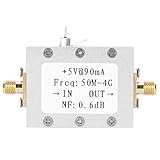
- Ultra low noise design: Features 0.6dB typical noise factor for maintaining signal clarity in weak signal environments.
- High linearity and gain: Delivers 19dB typical gain and 23dB P1dB, ideal for high dynamic range receiver applications.
- Wide frequency range: Operates from 50MHz to 4GHz, supporting VHF, UHF, and SDR amplifier needs.
- Cascadable for extra gain: Multiple LNA modules can be linked together to further boost signal strength.
- Versatile applications: Suitable as a receiver preamplifier, intermediate frequency preamplifier, or tower mounted amplifier for communication gear.
- Assemble the PCB. The project proceeds from design to a built amplifier board; the summaries do not supply enough information here to reproduce the exact component placement or bill of materials.
- Check the board with a NanoVNA. Tembe used the vector network analyzer as part of the bench testing. The published summaries do not specify the measured traces, calibration procedure, or numerical results, so they do not support a particular gain, return-loss, or passband value.
- Check it with a TinySA Ultra. The spectrum analyzer was the second bench instrument. The available accounts do not specify settings, test signals, or a numerical output spectrum.
- Try the amplifier with an RTL-SDR. This connects the bench-built design to an actual SDR reception setup. VERON reports that testing met the design specifications, but no quantitative reception comparison or before-and-after signal measurement is stated.
These steps demonstrate a useful test sequence, but the summaries do not describe a direct noise-figure measurement method or provide a measured noise figure for the completed unit. The PGA-103+ component specification should therefore not be treated as proof that the assembled LNA itself achieved a particular noise figure.
Should you build this LNA or buy one?
Tembe notes that an amplifier can simply be purchased, while designing one can be worthwhile for the experience. VERON’s Johan Evers reports that the tests showed the project met its design specifications. The choice depends on whether the goal is a ready-to-use receiver front end or hands-on RF design and test experience.
Quick wins for a faster PC:
Repair Windows errors before they cause bigger problemsFix Now →Fix the driver behind crashes, sound loss and screen glitchesFind Drivers →Clear out junk files and repair common Windows errorsFree Scan →Rank #3

- UNIVERSAL TV ANTENNA COMPATIBILITY — Works with all TV and antenna brands and supports HDTV, VHF and UHF broadcasts as well as 1080p HD, 4K Ultra HD and NEXTGEN TV (ATSC 3.0) technologies
- PUREAMP SIGNAL BOOSTING — Integrated amplifier with built-in 4G/5G LTE filter helps reduce cell phone interference and improve reception quality for available HDTV, VHF and UHF channels
- LOW-NOISE SIGNAL AMPLIFIER — Helps offset cable loss, minimize reception dropouts and strengthen signals already being received by compatible over-the-air TV antennas
- QUICK, TOOL-FREE INSTALLATION — Connects easily between your antenna and TV using standard coaxial connections; includes AC power adapter for convenient indoor use
- NEXTGEN TV READY — Compatible with ATSC 3.0 technology to support current and future over-the-air television standards where available
| Consideration | Tembe’s DIY design | Buying a commercial LNA |
|---|---|---|
| Noise figure | Design target below 1 dB; no completed-board measurement is stated in the cited summaries. | Varies by model; no specific model or comparable measurement is stated in the cited summaries. |
| Gain and linearity | Moderate gain and good linearity are stated design requirements; a measured gain table is not stated (VERON). | Depends on the model; not stated for a particular product in the cited summaries. |
| Passband and filtering | Includes a bandpass filter for satellite and 2-meter signals; detailed response figures are not stated. | Depends on the model; not stated for a particular product in the cited summaries. |
| Biasing | Includes a coaxial bias tee; voltage and current are not stated. | Depends on the model; not stated for a particular product in the cited summaries. |
| Testability and effort | Tembe used a NanoVNA and TinySA Ultra, then checked the board with an RTL-SDR; the project requires design, assembly, and testing effort. | Usually avoids designing and assembling the circuit; the summaries provide no model-specific setup or verification details. |
| Cost and availability | Not stated in the cited summaries. | Not stated in the cited summaries. |
| Learning value | Provides practical experience with RF design, assembly, and testing. | Tembe characterizes purchasing as the simpler route; learning value depends on the buyer’s aims. |
For someone who wants a working receiver front end with minimal build effort, a suitable commercial module is the straightforward choice—but its band coverage, filtering, gain, noise figure, bias requirements, and test evidence should be checked against the intended setup. For someone who wants to learn RF design and can devote time to assembly and measurement, Tembe’s project shows a route from component choice to SDR reception. The source accounts do not provide enough price or performance data for a product-versus-project value verdict.
Independent reader supportYour contribution helps us test, update, and keep practical guides available for everyone.What the project establishes—and what it does not
The project is useful as a practical design-and-test example rather than a complete construction recipe or product comparison. Hackster reports the amplifier choice and its stated device-level noise-figure specifications; VERON reports that testing met the project’s design specifications. The available summaries do not state the full parts list, detailed circuit values, numerical board measurements, current commercial alternatives, or a measured noise figure for the assembled LNA.
Quick Recap
Product prices and availability are accurate as of the date/time indicated and are subject to change. Any price and availability information displayed on Amazon at the time of purchase will apply.

