
The Raspberry Pi Compute Module 5 (CM5) is a Raspberry Pi 5-derived system-on-module for embedding in custom products. It offers up to 16GB of RAM, optional eMMC storage and wireless, and interfaces including PCIe and USB 3.0—but it is not a complete Raspberry Pi 5-style computer with ready-made ports. To use it, you generally need a compatible carrier board, such as the CM5 IO Board for development or a custom board for a finished product.
What is the Raspberry Pi Compute Module 5?
Raspberry Pi announced CM5 on 27 November 2024 as a modular counterpart to the Raspberry Pi 5. Rather than providing the familiar connectors on a single board, CM5 exposes capabilities through two high-density connectors for a carrier board. That makes it useful when a product needs Raspberry Pi computing but requires a different size, connector layout, or set of peripherals. Raspberry Pi describes the module as a system on module for custom embedded systems (launch announcement; product page).
In its 2024 announcement, Raspberry Pi CEO Eben Upton said that 70–80% of Raspberry Pi units went into industrial and embedded applications. That is the company’s estimate, not an independently audited market statistic (Raspberry Pi, 27 November 2024).
CM5 specifications and configurations
The current official specification lists these configurations and module capabilities. Availability of a capability in a finished product depends on the selected module and how its carrier board implements it (Raspberry Pi product page).
What’s actually slowing this PC down?
Pick the symptom - the matching free tool is one click away.
#1 Best Overall
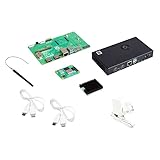
- COMPLETE KIT: Development kit includes Raspberry Pi Compute Module 5, IO Board, protective case, cooling system, antenna kit, power supply, and essential HDMI/USB cables
- POWERFUL PROCESSOR: Features BCM2712 64-bit processor with ARM Cortex-A76 architecture for high-performance computing capabilities
- DEVELOPMENT READY: IO Board provides comprehensive connectivity options including HDMI and USB ports for versatile prototyping and embedded solutions
- THERMAL MANAGEMENT: Includes dedicated cooler and heatsink system to maintain optimal operating temperatures during development
- CONNECTIVITY: Comes with antenna kit and multiple USB/HDMI cables for immediate setup and testing of wireless applications
| Category | CM5 specification |
|---|---|
| Processor | Broadcom BCM2712, quad-core 64-bit Arm Cortex-A76 (Armv8), running at 2.4GHz |
| Memory | 2GB, 4GB, 8GB, or 16GB LPDDR4-4267 SDRAM with ECC |
| Storage | 0GB Lite, 16GB, 32GB, or 64GB eMMC flash |
| Wireless | Optional dual-band 2.4GHz/5GHz 802.11 b/g/n/ac Wi-Fi and Bluetooth 5.0/BLE |
| Wired networking | Gigabit Ethernet PHY with IEEE 1588 support |
| Expansion and USB | PCIe Gen 2 x1; two USB 3.0 ports supporting simultaneous 5Gbps operation |
| Display and camera | Two HDMI 2.0 outputs supporting up to 4Kp60 simultaneously; two four-lane MIPI ports for DSI display or CSI-2 camera use |
| Graphics and video | 4Kp60 HEVC decoder; OpenGL ES 3.1 and Vulkan 1.3 graphics |
| GPIO | Up to 30 GPIO with 1.8V or 3.3V signalling |
These are module capabilities, not a list of sockets on the module itself. The carrier board determines which signals reach usable connectors and how the product is powered and assembled. For pin-level design details, consult the official Compute Module hardware documentation.
Do you need a carrier board?
Yes, unless the CM5 is being used in a design that already provides the required mating connectors and circuitry. A carrier board supplies the physical connections and routes the module’s signals to the interfaces your application needs.
For development and prototyping
The official CM5 IO Board breaks out interfaces for development, testing, and prototyping. Raspberry Pi also publishes its board design files in KiCad format, which can serve as a reference when designing a custom carrier (launch announcement; technical documentation).
Rank #2

- Upgraded processor BCM2712, quad-core Cortex-A76 64-bit SoC, more powerful performance
- Faster eMMC Flash storage, up to 200 Mbps data rate
- Adopts B to B connectors, most compatible with Compute Module 4
- Onboard Gigabit Ethernet PHY supporting IEEE1588, suitable for network applications
- Onboard PCIe Gen 2 x1 interface, allows connecting more useful modules
For a finished product
A production design may use a smaller, application-specific custom carrier rather than the IO Board. That can reduce size and expose only the interfaces the product needs, but it puts the integration and validation work on the product designer. Account for power, cooling, connectors, and any required wireless antenna arrangement in that design.
Will CM5 work with an existing CM4 design or IO Board?
CM5 is mechanically compatible with CM4, but that does not make an existing design electrically interchangeable without checking it. Raspberry Pi notes changes to the pinout and electrical behavior; among the interface changes, CM5 removes two two-lane MIPI interfaces and adds two USB 3.0 interfaces. Check the CM5 datasheet and validate the full design before substituting the module (launch announcement; technical documentation).
The official compatibility table says each generation’s IO Board can support the other generation with reduced functionality. It also warns that IO Boards are not universally compatible across Compute Module models. Check the table for the particular module and board combination rather than assuming that a familiar connector guarantees full support (Compute Module hardware documentation).
Rank #3

- POWERFUL PROCESSOR: Broadcom BCM2712 quad-core 64-bit Arm Cortex-A76 processor running at 2.4GHz delivers exceptional performance for embedded applications
- MEMORY AND STORAGE: Equipped with 16GB RAM and 64GB eMMC flash storage for robust data handling and storage capacity in a compact form factor
- WIRELESS CONNECTIVITY: Certified radio module with dual-band 2.4GHz/5.0GHz IEEE 802.11 b/g/n/ac Wi-Fi and Bluetooth 5.0 BLE, plus Gigabit Ethernet PHY with IEEE 1588 support
- DUAL 4K DISPLAY OUTPUT: Two HDMI 2.0 ports support simultaneous 4Kp60 output on both displays, plus two 4-lane MIPI ports for DSI and CSI-2 interfaces
- COMPACT DESIGN: Measures 2.17 x 1.57 x 0.19 inches with four M2.5 mounting holes, operating temperature range of -4°F to +185°F, and production guaranteed until January 2036
CM5 versus Raspberry Pi 5 and CM4
Choose based on the product you are building, not on an unqualified assumption that one board is simply better. A standard Raspberry Pi 5 is a single-board computer; CM5 is intended for integration with a carrier board. Against CM4, the practical questions are whether its interface changes suit your design, whether your existing carrier can be validated or adapted, and which RAM, storage, and wireless configuration you need. Raspberry Pi’s documentation and specifications are the references for those compatibility and configuration decisions (CM5 specifications; Compute Module documentation).
For prototyping, compare the cost and effort of a module plus IO Board and accessories with the convenience of a bundled kit. For a product, factor in the engineering time to design and validate a custom carrier. CM5 also has a long stated manufacturer production horizon: Raspberry Pi says it will remain in production until at least January 2036. This is not a promise that every configuration will be in stock at every reseller throughout that period (Raspberry Pi product page).
How much does CM5 cost?
Raspberry Pi advertised a $45 starting price at launch in November 2024. The current official product page, accessed 4 October 2026, displayed a $67.50 starting price. These are prices shown at different times, not interchangeable current quotes; the specific RAM, storage, and wireless variant affects what you pay. Check local resellers for current price and stock (2024 launch announcement; current product page).
What comes in the CM5 Development Kit?
According to Raspberry Pi’s launch announcement, the Development Kit includes a wireless CM5 with 4GB RAM and 32GB eMMC (CM5104032), CM5 IO Board, IO case, cooler, 27W USB-C PD supply, antenna kit, HDMI cables, and USB cable. It is a ready-to-use development bundle, unlike the module by itself. The product page displayed the kit at $195 when accessed on 4 October 2026; prices and availability may vary by region and change over time (launch announcement; product page).
Quick Recap
Product prices and availability are accurate as of the date/time indicated and are subject to change. Any price and availability information displayed on Amazon at the time of purchase will apply.

