textnets
textnets: A focused open-source choice for Python users studying document–term networks. Ranked #37 of 37 in Text Analytics Software by our editors (5.7/10); pricing: Free plan; best for python users analyzing document-term networks.
At a glance
- Editor score5.7 / 10
- PricingFree plan
- Best forPython users analyzing document-term networks
- Free planYes
- Paid fromFree
- Facts checked24 Sep 2026
Where it wins
- Builds document–term and projected networks with centrality metrics.
- Preprocesses text with tokenization, stemming, n-grams and noun phrases.
- Works with Python, spaCy, igraph and Jupyter for notebook analysis.
Where it doesn't
- Focuses on network analysis rather than sentiment or entity extraction.
- Self-hosted deployment puts installation and environment management on the user.
- Support centers on documentation rather than dedicated assistance.
Our verdict on textnets
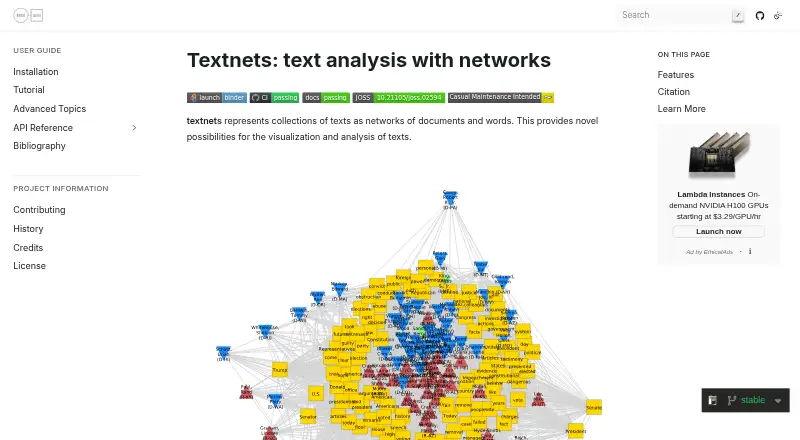
For researchers and developers working with document collections, textnets provides a Python package that represents texts as networks linking documents and terms. It is free GPLv3 open-source software designed for local, self-hosted use, with workflows suited to Jupyter notebooks and the Python scientific stack. Its audience is narrow but clear: people performing computational text analysis who want graph-based views of a corpus rather than a general-purpose text-analytics suite.
Its standout capability is the document–term network model. textnets tokenizes text, removes stop words, stems terms, filters punctuation, extracts n-grams and noun phrases, and applies TF-IDF weighting. Users can project bipartite graphs into document-only or term-only networks, then apply Leiden community detection, clustering, centrality measures such as degree, PageRank and BiRank, and network visualization. Graphs and textnets objects can also be saved and loaded. Integrations with spaCy, igraph and Jupyter support a Python-centered research workflow.
Choose textnets when network structure, term relationships and community patterns are central to the analysis. Installation is local through pip or Nix, and self-hosted deployment gives the user responsibility for the runtime environment. The trade-off is breadth: the package does not target sentiment analysis, entity extraction or broader text-analytics workflows. Teams seeking those capabilities, or support beyond documentation, should consider a more general platform. For solo researchers and small or mid-market technical teams comfortable with Python, textnets offers a focused toolkit; organizations wanting managed services or wider language-analysis coverage should look elsewhere.
Your product? Our editors can test textnets in depth and publish a review, labelled as paid · from $149/mo →
textnets pricing
textnets fact sheet
| Free plan | Yes |
|---|---|
| Paid from | Free |
| Sentiment analysis | Not verified |
| Entity extraction | Not verified |
| Intent detection | Not verified |
| Topic analysis | Yes |
| Analysis sources | Documents |
| Supported languages | Not verified |
| Deployment options | On_premise |
| Deployment | Self-hosted |
| Support | Docs |
| Built for | Solo, Small business, Mid-market (editorial estimate) |
| Integrations | 4 integrations: spaCy, igraph, Jupyter, Python scientific stack |
| Pricing | Free plan |
| Website | textnets.readthedocs.io |
| Facts checked | 24 Sep 2026 |
textnets integrations
textnets lists 4 integrations on its own site.
- spaCy
- igraph
- Jupyter
- Python scientific stack
Alternatives to textnets
- Brandwatch Consumer IntelligenceA broad conversation-analysis suite for organizations that need social and public-web insight.9.4
- spaCyA free developer toolkit for building and deploying custom NLP pipelines.9.2
- MAXQDAA broad desktop toolkit for research teams combining qualitative, text and statistical analysis.9.0



See all textnets alternatives →
Used textnets? Be the first to review it
The editor score above is our own research. What this page doesn't have yet is a reader's view — what you used textnets for, what worked and what didn't. No stars are seeded and no review is paid for; an editor reads every one before it appears.
Write a reviewTwo minutes · verified accounts only · read by an editor before it appears
Featured on iTechGuides

textnets is listed in our Text Analytics Software directory. Add the badge to your site — it links back to this page.
<a href="https://www.itechguides.com/products/textnets/"><img src="https://www.itechguides.com/best/badge/textnets.svg" alt="Featured on iTechGuides" width="230" height="46"></a>
Reviewed by iTechGuides Editors · Editorial team · Updated Oct 2026
Advertiser disclosure: iTechGuides is reader-supported. Vendors can pay for top positions in our rankings and for a place on other products' pages, and we may earn a commission when you click some links. Bought places stand at the number bought; this page and our disclosure say so. Paying vendors may get a fuller, more detailed review from our editors, and that review can change their score. How we rank.
Last updated · How we research and update