
Tesseract
Tesseract: A broad AI editor for remote, self-hosted, and multi-device agent workflows. Ranked #15 of 26 in AI Code Editors by our editors (8.0/10); pricing: Free plan; best for developers wanting remote and self-hosted AI editing.
At a glance
- Editor score8.0 / 10
- PricingFree plan
- Best forDevelopers wanting remote and self-hosted AI editing
- Free planYes
- Paid from$20/mo
- Agent modeYes
- Facts checked20 Sep 2026
Where it wins
- Supports Claude Code, OpenAI Codex, OpenCode, and Gemini CLI
- Combines editor, terminal, browser canvas, agents, voice, and viewers
- Runs across desktop, web, mobile, and self-hosted deployments
Where it doesn't
- Every tier requires your own agent login or subscription
- Free includes access to one machine
- Hosted web access is invite-only during early access
Our verdict on Tesseract
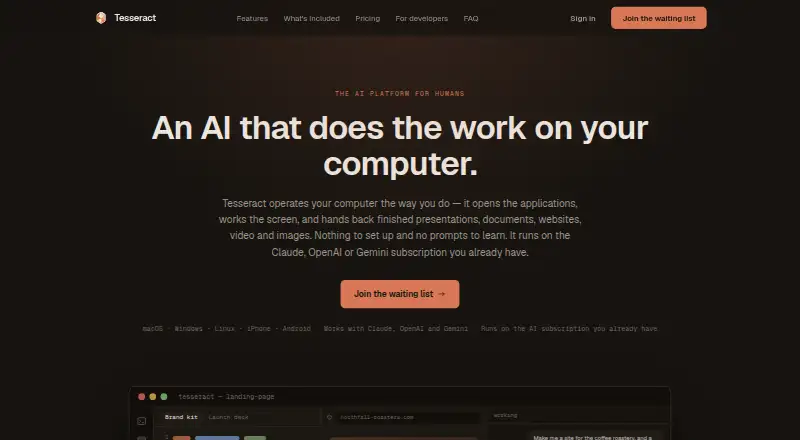
Tesseract is an AI-first integrated development environment for developers who want to work with coding agents across local, cloud, remote, and self-hosted environments. Its workspace combines a Monaco-based code editor, file tree, multi-pane tabs, integrated terminal, browser canvas, agent conversations, and review panels. Desktop apps support Windows, macOS, and Linux, while browser and mobile clients extend access to remote machines and agents. It is suited to developers who want one interface for coding, agent interaction, and remote control rather than a narrowly focused editor.
Pricing is structured around a free tier and paid collaboration features. Free includes unlimited agent usage, the full IDE, voice mode, mobile app, cloud workspace, and one machine. Pro costs $20 per month and adds unlimited machines, a managed always-on cloud server, deployment to a *.tesseract.dev URL, premium missions, settings sync, and email support. Team costs $40 per seat per month and adds team seats, shared workspaces, parallel agents, advanced browser automation, API access, SSO, audit logs, and centralized billing. Unlimited agent usage applies on every tier, but users bring their own agent login or subscription.
Tesseract’s main distinction is breadth across platforms and agent ecosystems. It supports Claude Code, OpenAI Codex, OpenCode, Gemini CLI, multiple voice providers, and MCP servers over stdio, HTTP, and SSE. The embedded browser canvas adds DOM inspection and visual editing, while built-in viewers cover documents, media, and data formats. Self-hosting is available through a Docker-based web stack, making the product relevant to teams that want deployment control. Choose Tesseract if remote access, multiple agents, voice, and self-hosting matter together. Developers seeking a simpler editor or an included AI subscription may prefer a narrower alternative.
Your product? Our editors can test Tesseract in depth and publish a review, labelled as paid · from $149/mo →
Tesseract pricing
All 3 Tesseract plans and prices →
Tesseract fact sheet
| Free plan | Yes |
|---|---|
| Paid from | $20/mo |
| Agent mode | Yes |
| Model choice | Multiple models |
| Codebase indexing | Not verified |
| Supported platforms | Not verified |
| Built-in terminal | Yes |
| Extensions support | Not verified |
| Included AI usage | Unlimited agent usage on every tier; users bring their own agent login or subscription |
| Deployment | Cloud, Self-hosted, Desktop, Mobile |
| Platforms | Web, Windows, macOS, Linux, iOS, Android |
| Support | Email, Community |
| Built for | Solo, Small business, Mid-market, Enterprise (editorial estimate) |
| Integrations | 8 integrations: Claude Code, OpenAI Codex, OpenCode, Gemini CLI, OpenAI voice, Google Gemini voice … |
| Pricing | Free plan (source) |
| Website | tesseract.dev |
| Facts checked | 20 Sep 2026 |
Tesseract integrations
Tesseract lists 8 integrations on its own site.
- Claude Code
- OpenAI Codex
- OpenCode
- Gemini CLI
- OpenAI voice
- Google Gemini voice
- ElevenLabs voice
- MCP servers
Alternatives to Tesseract
- ZedA capable open-source AI editor with native development tools and collaboration.9.4
- Devin DesktopA full desktop IDE for teams coordinating multiple coding agents.9.3
- Google Antigravity IDEA broad desktop IDE for developers who want AI agents operating across code, terminals, and browsers.9.2



See all Tesseract alternatives →
Used Tesseract? Be the first to review it
The editor score above is our own research. What this page doesn't have yet is a reader's view — what you used Tesseract for, what worked and what didn't. No stars are seeded and no review is paid for; an editor reads every one before it appears.
Write a reviewTwo minutes · verified accounts only · read by an editor before it appears
Featured on iTechGuides

Tesseract is listed in our AI Code Editors directory. Add the badge to your site — it links back to this page.
<a href="https://www.itechguides.com/products/tesseract/"><img src="https://www.itechguides.com/best/badge/tesseract.svg" alt="Featured on iTechGuides" width="230" height="46"></a>
Reviewed by iTechGuides Editors · Editorial team · Updated Oct 2026
Advertiser disclosure: iTechGuides is reader-supported. Vendors can pay for top positions in our rankings and for a place on other products' pages, and we may earn a commission when you click some links. Bought places stand at the number bought; this page and our disclosure say so. Paying vendors may get a fuller, more detailed review from our editors, and that review can change their score. How we rank.
Last updated · How we research and update