
Sidemantic
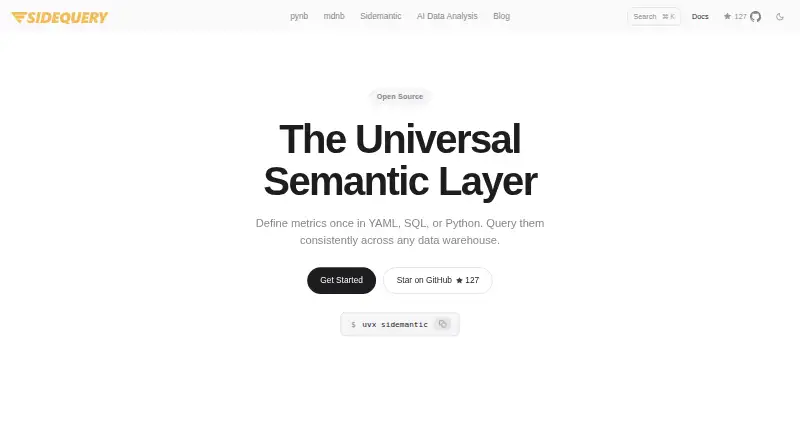
Sidemantic: A flexible, self-hosted semantic layer with broad query access and warehouse support. Ranked #19 of 28 in Semantic Layer Software by our editors (7.5/10); pricing: Open source; best for open-source semantic SQL and MCP workflows.
At a glance
- Editor score7.5 / 10
- PricingOpen source
- Best forOpen-source semantic SQL and MCP workflows
- Paid fromFree
- Governed metricsYes
- Facts checked20 Sep 2026
Where it wins
- Define models in YAML, SQL, or Python
- Automatic joins and symmetric aggregates support metric correctness
- Query through SQL, Python, CLI, MCP, REST, or Postgres wire protocol
Where it doesn't
- Self-hosted deployment requires teams to manage the operating environment
- Row-level security is not a documented capability
- The broad interface set may require added governance for consistent use
Our verdict on Sidemantic
Sidemantic is an open-source semantic layer for data teams defining reusable metrics, dimensions, relationships, and models across warehouses. It supports modeling in YAML, SQL, or Python, then translates semantic queries for systems such as DuckDB, Snowflake, BigQuery, Postgres, and ClickHouse. Its self-hosted and API deployment model suits teams that want control over their semantic SQL workflows, especially those building governed metrics or connecting analytical tools through MCP.
Its standout strength is the combination of model flexibility and query reach. Teams can import semantic models from 15+ supported formats, declare relationships for automatic join inference, and use symmetric aggregates to help prevent double-counting across one-to-many joins. Access is available through semantic SQL, a Python API, CLI, MCP server, REST API, or Postgres wire protocol. MCP tools add model discovery, querying, and chart generation, while adapters cover DuckDB, Snowflake, BigQuery, Postgres, ClickHouse, Databricks, Spark, MySQL, Trino, Redshift, and SQL Server.
Sidemantic is a strong fit for technically capable data teams that prefer open-source infrastructure, multiple modeling languages, and broad integration paths. The trade-off is operational and governance responsibility: self-hosting places more ownership on the adopting team, and row-level security is not a documented capability. Organizations that need a narrowly managed semantic service with established security controls should consider alternatives designed around those requirements. Teams prioritizing portable semantic definitions, SQL access, Python workflows, and MCP-based model interaction should find Sidemantic more aligned with their architecture.
Your product? Our editors can test Sidemantic in depth and publish a review, labelled as paid · from $149/mo →
Sidemantic pricing
Sidemantic fact sheet
| Free plan | Not verified |
|---|---|
| Paid from | Free |
| Governed metrics | Yes |
| Dimensions and joins | Yes |
| Row-level security | Not verified |
| Certified models | Not verified |
| Query API | Yes |
| Deployment model | Self_hosted |
| Deployment | Self-hosted |
| Support | Community, Docs |
| Built for | Solo, Small business, Mid-market, Enterprise (editorial estimate) |
| Integrations | 11 integrations: DuckDB, Snowflake, BigQuery, Postgres, ClickHouse, Databricks … |
| Pricing | Open source |
| Website | sidemantic.com |
| Facts checked | 20 Sep 2026 |
Sidemantic integrations
Sidemantic lists 11 integrations on its own site.
- DuckDB
- Snowflake
- BigQuery
- Postgres
- ClickHouse
- Databricks
- Spark
- MySQL
- Trino
- Redshift
- SQL Server
Alternatives to Sidemantic
- CubeA governed semantic layer for teams building internal and embedded analytics.9.4
- AtScaleA strong fit for enterprise teams standardizing governed metrics across BI and AI.9.3
- GoodDataA strong fit for teams building governed, embedded analytics across multiple data sources.9.1



See all Sidemantic alternatives →
Used Sidemantic? Be the first to review it
The editor score above is our own research. What this page doesn't have yet is a reader's view — what you used Sidemantic for, what worked and what didn't. No stars are seeded and no review is paid for; an editor reads every one before it appears.
Write a reviewTwo minutes · verified accounts only · read by an editor before it appears
Featured on iTechGuides

Sidemantic is listed in our Semantic Layer Software directory. Add the badge to your site — it links back to this page.
<a href="https://www.itechguides.com/products/sidemantic/"><img src="https://www.itechguides.com/best/badge/sidemantic.svg" alt="Featured on iTechGuides" width="230" height="46"></a>
Reviewed by iTechGuides Editors · Editorial team · Updated Oct 2026
Advertiser disclosure: iTechGuides is reader-supported. Vendors can pay for top positions in our rankings and for a place on other products' pages, and we may earn a commission when you click some links. Bought places stand at the number bought; this page and our disclosure say so. Paying vendors may get a fuller, more detailed review from our editors, and that review can change their score. How we rank.
Last updated · How we research and update