raid_recovery
raid_recovery: A focused, free Linux toolkit for reconstructing RAID5 disk images. Ranked #18 of 28 in RAID Data Recovery Software by our editors (7.7/10); pricing: Open source; best for free Linux RAID 5 image reconstruction.
At a glance
- Editor score7.7 / 10
- PricingOpen source
- Best forFree Linux RAID 5 image reconstruction
- Paid fromFree
- Virtual RAID builderYes
- Facts checked20 Sep 2026
Where it wins
- Detects RAID page sizes and member-disk ordering
- Checks parity and reconstructs RAID5 data
- Exposes recovered arrays through a virtual NBD drive
Where it doesn't
- Supports RAID5 only
- Runs on Linux with EXT4 filesystem support
- Requires command-line and low-level storage knowledge
Our verdict on raid_recovery
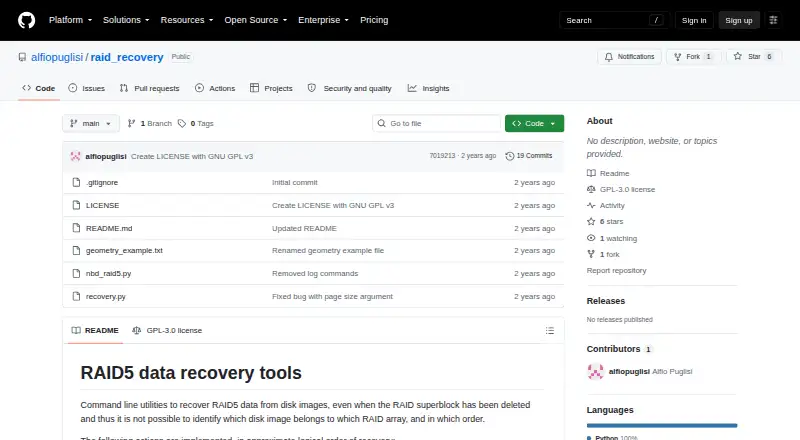
raid_recovery is an open-source set of command-line Python utilities for recovering RAID5 data from disk images. It is aimed at technically capable Linux users working with low-level storage tools, including cases where a RAID superblock has been deleted or member-disk ordering is unknown. The workflow centers on disk-image recovery rather than general-purpose file recovery, and its narrow scope makes it most relevant to specific RAID5 reconstruction tasks.
Its standout capability is the combination of detection, validation, ordering, and reconstruction tools. raid_recovery can detect RAID page sizes, identify disk images belonging to RAID5 arrays, check parity, determine image ordering, and reconstruct RAID5 data. It also supports split disk-image files, which fits workflows where array members are stored across separate image segments. The virtual RAID5 drive provided through an NBD plugin adds a practical Linux storage interface for working with a reconstructed array.
The trade-off is focus. raid_recovery supports RAID5, Linux, and EXT4, so it is not a broad RAID recovery suite for different array levels, operating systems, or filesystems. Its command-line Python approach also suits users comfortable with disk images and Linux storage tooling more than those seeking a guided graphical workflow. Choose it for free, open-source RAID5 image reconstruction on Linux; choose a broader recovery product when you need support beyond RAID5, EXT4, or this low-level workflow.
Your product? Our editors can test raid_recovery in depth and publish a review, labelled as paid · from $149/mo →
raid_recovery pricing
raid_recovery fact sheet
| Free plan | Not verified |
|---|---|
| Paid from | Free |
| Supported RAID levels | RAID5 |
| Virtual RAID builder | Yes |
| Disk-image recovery | Yes |
| Filesystem support | EXT4 |
| Supported platforms | Linux |
| Maximum drive count | Not verified |
| Deployment | Self-hosted |
| Platforms | Linux |
| Support | Docs |
| Built for | Solo, Small business (editorial estimate) |
| Pricing | Open source |
| Website | github.com |
| Facts checked | 20 Sep 2026 |
Alternatives to raid_recovery
- D-Recovery FusionA specialist platform for reconstructing complex RAID, NAS, and storage environments.9.4
- UFS ExplorerA broad professional recovery suite with dedicated RAID, NAS and forensic editions.9.3
- DiskInternals RAID RecoveryA broad Windows RAID recovery tool with virtual reconstruction and tiered export limits.9.2


See all raid_recovery alternatives →
Used raid_recovery? Be the first to review it
The editor score above is our own research. What this page doesn't have yet is a reader's view — what you used raid_recovery for, what worked and what didn't. No stars are seeded and no review is paid for; an editor reads every one before it appears.
Write a reviewTwo minutes · verified accounts only · read by an editor before it appears
Featured on iTechGuides

raid_recovery is listed in our RAID Data Recovery Software directory. Add the badge to your site — it links back to this page.
<a href="https://www.itechguides.com/products/raid-recovery/"><img src="https://www.itechguides.com/best/badge/raid-recovery.svg" alt="Featured on iTechGuides" width="230" height="46"></a>
Reviewed by iTechGuides Editors · Editorial team · Updated Oct 2026
Advertiser disclosure: iTechGuides is reader-supported. Vendors can pay for top positions in our rankings and for a place on other products' pages, and we may earn a commission when you click some links. Bought places stand at the number bought; this page and our disclosure say so. Paying vendors may get a fuller, more detailed review from our editors, and that review can change their score. How we rank.
Last updated · How we research and update