
Pulsar
Pulsar: A self-hosted monitoring stack for drift, performance metrics, dashboards, and alerts. Ranked #13 of 20 in Machine Learning Model Monitoring Software by our editors (7.6/10); pricing: Open source; best for engineers building a self-hosted monitoring stack.
At a glance
- Editor score7.6 / 10
- PricingOpen source
- Best forEngineers building a self-hosted monitoring stack
- Paid fromFree
- Drift monitoringYes
- Facts checked21 Sep 2026
Where it wins
- Collects production features, predictions, metadata, and model outputs
- Supports drift and classification or regression performance metrics
- Connects Grafana dashboards with scheduler-based standard and custom alerts
Where it doesn't
- Self-hosted deployment requires operational ownership
- Monitoring does not include documented data-quality or bias features
- Ground-truth updates depend on a feature store
Our verdict on Pulsar
Pulsar is open-source model performance and management software for monitoring machine learning models in production. It is designed for software engineers, data scientists, and machine learning engineers who need to collect model features, predictions, outputs, and metadata across historical and real-time data. The product is delivered through containerized services and open-source Python packages, making it a fit for teams building and operating their own monitoring environment rather than buyers seeking a fully managed service.
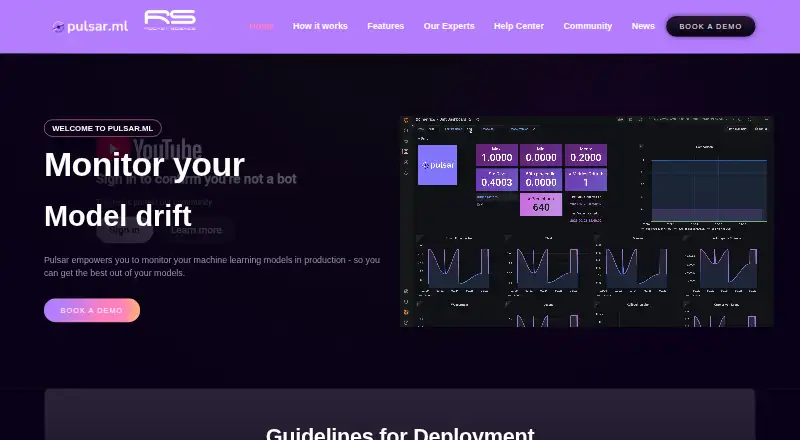
Its main strength is coverage across the monitoring workflow. Pulsar calculates data-drift metrics against baseline data and provides model performance metrics for both classification and regression. Teams can update ground truth through a feature store, visualize metrics in Grafana, and configure standard or custom alerts through a scheduler. The containerized data-ingestion service and SDK support production collection, while integrations with InfluxDB, AWS, Azure, Google Cloud, Flask, FastAPI, TensorFlow, and Seldon help it fit into varied model-serving and infrastructure setups.
Pulsar is most appropriate when self-hosting, open-source access, and control over the monitoring stack are priorities. Its focus is narrower than a broader model-governance suite: the published capabilities cover drift, performance, collection, visualization, and alerting, but do not include documented data-quality or bias monitoring. Teams should also account for the operational work associated with containerized services, storage, dashboards, scheduler configuration, and ground-truth workflows. Choose Pulsar for an engineer-led monitoring stack around production models; consider another product if managed operations or wider governance coverage is central to the buying decision.
Your product? Our editors can test Pulsar in depth and publish a review, labelled as paid · from $149/mo →
Pulsar pricing
Pulsar fact sheet
| Free plan | Not verified |
|---|---|
| Paid from | Free |
| Drift monitoring | Yes |
| Model performance metrics | Yes |
| Data quality checks | Not verified |
| Bias monitoring | Not verified |
| Alert channels | Not verified |
| Deployment options | Self-hosted |
| Included model limit | Not verified |
| Deployment | Self-hosted |
| Support | Community, Docs |
| Built for | Solo, Small business, Mid-market (editorial estimate) |
| Integrations | 9 integrations: InfluxDB, Grafana, AWS, Azure, Google Cloud, Flask … |
| Pricing | Open source |
| Website | pulsar.ml |
| Facts checked | 21 Sep 2026 |
Pulsar integrations
Pulsar lists 9 integrations on its own site.
- InfluxDB
- Grafana
- AWS
- Azure
- Google Cloud
- Flask
- FastAPI
- TensorFlow
- Seldon
Alternatives to Pulsar
- DeepchecksDeepchecks brings open-source validation and hosted monitoring into one ML quality workflow.9.3
- SUPERWISEBroad ML monitoring and governance from $10 per month, with production features on Business.9.1
- ArthurA flexible monitoring platform for teams that need fairness, drift, and explainability controls.8.9



Also Ranked In
Pulsar is ranked in 2 of our directories.
Used Pulsar? Be the first to review it
The editor score above is our own research. What this page doesn't have yet is a reader's view — what you used Pulsar for, what worked and what didn't. No stars are seeded and no review is paid for; an editor reads every one before it appears.
Write a reviewTwo minutes · verified accounts only · read by an editor before it appears
Featured on iTechGuides

Pulsar is listed in our Machine Learning Model Monitoring Software directory. Add the badge to your site — it links back to this page.
<a href="https://www.itechguides.com/products/pulsar-machine-learning-model-monitoring-software/"><img src="https://www.itechguides.com/best/badge/pulsar-machine-learning-model-monitoring-software.svg" alt="Featured on iTechGuides" width="230" height="46"></a>
Reviewed by iTechGuides Editors · Editorial team · Updated Oct 2026
Advertiser disclosure: iTechGuides is reader-supported. Vendors can pay for top positions in our rankings and for a place on other products' pages, and we may earn a commission when you click some links. Bought places stand at the number bought; this page and our disclosure say so. Paying vendors may get a fuller, more detailed review from our editors, and that review can change their score. How we rank.
Last updated · How we research and update