LLMSchema
LLMSchema: A focused open-source CLI for turning relational schemas into Markdown. Ranked #24 of 27 in Database Documentation Tools by our editors (6.7/10); pricing: Open source; best for CLI users producing Markdown schema files.
At a glance
- Editor score6.7 / 10
- PricingOpen source
- Best forCLI users producing Markdown schema files
- Paid fromFree
- Database coverageRelational
- Facts checked21 Sep 2026
Where it wins
- Documents tables, columns, types, indexes, constraints, and relationships
- Outputs one Markdown file or an overview plus per-table files
- Supports table filtering, CI, and migration-script integration
Where it doesn't
- Supports only PostgreSQL, MySQL, and SQLite
- Runs on macOS and Linux as a local CLI and Go library
- Does not provide a data dictionary
Our verdict on LLMSchema
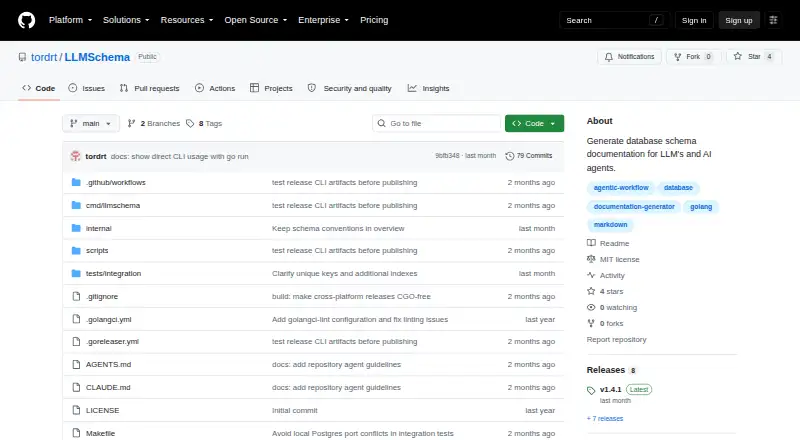
LLMSchema is an open-source command-line tool and Go library for turning relational database schemas into Markdown documentation for LLMs and AI coding agents. It is aimed at developers and teams working with development databases who want schema context in a format that can sit alongside code. The tool runs on macOS and Linux and connects to PostgreSQL, MySQL, and SQLite.
Its strongest feature is the level of schema detail in a compact output format. LLMSchema documents tables, columns, types, indexes, constraints, and relationships, then lets teams choose between a single Markdown schema document or an overview with one file per table. Table inclusion and exclusion filters, along with database schema selection, help keep generated documentation focused. CI and migration-script integration also make it suitable for workflows where schema documentation should be regenerated as database structure changes.
The trade-off is a deliberately narrow scope. LLMSchema focuses on relational schemas across three database engines and is delivered as a local CLI rather than a hosted documentation service. It does not provide a data dictionary, so teams that need broader cataloging or business glossary capabilities should consider another tool. LLMSchema is a good fit for CLI-oriented developers who want portable Markdown for AI-assisted coding, repositories, or migrations; it is less suitable for organizations seeking a broad, browser-based database documentation platform.
Your product? Our editors can test LLMSchema in depth and publish a review, labelled as paid · from $149/mo →
LLMSchema pricing
LLMSchema fact sheet
| Free plan | Not verified |
|---|---|
| Paid from | Free |
| Database coverage | Relational |
| Data lineage | Yes |
| Data dictionary | No |
| Schema history | Not verified |
| Deployment | Self_hosted |
| Single sign-on | Not verified |
| Deployment | Self-hosted |
| Platforms | macOS, Linux |
| Support | Docs |
| Built for | Solo, Small business (editorial estimate) |
| Pricing | Open source |
| Website | github.com |
| Facts checked | 21 Sep 2026 |
Alternatives to LLMSchema
- DataedoA broad, governed data catalog with strong lineage and quality coverage at a high annual price.9.4
- AzimuttA broad toolkit for exploring, analyzing, designing, and documenting large mixed-model schemas.9.2
- SchemaCrawlerA free, open-source choice for automated relational database documentation and analysis.9.0



See all LLMSchema alternatives →
Used LLMSchema? Be the first to review it
The editor score above is our own research. What this page doesn't have yet is a reader's view — what you used LLMSchema for, what worked and what didn't. No stars are seeded and no review is paid for; an editor reads every one before it appears.
Write a reviewTwo minutes · verified accounts only · read by an editor before it appears
Featured on iTechGuides

LLMSchema is listed in our Database Documentation Tools directory. Add the badge to your site — it links back to this page.
<a href="https://www.itechguides.com/products/llmschema/"><img src="https://www.itechguides.com/best/badge/llmschema.svg" alt="Featured on iTechGuides" width="230" height="46"></a>
Reviewed by iTechGuides Editors · Editorial team · Updated Oct 2026
Advertiser disclosure: iTechGuides is reader-supported. Vendors can pay for top positions in our rankings and for a place on other products' pages, and we may earn a commission when you click some links. Bought places stand at the number bought; this page and our disclosure say so. Paying vendors may get a fuller, more detailed review from our editors, and that review can change their score. How we rank.
Last updated · How we research and update