Linux Virtual Server
Linux Virtual Server: A focused, kernel-level Layer 4 balancer for self-managed Linux clusters. Ranked #24 of 31 in Load Balancing Software by our editors (6.9/10); pricing: Free plan; best for linux kernel-level Layer 4 balancing.
At a glance
- Editor score6.9 / 10
- PricingFree plan
- Best forLinux kernel-level Layer 4 balancing
- Free planYes
- Paid fromNone
- Layer 7 routingYes
- Facts checked20 Sep 2026
Where it wins
- Supports TCP and UDP service distribution
- Offers NAT, IP tunneling, and direct-routing methods
- Provides scheduling algorithms and connection-state synchronization
Where it doesn't
- Linux-only platform support
- Layer 7 routing is limited to KTCPVS
- TLS coverage is limited
Our verdict on Linux Virtual Server
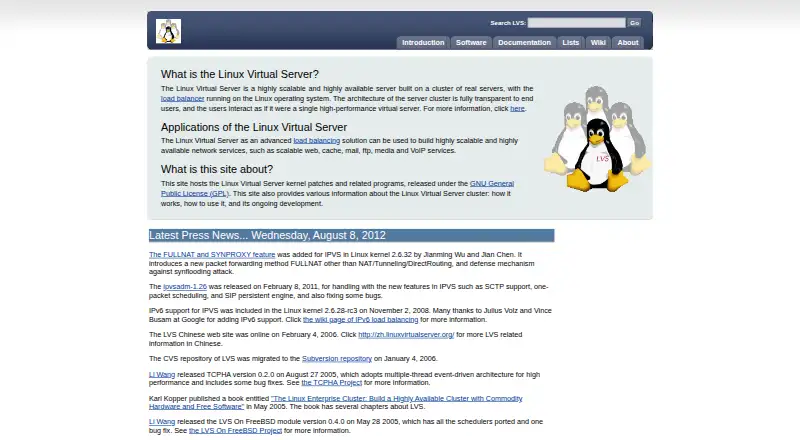
Linux Virtual Server (LVS) is an open-source load-balancing framework for Linux clusters. Its IPVS component operates inside the Linux kernel and distributes TCP and UDP services across real servers through virtual service addresses. It suits operators building highly available network services from self-managed Linux servers, especially when kernel-level Layer 4 balancing is the primary requirement.
LVS offers several ways to shape traffic flow without limiting deployments to one forwarding model. NAT, IP tunneling, and direct routing are supported, while multiple connection-scheduling algorithms provide options for distributing services across real servers. Virtual services can be presented through a single IP address, and connection-state synchronization helps coordinate load balancers. Administration is handled through the ipvsadm utility, keeping the operating model centered on Linux networking tools.
The product’s scope is deliberately focused. IPVS covers Layer 4 balancing for TCP and UDP inside the kernel, while application-level balancing is documented through KTCPVS. Layer 7 routing and TLS coverage are limited, so teams that need broader application-aware routing or more extensive TLS handling should choose another product. LVS is a strong fit for Linux operators who want open-source, self-managed traffic distribution with flexible forwarding and scheduling options; it is less suitable for teams seeking a broader platform with deeper Layer 7 capabilities.
Linux Virtual Server pricing
Linux Virtual Server fact sheet
| Free plan | Yes |
|---|---|
| Paid from | None |
| Managed service | Not verified |
| Layer 7 routing | Yes |
| Layer 4 routing | Yes |
| Global traffic management | Not verified |
| TLS termination | Not verified |
| Backend limit | Not verified |
| Deployment | Self-hosted |
| Platforms | Linux |
| Support | Docs |
| Built for | Small business, Mid-market, Enterprise (editorial estimate) |
| Pricing | Free plan |
| Website | linuxvirtualserver.org |
| Facts checked | 20 Sep 2026 |
Alternatives to Linux Virtual Server
- AWS Elastic Load BalancingBroad Layer 4 and Layer 7 load balancing for AWS production environments.9.3
- Google Cloud Load BalancingA managed load balancer for global, regional, Layer 4, and Layer 7 traffic.9.2
- Alibaba Cloud Server Load BalancerA broad Alibaba Cloud balancing service with Layer 4/7 routing and a low published entry price.9.1



See all Linux Virtual Server alternatives →
Used Linux Virtual Server? Be the first to review it
The editor score above is our own research. What this page doesn't have yet is a reader's view — what you used Linux Virtual Server for, what worked and what didn't. No stars are seeded and no review is paid for; an editor reads every one before it appears.
Write a reviewTwo minutes · verified accounts only · read by an editor before it appears
Featured on iTechGuides

Linux Virtual Server is listed in our Load Balancing Software directory. Add the badge to your site — it links back to this page.
<a href="https://www.itechguides.com/products/linux-virtual-server/"><img src="https://www.itechguides.com/best/badge/linux-virtual-server.svg" alt="Featured on iTechGuides" width="230" height="46"></a>
Reviewed by iTechGuides Editors · Editorial team · Updated Oct 2026
Advertiser disclosure: iTechGuides is reader-supported. We may earn a commission when you click some links. How we rank.
Last updated · How we research and update