
Kunobi
Kunobi: A cross-platform Kubernetes GUI with local clusters, GitOps workflows, and a free starting plan. Ranked #13 of 23 in Local Kubernetes Tools by our editors (8.2/10); pricing: Free plan · 7-day trial; best for GUI users needing local and GitOps workflows.
At a glance
- Editor score8.2 / 10
- PricingFree plan · 7-day trial
- Best forGUI users needing local and GitOps workflows
- Free planYes
- Paid from$12/mo
- Multi-node clustersYes
- Facts checked20 Sep 2026
Where it wins
- Free plan includes kind clusters, GitOps integrations, and resource operations
- Runs on macOS, Windows, and Linux with multi-context support
- Combines Helm, logs, shells, port forwarding, and MCP access
Where it doesn't
- Free plan supports up to 3 clusters simultaneously
- Advanced observability and cloud integrations require Pro
- Enterprise identity and onboarding features require the Enterprise plan
Our verdict on Kunobi
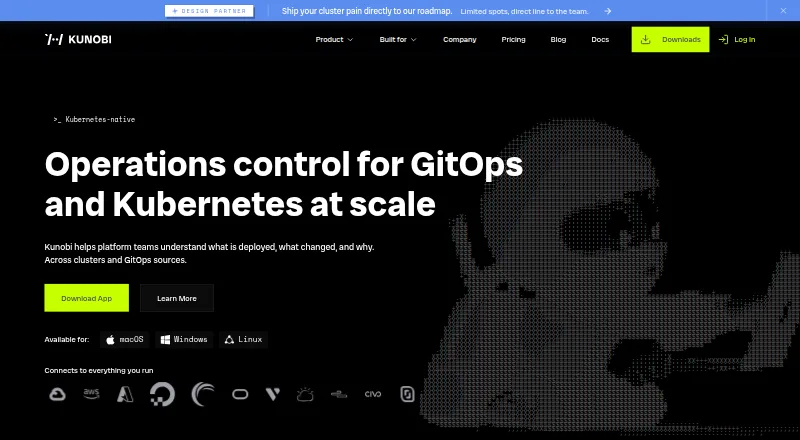
Kunobi is a desktop application for platform and DevOps engineers who manage Kubernetes clusters and GitOps workflows. It runs on macOS, Windows, and Linux, reads existing kubeconfig contexts, and can create local Kubernetes clusters with kind. Its graphical interface covers resource visualization and operations, including editing, scaling, restarting, rolling back, cordoning, draining, and deleting resources. It also supports logs, shells, port forwarding, Helm chart management, Flux, Argo CD, and an MCP server for exposing cluster context to external AI clients.
The free plan is a practical entry point: it requires no account or sign-up, supports up to 3 clusters simultaneously, and includes Kubernetes resource visualization, Flux and Argo CD integration, Helm chart visualization and management, and community support. Pro costs $12 per month when billed monthly and adds unlimited connected clusters, EKS, GKE, AKS, and other integrations, cross-cluster tail logs, PromQL queries, metrics exploration, AI cluster actions with approval controls, and direct Slack and priority GitHub issue responses. Enterprise adds SAML SSO, SCIM provisioning, priority support, account management, live onboarding, unified billing, usage analytics, and custom extensions and branding.
Kunobi’s strongest fit is for teams that want a desktop workflow spanning local development, multiple Kubernetes contexts, and GitOps operations without giving up direct resource controls. Selectable Kubernetes versions and Docker runtime support suit local cluster work, while Flux, Argo CD, and Helm keep deployment workflows visible in one interface. Choose Pro when broader cluster connectivity, observability features, and higher-touch support matter. Choose Enterprise for centralized identity, onboarding, billing, and account management. Teams seeking only a lightweight local cluster launcher may find Kunobi’s wider operational scope unnecessary.
Your product? Our editors can test Kunobi in depth and publish a review, labelled as paid · from $149/mo →
Kunobi pricing
All 3 Kunobi plans and prices →
Kunobi fact sheet
| Free plan | Yes |
|---|---|
| Paid from | $12/mo |
| Supported operating systems | macOS, Windows, Linux |
| Multi-node clusters | Yes |
| Graphical interface | Yes |
| Container runtime options | Docker |
| Kubernetes version control | Selectable Kubernetes version; documentation shows v1.32.8 |
| Local registry support | Not verified |
| Add-on catalog | Yes |
| Free trial | 7 days |
| Deployment | Desktop |
| Platforms | macOS, Windows, Linux |
| Compliance & security | SSO/SAML |
| Support | Live chat, Community, Docs |
| Built for | Solo, Small business, Mid-market, Enterprise (editorial estimate) |
| Integrations | 7 integrations: Flux, Argo CD, Helm, EKS, GKE, AKS … |
| Pricing | Free plan · 7-day trial (source) |
| Website | kunobi.com |
| Facts checked | 20 Sep 2026 |
Kunobi integrations
Kunobi lists 7 integrations on its own site.
- Flux
- Argo CD
- Helm
- EKS
- GKE
- AKS
- MCP
Alternatives to Kunobi
- Rancher DesktopA free, open-source GUI for cross-platform single-node k3s development clusters.9.4
- MinikubeA flexible, free way to create single- or multi-node Kubernetes clusters locally.9.3
- k3dAn open-source local k3s tool for Docker-based single- and multi-node clusters.9.2


Used Kunobi? Be the first to review it
The editor score above is our own research. What this page doesn't have yet is a reader's view — what you used Kunobi for, what worked and what didn't. No stars are seeded and no review is paid for; an editor reads every one before it appears.
Write a reviewTwo minutes · verified accounts only · read by an editor before it appears
Featured on iTechGuides

Kunobi is listed in our Local Kubernetes Tools directory. Add the badge to your site — it links back to this page.
<a href="https://www.itechguides.com/products/kunobi/"><img src="https://www.itechguides.com/best/badge/kunobi.svg" alt="Featured on iTechGuides" width="230" height="46"></a>
Reviewed by iTechGuides Editors · Editorial team · Updated Oct 2026
Advertiser disclosure: iTechGuides is reader-supported. Vendors can pay for top positions in our rankings and for a place on other products' pages, and we may earn a commission when you click some links. Bought places stand at the number bought; this page and our disclosure say so. Paying vendors may get a fuller, more detailed review from our editors, and that review can change their score. How we rank.
Last updated · How we research and update