kpack
kpack: A focused open-source choice for declarative Cloud Native Buildpacks workflows on Kubernetes. Ranked #20 of 34 in Container Build Tools by our editors (7.1/10); pricing: Open source; best for kubernetes-managed buildpack rebuilds.
At a glance
- Editor score7.1 / 10
- PricingOpen source
- Best forKubernetes-managed buildpack rebuilds
- Paid fromFree
- Build methodDaemonless
- Facts checked20 Sep 2026
Where it wins
- Declarative Builder, Image, and Build resources
- Git, blob, and OCI registry inputs with multiple cache types
- Optional cosign signing and SLSA build provenance
Where it doesn't
- Requires a Kubernetes environment to operate
- Self-hosted deployment requires platform ownership
- Focused on Cloud Native Buildpacks workflows
Our verdict on kpack
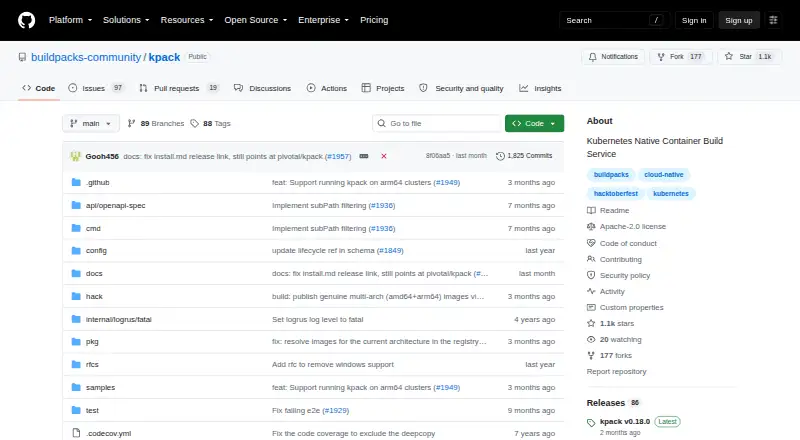
kpack is an open-source, Kubernetes-native container build service for teams running Cloud Native Buildpacks in Kubernetes clusters. Its declarative Builder, Image, and Build resources define buildpack order, operating-system stacks, image sources, registries, caches, and individual builds. Image resources can schedule rebuilds when source code, buildpacks, or stacks change, while Build resources support manually triggered, single Cloud Native Buildpacks builds. It is intended for organizations that want Kubernetes-managed OCI image builds rather than a hosted container build service.
The strongest fit is its Kubernetes and Cloud Native Buildpacks integration. kpack supports Git, blob, and OCI registry source inputs, with Kubernetes Secret-based credentials for registry, Git, SSH, and blob access. It can publish OCI images to container registries and use either registry-backed or persistent-volume build caches. That combination supports teams standardizing build configuration and rebuild behavior through Kubernetes resources. The platform fit is deliberately focused, however: teams not already operating Kubernetes or not using Cloud Native Buildpacks should consider a different container build approach.
Security and supply-chain controls are another important part of the product. kpack supports optional cosign image signing and SLSA build provenance, alongside credential management through Kubernetes Secrets. Its daemonless build method and multiple cache types suit cluster-based build operations, while the Builder, Image, and Build resource model separates recurring image maintenance from one-off builds. Choose kpack when declarative, Kubernetes-managed buildpack rebuilds are the priority. Choose an alternative when you need a broader self-hosted build platform beyond Cloud Native Buildpacks or a hosted service managed outside your Kubernetes environment.
Your product? Our editors can test kpack in depth and publish a review, labelled as paid · from $149/mo →
kpack pricing
kpack fact sheet
| Free plan | Not verified |
|---|---|
| Paid from | Free |
| Build method | Daemonless |
| Multi-architecture builds | Not verified |
| Build cache backends | Multiple |
| SBOM generation | Not verified |
| Build secret handling | Not verified |
| Concurrent builds | Not verified |
| Deployment | Self-hosted |
| Support | Community, Docs |
| Built for | Mid-market, Enterprise (editorial estimate) |
| Integrations | 4 integrations: Kubernetes, Cloud Native Buildpacks, OCI/container registries, GitHub |
| Pricing | Open source |
| Website | github.com |
| Facts checked | 20 Sep 2026 |
kpack integrations
kpack lists 4 integrations on its own site.
- Kubernetes
- Cloud Native Buildpacks
- OCI/container registries
- GitHub
Alternatives to kpack
- BuildKitA flexible, open-source builder for concurrent, cached, multi-platform container builds.9.4
- Docker BuildxA free BuildKit interface for multi-platform, cached, and attested image builds.9.3
- BuildahA free, daemonless Linux tool for building and managing container images.8.9


Used kpack? Be the first to review it
The editor score above is our own research. What this page doesn't have yet is a reader's view — what you used kpack for, what worked and what didn't. No stars are seeded and no review is paid for; an editor reads every one before it appears.
Write a reviewTwo minutes · verified accounts only · read by an editor before it appears
Featured on iTechGuides

kpack is listed in our Container Build Tools directory. Add the badge to your site — it links back to this page.
<a href="https://www.itechguides.com/products/kpack/"><img src="https://www.itechguides.com/best/badge/kpack.svg" alt="Featured on iTechGuides" width="230" height="46"></a>
Reviewed by iTechGuides Editors · Editorial team · Updated Oct 2026
Advertiser disclosure: iTechGuides is reader-supported. Vendors can pay for top positions in our rankings and for a place on other products' pages, and we may earn a commission when you click some links. Bought places stand at the number bought; this page and our disclosure say so. Paying vendors may get a fuller, more detailed review from our editors, and that review can change their score. How we rank.
Last updated · How we research and update