
HPCC Systems
HPCC Systems: A broad open-source data lake platform for distributed processing, queries, governance, and machine learning. Ranked #4 of 19 in Data Lake Software by our editors (8.7/10); pricing: Free plan; best for open-source analytics data lakes.
At a glance
- Editor score8.7 / 10
- PricingFree plan
- Best forOpen-source analytics data lakes
- Free planYes
- Paid fromFree
- Deployment modelHybrid
- Founded2000 · Atlanta metropolitan area, Georgia, United States
- Facts checked22 Sep 2026
Where it wins
- Free open-source deployment with distributed ingestion and query engines
- Replication, failover, Kubernetes, and hybrid cloud deployment support
- Machine learning, SQL, APIs, governance, and workflow capabilities
Where it doesn't
- ECL adds a platform-specific programming language to the learning curve
- The broad feature set may exceed the needs of narrow data lake projects
- Open table format workflows are not a stated focus
Our verdict on HPCC Systems
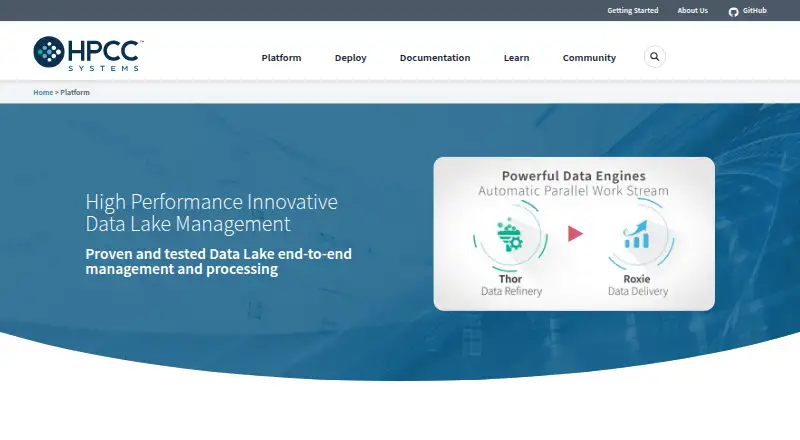
HPCC Systems is an open-source platform for enterprise data engineering, data lake management, analytics, and machine learning. It suits teams that need distributed ingestion, transformation, enrichment, indexing, querying, and information delivery across self-hosted or hybrid environments. Thor handles distributed data processing, while Roxie supports concurrent query and information delivery services. Developers can work in the declarative ECL language, with SQL access through JDBC and WsSQL for teams that prefer a more familiar query interface.
Its open-source model provides free deployment, with support for web, Linux, APIs, and self-hosted environments. The platform covers both ingestion modes, distributed storage with replication and failover, metadata catalog capabilities, governance controls, and data sharing. Kubernetes-based containerized deployment adds an option for teams standardizing on container orchestration, while integrations with AWS S3 and Azure Blob Storage support cloud object storage. The published feature set also includes a parallel machine learning library, making HPCC Systems a fit for organizations that want analytics and machine learning in the same data platform.
HPCC Systems has a wide ecosystem footprint through Apache Spark, Pentaho Data Integration, R, VS Code, REST, SOAP, XML, HTTP/HTTPS, and JSON interfaces. Tombolo provides data lake workflow documentation and governance, which helps address operational organization beyond processing and querying. The trade-off is breadth: teams must accommodate ECL and a multi-engine architecture, and open table format workflows are not a stated focus. Choose HPCC Systems for open-source, high-performance data lake processing with governance and machine learning; consider a narrower alternative if simplicity or a specific table format is the primary requirement.
Your product? Our editors can test HPCC Systems in depth and publish a review, labelled as paid · from $149/mo →
HPCC Systems pricing
HPCC Systems fact sheet
| Free plan | Yes |
|---|---|
| Paid from | Free |
| Deployment model | Hybrid |
| Ingestion modes | Both |
| Metadata catalog | Yes |
| Governance controls | Yes |
| Query interface | Both |
| Open table formats | Not verified |
| Data sharing | Yes |
| Deployment | Cloud, Self-hosted |
| Platforms | Web, Linux |
| Support | Email, Community, Docs |
| Built for | Mid-market, Enterprise (editorial estimate) |
| Integrations | 6 integrations: Apache Spark, Pentaho Data Integration, R, VS Code, AWS S3, Azure Blob Storage See all → |
| Pricing | Free plan |
| Website | hpccsystems.com |
| Facts checked | 22 Sep 2026 |
HPCC Systems integrations
HPCC Systems lists 6 integrations on its own site.
- Apache Spark
- Pentaho Data Integration
- R
- VS Code
- AWS S3
- Azure Blob Storage
See all HPCC Systems integrations →
Alternatives to HPCC Systems
- AWS Lake FormationA deep AWS-native governance layer for organizations building managed data lakes on Amazon S3.9.4
- Cloudera Data Lake ServiceA mature hybrid data lake service for enterprises needing governance, lineage, and Iceberg support.9.1
- Baidu EasyDAPA broad governed data platform for multi-source batch, streaming, SQL, and data services.8.9



See all HPCC Systems alternatives →
HPCC Systems vs the competition
- HPCC Systems vs AWS Lake Formation
- HPCC Systems vs Cloudera Data Lake Service
- HPCC Systems vs Baidu EasyDAP
- HPCC Systems vs Unilake
- HPCC Systems vs lakeFS
- HPCC Systems vs Qubole



Compare HPCC Systems with any tool side by side →
Used HPCC Systems? Be the first to review it
The editor score above is our own research. What this page doesn't have yet is a reader's view — what you used HPCC Systems for, what worked and what didn't. No stars are seeded and no review is paid for; an editor reads every one before it appears.
Write a reviewTwo minutes · verified accounts only · read by an editor before it appears
Featured on iTechGuides

HPCC Systems is listed in our Data Lake Software directory. Add the badge to your site — it links back to this page.
<a href="https://www.itechguides.com/products/hpcc-systems/"><img src="https://www.itechguides.com/best/badge/hpcc-systems.svg" alt="Featured on iTechGuides" width="230" height="46"></a>
Reviewed by iTechGuides Editors · Editorial team · Updated Oct 2026
Advertiser disclosure: iTechGuides is reader-supported. Vendors can pay for top positions in our rankings and for a place on other products' pages, and we may earn a commission when you click some links. Bought places stand at the number bought; this page and our disclosure say so. Paying vendors may get a fuller, more detailed review from our editors, and that review can change their score. How we rank.
Last updated · How we research and update