Hibari
Hibari: An Erlang-based store for ordered keys, chain replication, and bounded atomic transactions. Ranked #27 of 31 in Key-Value Databases by our editors (6.8/10); pricing: Free plan; best for erlang teams needing strongly consistent distributed storage.
At a glance
- Editor score6.8 / 10
- PricingFree plan
- Best forErlang teams needing strongly consistent distributed storage
- Free planYes
- Paid fromFree
- Deployment modelSelf_hosted
- Founded2005
- Facts checked24 Sep 2026
Where it wins
- Chain replication provides strong consistency across storage nodes.
- Supports per-key TTL, custom metadata, and timestamp-based compare-and-swap.
- Automatic failover, repair, and rebalancing as cluster size changes.
Where it doesn't
- Self-hosted deployment puts cluster operations in the team's hands.
- The documentation describes practical value blobs as limited to “16MB or so.”
- The published guide is dated 2015, leaving current maintenance unclear.
Our verdict on Hibari
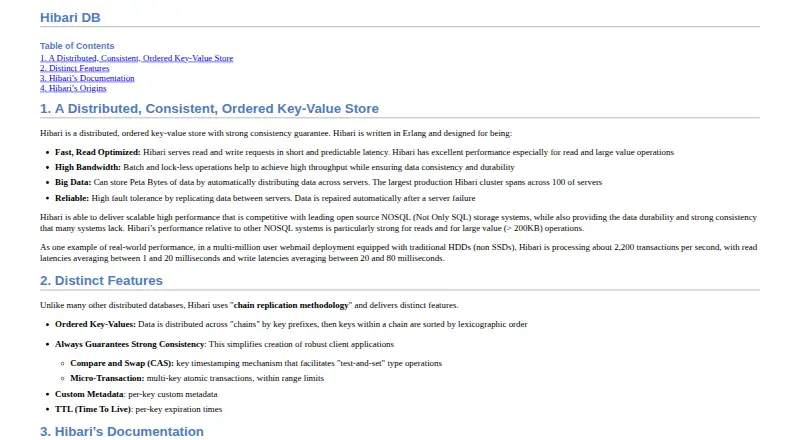
Hibari is an open-source distributed key-value store written in Erlang, aimed at teams building data-intensive services such as messaging, social media, or archiving. It distributes data across storage nodes with chain replication and is designed for strong consistency. Its ordered keys and native Erlang API make it a natural fit for Erlang teams that need distributed storage behavior rather than a managed database service.
The feature set extends beyond basic reads and writes: keys can have expiration times and custom metadata, compare-and-swap uses key timestamps, and bounded multi-key transactions provide atomic updates across a limited set of keys. Ordered multi-key reads are also described. For values, tables can use RAM-plus-disk or disk-only storage, while keys and metadata remain in RAM. The guide describes practical value blobs as limited to “16MB or so,” so applications with larger values should assess that constraint carefully.
Hibari is self-hosted on Linux and open source, with no paid tier described. It includes automatic replication, failover, repair, and rebalancing as cluster size changes, which may suit teams prepared to operate storage themselves. Client protocol options include UBF, EBF, JSON over TCP (JSF), HTTP (JSON-RPC), and Thrift, alongside the native Erlang API. The official guide is dated 2015, so teams choosing it should weigh that documentation age when assessing ongoing maintenance and operational support. It suits Erlang-centric teams with a strong consistency requirement; teams seeking managed hosting or current support assurances should consider alternatives.
Your product? Our editors can test Hibari in depth and publish a review, labelled as paid · from $149/mo →
Hibari pricing
Hibari fact sheet
| Free plan | Yes |
|---|---|
| Paid from | Free |
| Deployment model | Self_hosted |
| Maximum value size | Not verified |
| Persistence modes | Both |
| TTL support | Yes |
| Clustering support | Yes |
| Multi-region support | Not verified |
| Supported protocols | UBF, EBF, JSON over TCP (JSF), HTTP (JSON-RPC), Thrift |
| Deployment | Self-hosted |
| Platforms | Linux |
| Support | Docs |
| Built for | Small business, Mid-market, Enterprise (editorial estimate) |
| Pricing | Free plan |
| Website | hibari.github.io |
| Facts checked | 24 Sep 2026 |
Alternatives to Hibari
- Amazon DynamoDBA mature AWS database for scalable key-value and document workloads.9.3
- Aerospike DatabaseA strong fit for high-scale, consistency-sensitive workloads across hybrid environments.9.1
- Google Cloud BigtableA scalable Bigtable service for analytical workloads, with broad integrations and usage-based pricing.9.0



Used Hibari? Be the first to review it
The editor score above is our own research. What this page doesn't have yet is a reader's view — what you used Hibari for, what worked and what didn't. No stars are seeded and no review is paid for; an editor reads every one before it appears.
Write a reviewTwo minutes · verified accounts only · read by an editor before it appears
Featured on iTechGuides

Hibari is listed in our Key-Value Databases directory. Add the badge to your site — it links back to this page.
<a href="https://www.itechguides.com/products/hibari/"><img src="https://www.itechguides.com/best/badge/hibari.svg" alt="Featured on iTechGuides" width="230" height="46"></a>
Reviewed by iTechGuides Editors · Editorial team · Updated Oct 2026
Advertiser disclosure: iTechGuides is reader-supported. Vendors can pay for top positions in our rankings and for a place on other products' pages, and we may earn a commission when you click some links. Bought places stand at the number bought; this page and our disclosure say so. Paying vendors may get a fuller, more detailed review from our editors, and that review can change their score. How we rank.
Last updated · How we research and update