FFSB
FFSB: A flexible Linux benchmark for tailored filesystem workloads and syscall latency analysis. Ranked #13 of 29 in Disk Benchmark Software by our editors (7.0/10); pricing: Free plan; best for linux filesystem aging and workload tests.
At a glance
- Editor score7.0 / 10
- PricingFree plan
- Best forLinux filesystem aging and workload tests
- Free planYes
- Paid fromFree
- Random I/O testsYes
- Facts checked20 Sep 2026
Where it wins
- Custom multithreaded profiles with varied operation mixes
- Tests random, sequential, and multi-filesystem workloads
- Reports system-call latency statistics
Where it doesn't
- Command-line only, with local build and execution requirements
- Listed project update dates back to 2013
- Latest downloadable release is ffsb-6.0-rc2 from 2008
Our verdict on FFSB
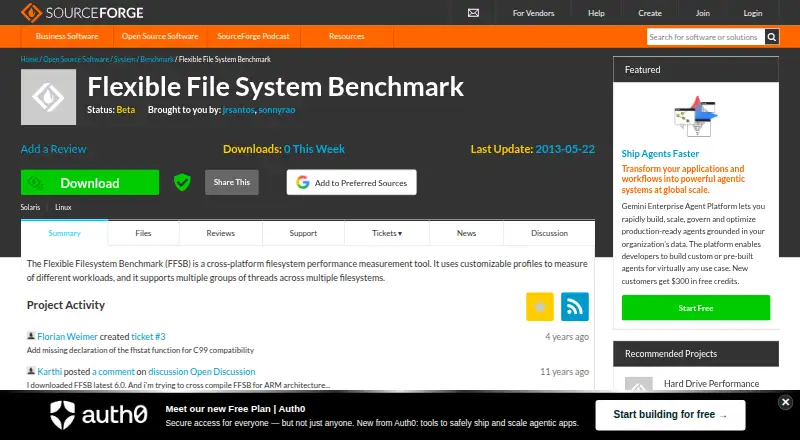
FFSB, or Flexible File System Benchmark, is an open-source command-line tool for measuring filesystem performance. It is aimed at developers, IT teams, and system administrators who need to define workload behavior rather than run a single fixed test. Profiles can combine multiple thread groups, operation mixes, filesystems, and access patterns, making FFSB particularly suited to Linux filesystem aging and workload-focused investigations.
Its main strength is workload depth. FFSB supports sequential and randomized reads and writes, file creation and deletion, metadata operations, appends, and synchronization-related operations. Users can age a filesystem before benchmarking, then examine system-call latency statistics alongside throughput-oriented workload results. That combination makes it useful when a benchmark needs to reflect concurrent activity or changing filesystem conditions instead of treating storage as one undifferentiated read or write test.
The trade-off is operational and project-related. FFSB is distributed as a command-line program intended to be built and run locally on supported Unix-like systems, so it favors technical teams comfortable with shell-based workflows and custom configuration. The listed project update is from 2013, the latest downloadable release is ffsb-6.0-rc2 from 2008, and a GitHub fork describes the original project as apparently dead. Choose FFSB when customizable workloads, filesystem aging, and syscall latency matter most; choose an alternative when current project activity or a more guided interface is a priority.
Your product? Our editors can test FFSB in depth and publish a review, labelled as paid · from $149/mo →
FFSB pricing
FFSB fact sheet
| Free plan | Yes |
|---|---|
| Paid from | Free |
| Random I/O tests | Yes |
| Sequential tests | Yes |
| IOPS measurement | Not verified |
| Latency measurement | Yes |
| Supported platforms | BSD, IBM AIX, Linux, Solaris |
| Command-line interface | Yes |
| Deployment | Self-hosted |
| Platforms | Linux |
| Built for | Small business, Mid-market, Enterprise (editorial estimate) |
| Pricing | Free plan |
| Website | sourceforge.net |
| Facts checked | 20 Sep 2026 |
Alternatives to FFSB
- CrystalDiskMarkA configurable Windows disk benchmark with detailed speed, IOPS, and latency results.9.0
- fioA free, open-source benchmark for detailed storage and filesystem performance analysis.8.8
- HD Tune ProA capable Windows drive benchmark and diagnostic utility with a one-time license.8.5

Used FFSB? Be the first to review it
The editor score above is our own research. What this page doesn't have yet is a reader's view — what you used FFSB for, what worked and what didn't. No stars are seeded and no review is paid for; an editor reads every one before it appears.
Write a reviewTwo minutes · verified accounts only · read by an editor before it appears
Featured on iTechGuides

FFSB is listed in our Disk Benchmark Software directory. Add the badge to your site — it links back to this page.
<a href="https://www.itechguides.com/products/ffsb/"><img src="https://www.itechguides.com/best/badge/ffsb.svg" alt="Featured on iTechGuides" width="230" height="46"></a>
Reviewed by iTechGuides Editors · Editorial team · Updated Oct 2026
Advertiser disclosure: iTechGuides is reader-supported. Vendors can pay for top positions in our rankings and for a place on other products' pages, and we may earn a commission when you click some links. Bought places stand at the number bought; this page and our disclosure say so. Paying vendors may get a fuller, more detailed review from our editors, and that review can change their score. How we rank.
Last updated · How we research and update