
Datadog Test Optimization
Datadog Test Optimization: A focused Datadog option for detecting, governing, and investigating flaky CI tests. Ranked #6 of 31 in Test Flakiness Management Software by our editors (8.7/10); pricing: 14-day trial; best for datadog users needing affordable flake controls.
At a glance
- Editor score8.7 / 10
- Pricing14-day trial
- Best forDatadog users needing affordable flake controls
- Free planNo
- Paid from$20/user/mo
- Quarantine workflowYes
- Founded2010 · New York City, New York, USA
- Facts checked22 Sep 2026
Where it wins
- Automatic detection, quarantine policies, retries, and early flake detection
- Traces, stack traces, and Test Impact Analysis support failure investigation
- Integrates with Jira, GitHub, GitLab, and Azure DevOps
Where it doesn't
- There is no free plan for teams wanting a no-cost starting point
- Annual pricing is tied to active Git committers
- Monthly on-demand pricing is higher at $29 per committer
Our verdict on Datadog Test Optimization
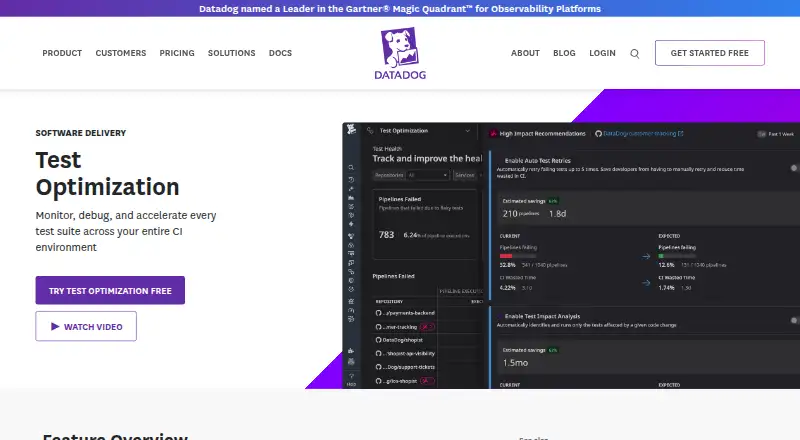
Datadog Test Optimization is a CI test visibility and flaky-test management product for software and platform engineering teams. It instruments and traces tests to show test health, performance, reliability, failures, and flakiness. Teams can detect flaky and slow tests, manage their lifecycle, retry failures, and use Test Impact Analysis to skip tests unrelated to code changes. Support spans JUnit 4, JUnit 5, TestNG, Spock, Cucumber, Karate, Scalatest, Scala MUnit, Scala Weaver, Jest, Mocha, Cypress, Playwright, Vitest, RSpec, Minitest, and pytest.
The published plans use the same Test Optimization feature set at two prices. Annual billing is $20 per active committer per month, while monthly on-demand pricing is $29 per committer per month. Both include automatic detection of flaky tests and performance regressions, full flaky-test lifecycle management, Test Impact Analysis, distributed tracing, and stack traces. There is no free plan, so it suits teams prepared to pay for CI test management rather than teams seeking a no-cost entry point. The annual option is the lower listed rate, while monthly billing provides a different commitment structure at a higher price.
Its strongest fit is for organizations already working across Datadog and common development workflows. Jira, GitHub, GitLab, and Azure DevOps integrations connect test findings with issue tracking and source-control processes. Quarantine, disable, and fixed states provide a defined workflow for flaky tests, while automated policies and configurable retries help teams govern recurring failures. Early flake detection, distributed tracing, stack traces, and AI-powered categorization add investigation and triage capabilities. Choose it when broad CI visibility and Datadog-aligned workflows matter; consider another option if a free plan or a lower monthly rate is essential.
Your product? Our editors can test Datadog Test Optimization in depth and publish a review, labelled as paid · from $149/mo →
Datadog Test Optimization pricing
All 1 Datadog Test Optimization plans and prices →
Datadog Test Optimization fact sheet
| Free plan | No |
|---|---|
| Paid from | $20/user/mo |
| Flake detection | Yes |
| Quarantine workflow | Yes |
| Failure clustering | Not verified |
| Rerun policies | Yes |
| Supported frameworks | JUnit 4, JUnit 5, TestNG, Spock, Cucumber, Karate, Scalatest, Scala MUnit, Scala Weaver, Jest, Mocha, Cypress, Playwright, Vitest, RSpec, Minitest, pytest |
| Issue tracker links | Yes |
| Free trial | 14 days |
| Deployment | Cloud |
| Platforms | Web |
| Support | Live chat, Email, Community, Docs |
| Built for | Mid-market, Enterprise (editorial estimate) |
| Integrations | 4 integrations: Jira, GitHub, GitLab, Azure DevOps See all → |
| Pricing | 14-day trial (source) |
| Website | datadoghq.com |
| Facts checked | 22 Sep 2026 |
Datadog Test Optimization integrations
Datadog Test Optimization lists 4 integrations on its own site.
- Jira
- GitHub
- GitLab
- Azure DevOps
See all Datadog Test Optimization integrations →
Alternatives to Datadog Test Optimization
- Flakiness.ioA broad flake analytics suite with AI workflows, self-hosting, and a free plan.9.4
- Trunk Flaky TestsA broad flakiness-management option for large, multi-framework CI estates.9.3
- TesteryA broad test execution platform with practical flake detection and quarantine workflows.9.1



See all Datadog Test Optimization alternatives →
Datadog Test Optimization vs the competition
- Datadog Test Optimization vs Flakiness.io
- Datadog Test Optimization vs Trunk Flaky Tests
- Datadog Test Optimization vs Testery
- Datadog Test Optimization vs Captain
- Datadog Test Optimization vs Develocity
- Datadog Test Optimization vs Mergify



Compare Datadog Test Optimization with any tool side by side →
Also Ranked In
Datadog Test Optimization is ranked in 2 of our directories.
Used Datadog Test Optimization? Be the first to review it
The editor score above is our own research. What this page doesn't have yet is a reader's view — what you used Datadog Test Optimization for, what worked and what didn't. No stars are seeded and no review is paid for; an editor reads every one before it appears.
Write a reviewTwo minutes · verified accounts only · read by an editor before it appears
Featured on iTechGuides

Datadog Test Optimization is listed in our Test Flakiness Management Software directory. Add the badge to your site — it links back to this page.
<a href="https://www.itechguides.com/products/datadog-test-optimization/"><img src="https://www.itechguides.com/best/badge/datadog-test-optimization.svg" alt="Featured on iTechGuides" width="230" height="46"></a>
Reviewed by iTechGuides Editors · Editorial team · Updated Oct 2026
Advertiser disclosure: iTechGuides is reader-supported. Vendors can pay for top positions in our rankings and for a place on other products' pages, and we may earn a commission when you click some links. Bought places stand at the number bought; this page and our disclosure say so. Paying vendors may get a fuller, more detailed review from our editors, and that review can change their score. How we rank.
Last updated · How we research and update