
Canonical OpenStack
Canonical OpenStack: A broad, self-hosted toolkit for building private cloud infrastructure on Ubuntu. Ranked #5 of 33 in Cloud Management Software by our editors (8.8/10); pricing: Free plan; best for open-source private-cloud builders.
At a glance
- Editor score8.8 / 10
- PricingFree plan
- Best forOpen-source private-cloud builders
- Free planYes
- Cloud coverageHybrid
- Facts checked20 Sep 2026
Where it wins
- Free, open-source platform with self-hosted deployment options
- Covers compute, network, storage, HA, upgrades, and observability
- Integrates with KVM, OVN, Ceph, MAAS, Juju, and Kubernetes
Where it doesn't
- Requires organizations to operate their own private-cloud deployment
- Commercial support and services are separate from the free software
- May be more infrastructure than teams seeking a narrow cloud tool need
Our verdict on Canonical OpenStack
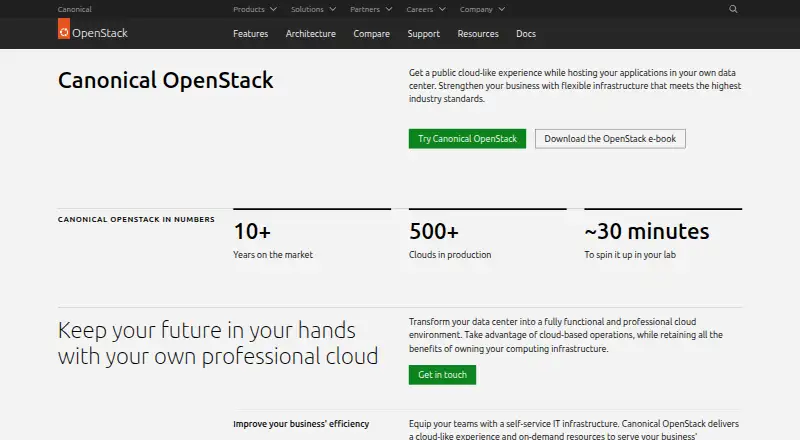
Canonical OpenStack is an open-source platform for deploying private, sovereign infrastructure on Ubuntu. It is aimed at organizations that want to build and operate their own cloud environment, with on-demand compute, networking, and storage delivered through a self-service portal, dashboard, CLI, and upstream OpenStack APIs. Deployment can be single-node or multi-node, with options for high availability, bare-metal automation, observability, Kubernetes, GPU virtualization, and workload acceleration.
Its ecosystem is a central strength. Canonical OpenStack integrates with KVM for virtualization, OVN for networking, Ceph for storage, Canonical MAAS for bare-metal automation, Juju, and Kubernetes. The platform also supports hybrid multi-cloud use and provides automated upgrades between supported versions. That combination gives private-cloud builders a broad infrastructure foundation rather than a tool focused on one layer of cloud operations. Teams selecting it should value open-source control, self-service provisioning, and the ability to combine infrastructure services in one deployment.
The main trade-off is operational ownership. The deployment model is self-hosted, so organizations must plan and run the cloud themselves or engage Canonical for deployment, consulting, support, and managed services. The OpenStack software is free of charge, while commercial support is available through Ubuntu Pro subscriptions and related Canonical services. Canonical OpenStack is therefore a strong fit for teams building private infrastructure with Linux and open-source components, but a less direct choice for organizations seeking a narrowly scoped tool or an entirely external managed cloud service.
Your product? Our editors can test Canonical OpenStack in depth and publish a review, labelled as paid · from $149/mo →
Canonical OpenStack pricing
Canonical OpenStack fact sheet
| Free plan | Yes |
|---|---|
| Paid from | Not verified |
| Cloud coverage | Hybrid |
| Cloud providers | Not verified |
| Policy governance | Not verified |
| Provisioning automation | Yes |
| Infrastructure as code | Not verified |
| Self-service catalog | Yes |
| Deployment model | Self_hosted |
| Deployment | Self-hosted, Cloud |
| Platforms | Web, Linux |
| Compliance & security | 2FA |
| Support | Phone, Tickets, Docs, Community · 24/7 |
| Built for | Mid-market, Enterprise (editorial estimate) |
| Integrations | 6 integrations: KVM, OVN, Ceph, Canonical MAAS, Juju, Kubernetes |
| Pricing | Free plan (source) |
| Website | canonical.com |
| Facts checked | 20 Sep 2026 |
Canonical OpenStack integrations
Canonical OpenStack lists 6 integrations on its own site.
- KVM
- OVN
- Ceph
- Canonical MAAS
- Juju
- Kubernetes
Alternatives to Canonical OpenStack
- Microsoft Azure ArcA strong Azure-centered control plane for teams managing hybrid and multicloud infrastructure.9.3
- Nutanix Cloud ManagerA broad hybrid-cloud operations suite for teams managing Nutanix, VMware, and public clouds.9.1
- OpenText Cloud ManagementA broad platform for governing workflows, infrastructure, CMDB data, and cloud spend.9.0


See all Canonical OpenStack alternatives →
Canonical OpenStack vs the competition
- Canonical OpenStack vs Microsoft Azure Arc
- Canonical OpenStack vs Nutanix Cloud Manager
- Canonical OpenStack vs OpenText Cloud Management
- Canonical OpenStack vs HPE Morpheus Enterprise
- Canonical OpenStack vs Terraform
- Canonical OpenStack vs Microsoft System Center Virtual Machine Manager



Compare Canonical OpenStack with any tool side by side →
Also Ranked In
Canonical OpenStack is ranked in 2 of our directories.
Used Canonical OpenStack? Be the first to review it
The editor score above is our own research. What this page doesn't have yet is a reader's view — what you used Canonical OpenStack for, what worked and what didn't. No stars are seeded and no review is paid for; an editor reads every one before it appears.
Write a reviewTwo minutes · verified accounts only · read by an editor before it appears
Featured on iTechGuides

Canonical OpenStack is listed in our Cloud Management Software directory. Add the badge to your site — it links back to this page.
<a href="https://www.itechguides.com/products/canonical-openstack/"><img src="https://www.itechguides.com/best/badge/canonical-openstack.svg" alt="Featured on iTechGuides" width="230" height="46"></a>
Reviewed by iTechGuides Editors · Editorial team · Updated Oct 2026
Advertiser disclosure: iTechGuides is reader-supported. Vendors can pay for top positions in our rankings and for a place on other products' pages, and we may earn a commission when you click some links. Bought places stand at the number bought; this page and our disclosure say so. Paying vendors may get a fuller, more detailed review from our editors, and that review can change their score. How we rank.
Last updated · How we research and update