
Apache Camel
Apache Camel: A developer-focused integration framework with broad connectors and flexible runtime choices. Ranked #34 of 110 in Integration Platform as a Service Software by our editors (5.8/10); pricing: Free plan; best for developers building open-source integration routes.
At a glance
- Editor score5.8 / 10
- PricingFree plan
- Best forDevelopers building open-source integration routes
- Free planYes
- Paid fromFree
- Deployment modelHybrid
- Facts checked20 Sep 2026
Where it wins
- 350+ ready-made connectors across cloud and on-premises systems
- Java, XML, and YAML DSLs for defining route-based integrations
- Enterprise patterns, REST/OpenAPI, messaging, and data transformation
Where it doesn't
- Framework model requires teams to choose and manage their runtime
- Developer-oriented design may not suit no-code integration teams
- Not a hosted SaaS product with packaged paid tiers
Our verdict on Apache Camel
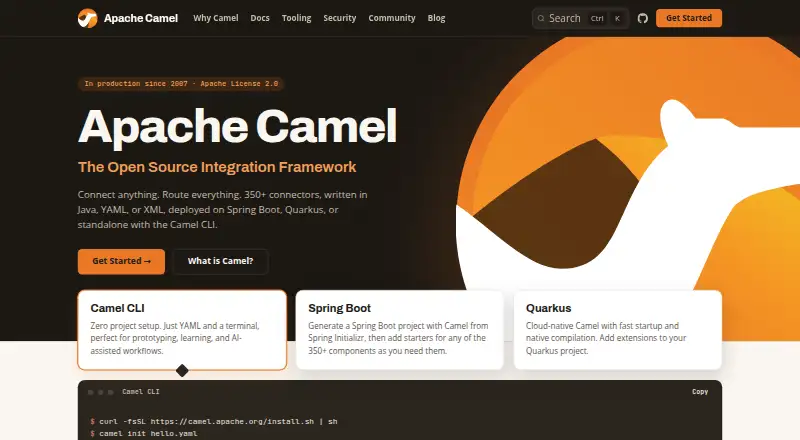
Apache Camel is an open-source integration framework for connecting applications, services, APIs, and data across cloud and on-premises environments. It is aimed at developers who need route-based integration flows, workflow orchestration, data transformation, real-time synchronization, and on-premises connectivity. Teams can define integrations with Java, XML, or YAML DSLs and run them through standalone runtimes or frameworks such as Spring Boot, Quarkus, and Camel K.
Its main strength is breadth without locking integrations to one protocol or application type. Apache Camel provides 350+ ready-made connectors covering HTTP, JMS, FTP, Kafka, AMQP, AWS, Azure, databases, files, and REST. Enterprise Integration Patterns, event-driven and polling consumers, message handling, and in-transit transformation support more than simple point-to-point transfers. REST DSL capabilities and contract-first OpenAPI support also make it relevant when integration work includes API definitions or REST services. Camel K adds a Kubernetes runtime option for teams operating containerized environments.
The trade-off is that Apache Camel is a framework rather than a hosted SaaS product. Teams must select the deployment approach and runtime that fit their environment, which suits engineering-led organizations more than buyers seeking a visual, managed integration service. Its open-source model avoids packaged licensing tiers and supports Linux, Windows, macOS, and self-hosted deployment, but it also places more responsibility on the team building and operating routes. Choose Apache Camel for flexible, developer-controlled integration across varied systems; consider a managed alternative if your priority is no-code onboarding or a vendor-operated runtime.
Your product? Our editors can test Apache Camel in depth and publish a review, labelled as paid · from $149/mo →
Apache Camel pricing
Apache Camel fact sheet
| Free plan | Yes |
|---|---|
| Paid from | Free |
| Deployment model | Hybrid |
| Connector count | Not verified |
| Workflow orchestration | Yes |
| Data transformation | Yes |
| Real-time sync | Yes |
| On-premises connectors | Yes |
| API management | Yes |
| Deployment | Cloud, Self-hosted |
| Platforms | Linux, Windows, macOS |
| Support | Community, Docs |
| Built for | Small business, Mid-market, Enterprise (editorial estimate) |
| Integrations | 350+ integrations: HTTP, JMS, FTP, Kafka, AMQP, AWS … See all → |
| Pricing | Free plan |
| Website | camel.apache.org |
| Facts checked | 20 Sep 2026 |
Apache Camel integrations
Apache Camel lists 350+ integrations on its own site — the 10 named here are the ones its pages call out.
- HTTP
- JMS
- FTP
- Kafka
- AMQP
- AWS
- Azure
- databases
- files
- REST
See all Apache Camel integrations →
Alternatives to Apache Camel
- ZapierA broad no-code automation platform with strong workflow depth and usage limits.9.4
- MakeA broad no-code automation platform with flexible routing and a low paid entry point.9.2
- n8nA flexible workflow platform for technical teams that need code and deployment choice.9.0



See all Apache Camel alternatives →
Also Ranked In
Apache Camel is ranked in 5 of our directories.
Used Apache Camel? Be the first to review it
The editor score above is our own research. What this page doesn't have yet is a reader's view — what you used Apache Camel for, what worked and what didn't. No stars are seeded and no review is paid for; an editor reads every one before it appears.
Write a reviewTwo minutes · verified accounts only · read by an editor before it appears
Featured on iTechGuides

Apache Camel is listed in our Integration Platform as a Service Software directory. Add the badge to your site — it links back to this page.
<a href="https://www.itechguides.com/products/apache-camel/"><img src="https://www.itechguides.com/best/badge/apache-camel.svg" alt="Featured on iTechGuides" width="230" height="46"></a>
Reviewed by iTechGuides Editors · Editorial team · Updated Oct 2026
Advertiser disclosure: iTechGuides is reader-supported. Vendors can pay for top positions in our rankings and for a place on other products' pages, and we may earn a commission when you click some links. Bought places stand at the number bought; this page and our disclosure say so. Paying vendors may get a fuller, more detailed review from our editors, and that review can change their score. How we rank.
Last updated · How we research and update