
Crashes, No Sound, or Screen Glitches?
Random freezes, missing sound and display glitches usually trace back to one bad driver. Find and replace yours safely.Free scan · under a minutePC Slower Than It Used to Be?
A free scan shows the junk files, broken settings and background clutter dragging Windows down - then fixes them in one click.Free scan · Windows 10 & 11Power management in electronics is the coordinated conversion, regulation, distribution, monitoring and conservation of electrical energy so each circuit gets suitable power while the system operates efficiently and safely. It includes hardware such as voltage regulators and battery-management circuits, as well as firmware that turns off unused functions or selects lower-power states.
What power management does in an electronic system
A device’s power source rarely provides exactly the voltage and current every component needs. Power-management circuits convert and regulate that supply, route power to different loads, monitor operating conditions and respond to changes in demand. Their design affects heat, battery life, noise, board area, startup behavior and protection against electrical faults.


Power management is therefore a system-level design problem, not just the choice of one regulator. It can involve several power rails, charging and battery monitoring, load switches, voltage supervisors, startup sequencing and firmware-controlled power states.
Which power-management blocks are used?
Linear regulators (LDOs)
A low-dropout linear regulator is often a good fit when the required voltage is close to the input voltage and low output noise or straightforward implementation matters. It dissipates the voltage difference as heat: approximately (input voltage − output voltage) × load current. Check the resulting thermal conditions as well as the regulator’s voltage and current limits.
Quick wins for a faster PC:
Scan for outdated or missing drivers - takes under a minuteDriver Scan →Repair Windows errors before they cause bigger problemsFix Now →#1 Best Overall
Switching regulators
Switching converters transfer energy using rapid switching and energy-storage components. A buck converter steps voltage down, a boost converter steps it up, and a buck-boost converter supports conversion in either direction relative to its output. They generally offer better efficiency than an LDO when there is a substantial voltage difference, but add switching noise and design considerations such as component selection and board layout.
PMICs and power-control circuits
A power-management IC (PMIC) combines functions that might otherwise need several separate chips. Depending on the device, those functions can include voltage regulators, battery charging, supervision and power sequencing. Integration can reduce board area and simplify coordination among rails, though the selected IC still has to meet each rail’s electrical and software-control requirements.
Rank #2

- Chip Model; MAX77812 Regulator Chip :Suitable for MAX77812EWB+T Motherboard Repair Replacemen IC
- CHIP TYPE: MAX77812 PMIC (Power Management Integrated Circuit) in WLCSP-64Pin Chip
- Each pack come with 1x MAX77812EWB {PMIC}Management IC Chip
- ENSURE CUSTOMER SATISFACTION: Ensure 100% Customer Satisfaction! If You Have any Questions About the Product or Order, Please Feel free To Contact us at any Time. Click on the Seller To Contact us. We will Effectively Address Your issue On 7/24
For example, Nordic Semiconductor describes its nPM1304 as integrating a linear charger, fuel gauge, two buck regulators, two LDOs/load switches and system-management functions. The manufacturer specifies buck-conversion efficiency of up to 93%; that is a stated maximum, not a guarantee of efficiency at every input voltage or load.
Battery-management electronics
Battery-management electronics can monitor cell voltage and temperature, estimate state of charge, control charging, balance cells and disconnect a battery or load under abnormal conditions. The exact functions depend on the battery and product. Charging control, monitoring and protective cutoffs should be designed for the battery chemistry and applicable safety requirements rather than assumed to be interchangeable.
Recommended Free Tools
Switches, supervisors and firmware
Load switches can disconnect parts of a system when they are not needed. Supervisors detect conditions such as undervoltage or overvoltage, while sequencing logic ensures that power rails start in an intended order. Firmware can complement these circuits by disabling unused rails or placing subsystems into low-power states. IEEE 1801 provides a standardized power-intent format for specifying, verifying and implementing low-power architectures in electronic designs.
How to choose a voltage regulator
Start with the source and the load, then compare candidate regulators using the conditions the finished product will actually experience. A maximum-current rating alone is not enough: the regulator must also handle load changes, heat, startup and the surrounding circuit’s noise requirements.
Rank #4
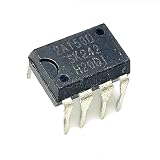
- 2Pcs 2A153D 2A153D 2A153 DIP8 Power management IC chip
- Define the input and output ranges. Record the source’s minimum and maximum voltage and the required output range, including tolerances and operating conditions.
- Characterize the load. Determine normal, peak and startup current, how quickly demand changes, and whether more than one rail must start in a particular order.
- Compare efficiency and heat at the real load profile. Do not rely on a single headline efficiency figure. Check expected operating points and, for a linear regulator, calculate the voltage-drop loss and confirm that the package and board can dissipate the heat.
- Check output behavior. Compare transient response, ripple and noise against what the powered circuit can tolerate. Sensitive analog or radio circuitry may need different treatment from a less noise-sensitive load.
- Review protection and startup. Check available overcurrent, overtemperature, undervoltage or overvoltage responses, plus enable behavior, sequencing and recovery after a fault.
- Confirm implementation requirements. Review external components, package and layout demands, and any software-control interface. Validate the design against the regulator’s specifications before committing to a board layout.
In broad terms, consider an LDO when the voltage drop and resulting heat are acceptable and simplicity or low noise is valuable. Consider a switching converter when conversion would otherwise waste substantial energy as heat. Consider a PMIC when multiple rails or charging and supervisory functions make integration useful.
What a BMS monitors and why it matters
A battery-management system (BMS) is an electronic system associated with a battery that monitors or manages its state, calculates and reports related data, and may control its environment to influence performance and service life. Depending on its scope, it can also balance cells and cut off abnormal conditions such as overcharging, overcurrent or overheating.
Free tools Windows power users keep installed
One-click scans. No signup required.
Best Value

- Transistor Type: Positive Voltage Regulator Transistor for power regulation.
- Specification: Outputs VO of 1.2~37V and IO of 1.5A, with an input voltage limit (VI) of 40V and a minimum voltage drop (VD) of 3V.
- Application: Widely utilized in power supply designs for output voltage regulation, ensuring consistent power for your electronics.
- Features: Adjustable 3-Terminal voltage regulation, providing flexibility and adaptability in various electronic circuit designs.
- Package: Shipped in an Anti-Static bag for electrostatic protection, ESD safety, and prolonged shelf life.
Monitoring and protective control serve different purposes: reporting battery state helps a system make informed decisions, while fault detection and cutoffs help prevent operation outside permitted conditions. An interface may expose information such as charge level, charging state and completed charging cycles; those reports do not replace appropriate battery-level protection.
Independent reader supportYour contribution helps us test, update, and keep practical guides available for everyone.Extra checks for energy-harvesting designs
When a circuit draws power from an intermittent source such as harvested energy, the power-management device itself can consume a meaningful share of the available energy. In addition to ordinary regulator checks, assess:
- Cold-start voltage: whether the circuit can begin operating from the source’s available voltage without an already charged supply.
- Intermittency: how the system behaves when harvested input disappears or fluctuates, including whether stored energy can support the load.
- Source matching or MPPT: whether impedance matching or maximum power point tracking is needed for the source and operating conditions.
- Quiescent current: power consumed by the PMIC while the system is waiting or the source is weak.
What the relevant standards cover
Standards address different parts of power management; they should not be treated as interchangeable design rules or automatic compliance requirements. Confirm applicability against the product, geography, battery chemistry, safety regime and lifecycle.
Quick Recap
| Document | Scope and applicability |
|---|---|
| IEEE 1801-2024 | Power-intent specification for electronic designs, supporting verification and implementation of a power-management architecture. It supersedes the 2018 edition and was published March 4, 2025. |
| IEEE 2686-2024 | Recommended practice for stationary energy-storage battery-management-system design, configuration, interoperability and cybersecurity. Published February 7, 2025; it explicitly excludes mobile applications such as electric vehicles. |
| RFC 6988 | Requirements for energy-management monitoring and control interfaces, including battery charge, charging state and completed charging cycles. It is not a regulator circuit-design standard. |
| ITU-T L.1397 (2025) | Defines a BMS or battery-management unit in terms of monitoring or managing battery state, reporting calculated data, controlling the battery environment and potentially responding to abnormal conditions. |
Product prices and availability are accurate as of the date/time indicated and are subject to change. Any price and availability information displayed on Amazon at the time of purchase will apply.

