
For a working Phenom II X4 945 system, keep the Phenom: replacing it with an FX-4100 is usually a sidegrade, not a worthwhile upgrade. At stock settings, results vary by workload; the Phenom often holds up well in older software, while the FX has a higher clock and newer instruction support. Choose the FX when you already have a compatible AM3+ board and a specific reason to use it, such as an AVX-optimized workload or an overclocking experiment. For a new general-purpose PC in 2026, neither is a sensible platform to build around.
At a glance: Phenom II X4 945 vs. FX-4100
| Feature | Phenom II X4 945 | FX-4100 |
|---|---|---|
| Architecture | Deneb / K10 | Zambezi / Bulldozer |
| Manufacturing process | 45 nm | 32 nm |
| Core arrangement | 4 conventional cores / 4 threads | 4 reported cores / 4 threads, organized as 2 Bulldozer modules |
| Base clock | 3.0 GHz | 3.6 GHz |
| Maximum Turbo | None listed for this comparison | 3.8 GHz |
| L3 cache | 6 MB | 8 MB |
| Socket | AM3 | AM3+ |
| Default TDP | Variant-dependent: 95 W or 125 W versions existed | 95 W |
| Integrated graphics | No | No |
| Overclocking | Depends on SKU and method; some 945 models are multiplier-locked | Unlocked multiplier |
The FX-4100’s four reported cores are not four fully independent Phenom-style cores: each pair sits in a Bulldozer module and shares some resources. But describing it as merely a dual-core with Hyper-Threading is also inaccurate. The module design helps explain why its higher clock and core count do not guarantee a win in every program. The comparative specifications and benchmark database are available from CPU-Monkey.
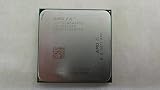
Check which Phenom 945 you have
The model name alone does not tell you its power rating. A documented 95 W C3 version is identified by the OPN HDX945WFK4DGM; older 125 W versions also existed. Check the full OPN printed on the processor and compare it with the support list for your exact motherboard. ASRock, for example, lists the 95 W model and its board-specific support information on its CPU support page.
How do they compare at stock settings?
There is no universal winner. The FX-4100 runs at a higher nominal frequency and can pull ahead in some lightly threaded or instruction-optimized work. The Phenom II often benefits from stronger per-clock behavior in older software. Benchmark databases illustrate that variation rather than settle it: CPU-Monkey reports the FX ahead in single-core Geekbench 5 and the Phenom slightly ahead in multi-core Geekbench 5, with other tests producing different or narrower results. Treat those results as indicators for particular tests, not predictions for every application.
What’s actually slowing this PC down?
Pick the symptom - the matching free tool is one click away.
#1 Best Overall

- Frequency: 3.6 or 3.8GHZ (Base or Overdrive)
- Cores: 4
- Cache: 4 or 8MB (L2 or L3)
- Socket Type: AM3plus
- Power Wattage: 95W
Everyday desktop tasks
Both can handle basic legacy desktop duties—browsing, office work and media playback—when paired with adequate memory, a supported browser and preferably an SSD. The FX’s higher clock may help in some lightly threaded tasks, but it is not by itself a compelling reason to replace a working Phenom system. Neither chip has integrated graphics, so a discrete GPU is required.
Multithreaded work and encoding
Rendering, compression and video encoding depend on the specific application and its instruction paths. The Phenom offers four conventional cores and can do well in software that does not favor Bulldozer. The FX may improve its position where a workload is optimized for its architecture or uses instructions such as AVX. Support matters only if the application actually uses those instructions; AVX is not a general speed boost, and FMA4 or XOP are niche legacy features rather than strong reasons to buy an FX-4100 today.
Historical FX-4100 reviews and enthusiast comparisons likewise show workload-dependent results, not a reliable across-the-board win for either chip (AnandTech review discussion; Phenom-versus-FX discussion).
Which is better for gaming?
For older games, the Phenom II is often the safer stock choice because its per-core behavior can suit games sensitive to single-thread performance and draw-call throughput. The FX-4100’s 3.6 GHz base clock does not automatically mean higher frame rates. In a GPU-limited setup—often at higher resolutions or demanding graphics settings—the graphics card can hide much of the CPU difference. In a CPU-limited game, the engine, operating system, memory configuration, background tasks and CPU clock all matter.
Windows Errors? Fix Them Before They Spread
Repair common Windows errors and clear accumulated junk for a smoother, more stable PC - no reinstall needed.Free scan · no reinstallCrashes, No Sound, or Screen Glitches?
Random freezes, missing sound and display glitches usually trace back to one bad driver. Find and replace yours safely.Free scan · under a minuteRank #3

- High-Performance Computing: The AMD FX-Series 4100 Processor features quad-core design and a maximum clock speed of 3.6GHz, achieving unparalleled performance for demanding tasks.
- Easy Overclocking: With AMD Overdrive software, you can easily overclock this processor for even greater performance.
- AMD Turbo Core Technology: This processor features AMD Turbo Core Technology, which automatically boosts clock speed to ensure maximum performance when you need it the most.
- Compatibility: The AMD FX-Series 4100 Processor is compatible with a variety of socket types, making it easy to upgrade your existing setup.
- Energy Efficient: This processor is designed for energy efficiency, reducing power consumption and helping keep your system environmentally friendly.
Average FPS alone also misses frame-time consistency and minimum-FPS behavior. There is no single result that predicts performance across games and configurations. Neither processor is a good recommendation for modern high-refresh gaming; they make more sense for retro gaming, repair or a severely constrained legacy system.
Power, cooling and overclocking
The FX-4100 is rated at 95 W. The Phenom 945 may be a 95 W or 125 W part, so identify the exact variant before checking board and cooler suitability. TDP is a thermal-design rating, not a measurement of total system power at the wall; it cannot establish which complete PC will use less electricity or perform better per watt.
Rank #4

- 3.3GHz Operating Frequency,
- AM3+ Socket, FX-8300
- Shared L3 cache
- Dual 128-bit Floating point engines – capable of teaming together for 256-bit AVX instructions or operating separately with each core.
The FX-4100 is the more straightforward overclocking candidate because its multiplier is unlocked. AMD’s launch announcement listed a 3.6 GHz base clock, up to 3.8 GHz Turbo and the FX line’s unlocked positioning (AMD launch announcement). That does not guarantee a particular overclock: results depend on the individual chip, voltage, cooling and motherboard voltage-regulator (VRM) quality. Sustained overclocking makes the board’s VRM and cooling capacity especially important.
Some Phenom II X4 945 variants are multiplier-locked. Raising the reference clock can also affect memory and other buses, so the result depends on the exact CPU, board, settings and cooler. Compare both processors at stock first; an overclocked FX-4100 is a different scenario, not evidence that it is the better stock replacement.
Quick wins for a faster PC:
Fix the driver behind crashes, sound loss and screen glitchesFind Drivers →Repair Windows errors before they cause bigger problemsFix Now →Scan for outdated or missing drivers - takes under a minuteDriver Scan →Best Value

- Overclocking capabilities: Unlocked for a big boost in performance and speed.
- "Bulldozer" architecture: Designed to increase core communication for unparalleled multitasking and pure core performance.
- AMD Turbo Core Technology: A burst of speed for the task at hand. Delivers dynamic core performance boosts depending on users' workload at frequencies of up to 900MHz faster.
- AMD OverDrive software: Tuning controls to push performance to the limits and monitors system stability when overclocking
- 32NM die shrink: Stable and smooth performance with impressive energy efficiency
Will your motherboard support either processor?
The Phenom II X4 945 is an AM3 processor; the FX-4100 is AM3+. Related socket families do not guarantee compatibility in either direction. Some AM3+ boards support Phenom II chips, while an AM3 board may not support an FX processor. The exact board model and revision, CPU-support list, BIOS version and power delivery determine whether a swap will work.
- Identify the motherboard’s exact model and revision.
- Open the manufacturer’s CPU-support list and find the exact processor or OPN.
- Check the minimum BIOS version required for that CPU; update the BIOS before swapping if the manufacturer requires it and the current processor still boots.
- Check the board’s stated TDP limits and, especially for an FX or overclocked setup, whether its VRM is suitable for sustained CPU loads.
- Confirm cooler compatibility, use a functioning cooler with fresh thermal compound, and verify that the BIOS identifies the installed processor correctly after installation.
ASRock’s AM3 support list and additional CPU-support examples show how support can depend on the specific board and BIOS rather than the socket label alone.
Which one makes sense for your situation?
| Your situation | Recommendation |
|---|---|
| You already have a working Phenom II X4 945 system | Keep the Phenom; an FX-4100 is usually not a worthwhile upgrade. |
| You are choosing between similarly priced CPUs for older games | Usually choose the Phenom II, assuming your board supports it. |
| You already own a compatible AM3+ board but no CPU | The FX-4100 can be usable; first check whether the board supports a stronger FX-6300- or FX-8300-series option. |
| Your application benefits from AVX or a specific Bulldozer-era instruction path | The FX-4100 may be preferable, but only if the application actually uses that path. |
| You want an overclocking experiment | The FX-4100 is easier to justify because its multiplier is unlocked; board VRM and cooling still matter. |
| You want an ordinary, low-risk legacy desktop | A compatible Phenom II is the safer stock choice; confirm whether the particular chip is 95 W or 125 W. |
| You need to buy a motherboard as well as the CPU | Buy neither unless you specifically want a retro build, repair part or very low-cost experiment. |
| You have a very weak graphics card | The GPU may be the limiting component, masking CPU differences. |
| You want modern competitive or high-refresh gaming | Neither is a suitable mainstream choice. |
What to consider instead
If you already own an AM3+ board, check its support list for an FX-6300 or FX-8300-series processor before settling on an FX-4100; compatibility and power delivery vary by board. If you would need to buy a board or assemble a complete PC, compare the total cost and effort with a complete newer used system, such as a Ryzen-based desktop. No current prices are asserted here, so assess the specific local listings rather than assuming an old CPU is a bargain.
If you are keeping an existing machine, an SSD, adequate RAM or a more suitable graphics card may address the actual bottleneck more effectively than changing between these processors. Neither CPU offers the software longevity and upgrade path expected of a modern desktop platform, though both can still be useful for legacy applications, Linux experimentation, repair or period-correct builds.
Quick Recap
Product prices and availability are accurate as of the date/time indicated and are subject to change. Any price and availability information displayed on Amazon at the time of purchase will apply.

