
Recommended Free Tools
A pay stub generator creates an itemized wage statement; payroll software or a payroll service can help run recurring payroll, handle tax tasks, and maintain records. If payroll has already been correctly calculated and paid and you only need to produce a statement, a generator may fit. If you need help calculating pay, withholding and depositing taxes, filing returns, or preparing year-end forms, evaluate payroll software or a service—and confirm which tasks it actually performs.
This guide is for U.S. employers. Federal, state, and local requirements can vary with where employees work and their circumstances.


What is the difference between a pay stub generator and payroll software?
| Question | Pay stub generator | Payroll software or service |
|---|---|---|
| Primary job | Creates an itemized wage statement from pay information entered or otherwise supplied. | May administer recurring payroll, including calculations and specified tax and recordkeeping tasks. |
| Calculates and pays wages? | Not inherently. A statement generator should not be treated as evidence that payroll was calculated correctly or paid. | May calculate pay and prepare payments, depending on the provider and service agreement. |
| Tax deposits and filings? | Document creation alone does not make tax deposits or file returns. | A provider may handle specified deposits, payments, returns, and year-end forms; verify what is included. |
| Best fit | Payroll is already calculated and paid, and the remaining need is an itemized statement. | You need recurring payroll administration or an ongoing system for payroll records and employee access. |
The IRS describes payroll service providers as potentially helping with paycheck preparation, Forms 940 and 941, certain return filings, federal tax deposits and payments, and Forms W-2 and W-3. Those are possible services, not a guarantee that every provider or plan covers all of them. A generator’s scope can be narrower: PaymentStub describes its tool as creating itemized statements for pay that has already been run, and says it is not a replacement for a payroll service when tax deposits need handling. That is the vendor’s description, not an independent assessment of its calculations. PaymentStub | IRS: third-party payer arrangements
Which option fits your business?
A generator may fit when payroll is already complete
Consider a generator if wages, hours, deductions, and applicable withholding have already been accurately determined, employees have been paid, and you only need an itemized statement. You remain responsible for the underlying payroll information and for meeting applicable wage-statement requirements. Generating a document does not establish that taxes were deposited or returns filed.
Evaluate payroll software or a service when you need recurring administration
Look at payroll software or a service if you need help with recurring calculations, withholding, deposits, employment tax returns, year-end forms, or organizing ongoing payroll records. Establish the precise division of work: which forms the provider prepares or files, which payments it makes, what authorizations it needs, and what you must review or submit. The IRS lists possible provider tasks, but the service agreement determines what a particular provider has undertaken. IRS guidance on provider tasks
Do not decide by headcount alone
There is no universal employee-count threshold established here for choosing one option. First consider whether your workers are employees or contractors, how often you run payroll, the states and localities where employees work, the kinds of workers you employ, and whether you can reliably handle deposits, filings, and records. Those facts affect both the work involved and the rules to check.
Rank #2

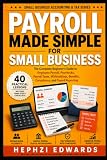
- QUALITY PAYROLL RECORDS: Adams Payroll Record Books provides everything you need to account for your employees' compensation; it tracks hours worked, gross earnings, deductions and net pay
- TWO-PART CARBONLESS FORMS: 2-part carbonless design features white and canary copies to create clear records for employees and management
- WRAP-AROUND COVER: Fold the back cover between sets to keep forms neat and legible
- CONSECUTIVELY NUMBERED: Large 6-digit numbers in the upper right hand corner help you thumb through orders quickly
- 55 SETS PER BOOK: Stock up so you never run out; each books provide 55 carbonless sets
What employers remain responsible for
Employers generally have federal employment-tax duties that include withholding federal income tax and employee Social Security and Medicare taxes, paying the employer share of Social Security and Medicare taxes, depositing employment taxes, reporting wages on required returns, and preparing Forms W-2. Deposit schedules depend on the employer’s circumstances. Use current tax-year IRS instructions and forms for rates, thresholds, and deadlines rather than relying on figures from a prior year. IRS: Understanding employment taxes
Outsourcing can delegate specified work, but an ordinary payroll service or software arrangement does not automatically transfer all employer responsibility. The IRS says employers generally remain responsible for withheld income tax and employer and employee Social Security and Medicare taxes; responsibility depends on the arrangement, with a limited exception involving Certified Professional Employer Organizations. The IRS also says use of a reporting agent or other third-party payroll service does not relieve an employer of responsibility to ensure Forms W-2 are furnished and Forms W-2 and W-3 are filed correctly and on time. Understand the arrangement and retain a process for checking that payments and filings were completed. IRS: Outsourcing payroll and third-party payers | IRS: General Instructions for Forms W-2 and W-3 (2026)
Do these 3 things before closing this tab:
1Scan for outdated or missing drivers - takes under a minute2Repair Windows errors before they cause bigger problems3Fix the driver behind crashes, sound loss and screen glitchesPay statements are not the whole recordkeeping system
For covered workers, the Department of Labor says employers must keep accurate records that include identifying information, hours worked, wage basis and rates, additions to and deductions from wages, wages paid, payment date, and the pay period covered. Its Fact Sheet #21 describes retention periods of at least three years for payroll records and two years for records used to compute wages. A pay stub alone does not necessarily meet every recordkeeping duty; confirm how federal and state requirements apply to your workforce. DOL Fact Sheet #21: FLSA recordkeeping
Check state and local rules before choosing a process
Payday frequency requirements differ among states and can vary by occupation or circumstance. The Department of Labor’s State Payday Requirements page shows that variation, but it displays a January 1, 2023 date and directs users to the relevant state labor office for official information. Check current rules with the agency for each state where employees work. Separately verify applicable state wage-statement requirements: the cited federal and state payday material does not establish a complete, current state-by-state list of required pay-statement contents. DOL: State Payday Requirements
Independent reader supportYour contribution helps us test, update, and keep practical guides available for everyone.How to compare payroll providers
Once you know the work you need done, compare providers on the scope and reliability of the service—not just the fact that a product is called payroll software. The IRS distinguishes third-party payer arrangements and the tasks a provider may perform; your contract and authorizations matter. IRS: third-party payer arrangements
Quick Recap
- Tasks included: Confirm whether the provider calculates payroll, prepares payments, deposits taxes, prepares or files returns, and prepares or files year-end forms. Ask which tasks are excluded.
- Authorization and responsibility: Find out what forms or permissions are required, who approves payroll, and what the employer must still submit, pay, or verify.
- Coverage: Check that the service supports the states and localities where your employees work and the worker types and circumstances relevant to your business.
- Records and access: Determine what wage, hours, deduction, and payment records are retained, how they can be retrieved, and whether employees can access their statements.
- Exceptions and errors: Ask how corrections, rejected filings, missed payments, and notices are handled, who is notified, and what action the employer must take.
- Total cost and time: Compare current quotes only after confirming the same set of services, fees, and responsibilities. No current provider prices or universal savings figures are established here.
A practical decision checklist
- Identify the task. If you need only an itemized statement for payroll already calculated and paid, a generator may be enough. If you need payroll calculations or tax administration, assess payroll software or a service.
- Map your workforce and locations. Establish employee status, work locations, payroll frequency, and relevant worker circumstances before choosing a process.
- List the duties you will retain. Account for employer tax obligations, records, and wage-statement and payday rules even if a provider performs some tasks.
- Confirm the provider’s actual scope. Get clarity on calculations, deposits, returns, year-end forms, authorizations, exceptions, and employer review responsibilities.
- Check current requirements and terms. Use current IRS tax-year materials and the relevant state labor agencies; review current vendor service areas, features, pricing, and contract terms.
Product prices and availability are accurate as of the date/time indicated and are subject to change. Any price and availability information displayed on Amazon at the time of purchase will apply.
The Tool Desk
Outbyte Driver Updater FREEFix the driver behind crashes, sound loss and screen glitchesFind Drivers →Outbyte PC Repair FREERepair Windows errors before they cause bigger problemsFix Now →
