
There is no universal “360-video” OpenCV pipeline. The correct integration depends first on what your camera actually outputs: a raw fisheye image, two fisheye images, or a stitched equirectangular panorama. Confirm that projection, the camera’s stream backend and pixel format, your ROS distribution, timestamp behavior, and sensor-synchronization requirements before treating any example as deployable.
A robust design separates four jobs: acquire frames, calibrate the camera with a matching model, rectify or re-project images for the robot’s algorithms, and publish frames plus metadata to the robotics middleware.
How do I use OpenCV with a 360 camera in ROS?
Use OpenCV as the image-processing layer and ROS as the transport and metadata layer, with an explicit adapter between them. A typical flow is:
- Identify the input. Record whether the device supplies raw fisheye frames, synchronized lens images, or a stitched/equirectangular stream. “360” by itself does not identify the projection model.
- Acquire frames through a verified route. This may be an OpenCV
VideoCapturebackend, a vendor SDK, or a middleware-native driver. Verify supported resolution, frame rate, encoding, buffering, and capture timestamps on the target hardware. - Calibrate with the appropriate OpenCV model. Use detected calibration-pattern points and known pattern coordinates to estimate intrinsics and distortion.
- Transform only when needed. Generate perspective views, rectify a full image, or keep the native projection if the downstream algorithm supports it.
- Publish image and camera metadata together. Preserve encoding, dimensions, timestamp, and frame ID, and publish matching camera information.
- Measure the complete path. Check dropped frames, queueing, end-to-end latency, and synchronization with odometry, IMU, lidar, or other cameras.
The historical ROS Jade cv_camera::Capture API illustrates this boundary: it uses cv::VideoCapture, exposes a cv::Mat, image messages and CameraInfo, and references ROS image transport and a camera publisher. It is useful as an architectural example, not as proof that the package is maintained or compatible with ROS 2.
Quick wins for a faster PC:
Repair Windows errors before they cause bigger problemsFix Now →Fix the driver behind crashes, sound loss and screen glitchesFind Drivers →Clear out junk files and repair common Windows errorsFree Scan →#1 Best Overall
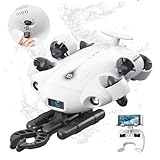
- 4K 60FPS High Frame-rate Camera: Create epic footage and wonderful underwater moments with V-EVO's upgraded camera system, achieving professional-class shots with ease and enhanced smoothness.
- Removal SD Card: The new version is a removable SD card, providing you with more convenient gameplay and storage functions. The FIFISH V-EVO's hydrodynamic, fluid, and rugged water droplet design ensures minimal resistance against ocean currents, allowing for longer dives. An attachment port accommodates a variety of tools, enabling integration and versatility for various tasks and scenarios
- 360° Omnidirectional Mobility: Reach beyond the limits of traditional methods, and achieve full 360° freedom in underwater mobility, hovering and posture holds. Turn your creative imagination into cinematic 4K imaging reality.
- 5000 Ultra-bright Lumen LEDs: FIFISH V-EVO comes equipped with a pair of combined 5000 lumens · 5500K white LED lights. Optimize your vision across the deep sea and restore the colors of the world below, especially through dark and turbid environment.
- 166° Ultra Wide Lens: See the bigger picture and discover an extraordinary world below. Go beyond a conventional underwater lens to achieve a greater impact with your visuals.
Which camera model should OpenCV use?
Choose the model from the camera’s optical and output geometry, not from the marketing label.
| Input you have | Likely processing concern | What must be verified |
|---|---|---|
| Raw wide-angle or fisheye sensor image | OpenCV’s fisheye calibration model may fit the lens | Lens characteristics, field of view, image crop, and calibration residuals |
| Omnidirectional or catadioptric image | OpenCV’s omnidirectional module provides a separate calibration and rectification workflow | Projection assumptions and whether the image is raw or transformed by camera firmware |
| Stitched equirectangular panorama | The panorama is already a projection produced by stitching; treating it as one ordinary fisheye image can be wrong | Stitching seam behavior, panorama convention, per-lens calibration availability, and the camera manufacturer’s geometry |
OpenCV documents the fisheye namespace and its angular-distortion model in the camera-calibration documentation. Do not assume that every consumer 360 camera can be represented by one fisheye lens: dual-lens systems commonly output a stitched panorama rather than raw sensor views.
How do I calibrate an omnidirectional camera with OpenCV?
Calibration estimates the camera parameters that map known 3D pattern points to observed image points. The OpenCV omnidirectional calibration tutorial covers calibration, rectification and stereo reconstruction for large-field-of-view cameras.
1. Choose and mount a target
Use a rigid checkerboard or circle-grid target. The tutorial supports both pattern types. Dimensions and spacing should suit the camera’s working distance and resolution; a target that occupies only a few pixels will produce poor feature localization.
Windows Errors? Fix Them Before They Spread
Repair common Windows errors and clear accumulated junk for a smoother, more stable PC - no reinstall needed.Free scan · no reinstallCrashes, No Sound, or Screen Glitches?
Random freezes, missing sound and display glitches usually trace back to one bad driver. Find and replace yours safely.Free scan · under a minute2. Collect varied views
Capture the target at different positions, rotations, distances and image regions, including useful portions near the edges of the field of view. Keep the camera fixed while moving the target, or use a controlled motion that does not blur the pattern.
Rank #2

- 【High-Performance Motion】Features a 2-axis design with a powerful 30kg.cm servo torque, offering a full 360 horizontal pan and 135 vertical tilt range for comprehensive coverage.
- 【Advanced Visual Sensing】Equipped with a 5MP ultra wide-angle camera that ensures clear imaging in various lighting conditions, ideal for face detection, motion tracking, and video recording applications.
- 【Open Source & Developer Friendly】Based on a general driver board, it comes with open-source Web App control demos for easy secondary development, perfect for makers, IoT projects, and custom electronics kits.
- 【Flexible Integration & Expansion】Highly compatible with popular development boards and microcontrollers.Includes a Picatinny rail and 1/4 screw for easy mounting into your robotics or DIY setups.
- 【Precision Closed-Loop Control】Utilizes high-precision serial bus servos with magnetic encoders for accurate joint angle and load feedback, enabling stable and reliable automated control.
3. Detect pattern features
For every usable frame, detect checkerboard corners or circle centers and pair them with the corresponding known object points. Reject images where features are missing, ambiguous or badly blurred.
4. Estimate parameters with the matching model
Use the omnidirectional calibration functions when the camera’s projection requires that model; use the fisheye functions when the lens and output match the fisheye assumptions. A pinhole model with ordinary distortion is not automatically adequate for a very wide field of view.
5. Validate on images not used for fitting
Hold back several target views and inspect reprojection error and visible alignment on those images. Also check whether straight features and pattern geometry behave acceptably across the image, especially at the edges. This engineering check helps expose overfitting or a mismatched projection model.
6. Save calibration with its conditions
Store image dimensions, crop or binning settings, model type, intrinsic parameters, distortion coefficients and calibration date. Recalibrate if the camera changes resolution, lens configuration, focus, crop, or stitching mode.
How do I undistort or rectify a 360 camera image?
Rectification is a computed transform from the original omnidirectional image into a chosen output projection. It is not an automatic property of the camera. The desired view, field of view, output size and downstream algorithm determine the transform.
Rank #3

- Big Views, Brilliant Quality - Groundbreaking 1-inch 360° imaging [1] delivers excellent low-light for sharper shots on every adventure. Now with 8K/30fps 360° video, perfect for outdoor sports and travel.
- Stunning, Day or Night - Capture every detail with 8K 360° videos and store them effortlessly with 105GB Built-in Storage. Whether you're exploring city nights or chasing sunrise, your 360 camera delivers crisp, vibrant panoramas, even in low light.
- No Pole, All Action - 1.2m Invisible Selfie Stick turns your Osmo 360 into a cameraman that follows you. Shoot super-smooth 4K/120fps and magical third-person angles. Perfect for skiing: carve, jump, and relive every run.
- Ultra-High-Res 360° Photo - Capture your world in breathtaking detail with this 360 camera. Snap 120MP 360° photos in one tap for immersive, lifelike views you can relive anytime.
- Snap-On Freedom - Switch from 360° selfies to single-lens vlogs in seconds! Magnetic quick‑release works with Osmo Action Quick-Release Adapter Mount; 1/4" thread fits classic gear. Perfect for travel vlogs, cycling POVs — fast, stable, fuss‑free.
Full-frame rectification
Convert the source into a perspective-like image when an algorithm expects approximately pinhole geometry. This can simplify feature tracking or object detection, but one perspective view cannot preserve the entire spherical field without severe stretching or cropping.
Perspective view generation
For navigation, create one or more virtual camera views with defined heading, elevation and field of view. Multiple views retain more coverage at the cost of extra processing and topic management.
Free tools Windows power users keep installed
One-click scans. No signup required.
Native-projection processing
Keep the equirectangular or omnidirectional image when the algorithm understands that geometry. This avoids an unnecessary resampling step, but every geometric operation must account for projection-dependent distortion and the panorama’s seam.
Before deploying, verify that the rectification map corresponds to the exact source dimensions and camera mode. A map made for one crop or panorama layout cannot safely be reused for another.
How should live capture and ROS publication be separated?
Keep acquisition, image conversion, geometry, and publication as distinct stages so each can be tested independently.
Rank #4

- 5.7K 360° Video: AKASO 360 action camera captures fully immersive 360° video in stunning 5.7K clarity, ensuring you never miss the action. Unleash your creativity to record your adventures like never before.
- 360° Supersmooth Video: Advanced in-app stabilization algorithms smooth out shakes and jitters in your action for silky smooth footage, even without a gimbal!
- 360° Horizon Steady: Unlock a new level of stabilization—360° Horizon Lock keeps your footage level all the time, no matter how you flip or spin.
- Invisible Selfie Stick: Yes! You can create unbelievable third-person shots on your own! The selfie stick automatically disappears from your footage like magic. No photographer? No problem! Invisible Selfie Stick is included.
- Dual 1/2" 48MP Sensors: Equipped with two massive 1/2" 48MP sensors, AKASO 360 captures more pixels for sharper, clearer images, bringing your action to life.
Capture stage
- Open the camera through a tested OpenCV backend, vendor SDK, or ROS driver.
- Confirm pixel format, channel order, dimensions and negotiated frame rate rather than assuming them.
- Use the camera’s capture timestamp when available; otherwise document when the timestamp is assigned.
- Bound queues so a slow consumer does not silently publish old frames.
Processing stage
- Convert color or encoding explicitly and record the conversion.
- Apply rectification or view generation using calibration parameters tied to the current camera mode.
- Preserve a clear relationship between source-frame time and processed-frame time.
ROS stage
- Publish an image message with the correct encoding and dimensions.
- Publish matching
CameraInfofor the image actually delivered, not for an unrectified source if the topic contains a rectified view. - Set a stable optical frame ID and use a consistent convention across image, camera information and transforms.
- Choose image transport and compression only after checking CPU, bandwidth and latency effects on the robot.
The old cv_camera interface demonstrates access to cv::Mat, image messages and CameraInfo, but current ROS 1 or ROS 2 implementations require separate compatibility verification for the chosen distribution and driver.
What decisions must be made before calling the pipeline deployable?
| Decision | Questions to answer | Why it matters |
|---|---|---|
| Input representation | Raw fisheye, paired lenses, or stitched equirectangular? | Determines calibration model, seam handling and rectification strategy. |
| Processing location | Full-frame transform, several perspective views, or native projection? | Changes algorithm compatibility, bandwidth and compute demand. |
| Capture route | Does OpenCV or the vendor path expose the required format and timestamps? | A nominally working stream may still have unusable timing or conversion overhead. |
| ROS integration | Which ROS distribution, image transport, encoding and frame conventions are required? | Interfaces and package support differ between ROS versions. |
| Synchronization | How will camera frames align with IMU, lidar, odometry and other cameras? | Unsynchronized measurements can degrade localization and perception even when images look correct. |
| Resources | What resolution, frame rate, latency budget and compute headroom are available? | 360-degree imagery can make memory bandwidth and processing cost significant; the cited sources provide no universal performance figures. |
Calibration setup checklist
- Camera output mode and projection documented.
- Checkerboard or circle-grid target rigidly mounted and large enough for the workspace.
- Images collected across the usable field, not only the center.
- Pattern detections reviewed for blur and false corners or centers.
- Correct OpenCV model selected and parameters saved with image dimensions.
- Held-out views checked for reprojection and visual alignment.
- Rectification maps regenerated after resolution, crop or stitching-mode changes.
- ROS image encoding,
CameraInfo, timestamps and frame IDs verified together. - End-to-end latency, dropped frames and cross-sensor timing measured on the robot computer.
Common failure modes
The image looks stretched after “undistortion”
The model may not match the input, or an equirectangular panorama may have been treated as a raw lens image. Recheck the camera’s actual output and calibrate that representation.
Calibration works in the center but fails at the edges
Collect more views covering the peripheral field and test the omnidirectional or fisheye model appropriate to the optics. Confirm that the image was not cropped or resized between capture and calibration.
ROS receives images but downstream nodes reject them
Inspect encoding, dimensions, frame ID and CameraInfo. A rectified topic needs metadata describing the rectified image, not merely the source camera.
Perception is delayed even though capture is live
Look for unbounded queues, software conversion, panorama stitching, compression and rectification cost. Measure capture-to-publish and publish-to-consumer latency instead of inferring it from displayed video.
What’s actually slowing this PC down?
Pick the symptom - the matching free tool is one click away.
Best Value

- 1-Inch 8K 360° Imaging - With 1-inch-equivalent sensors [1], light and shadow are captured with exquisite clarity. 8K/60fps HDR 360° video provides sufficient resolution for sharp cropped shots.
- O4+ FHD Video Transmission - Features strong anti-interference capabilities, delivers high-definition, high-frame-rate transmission at 1080p/60fps, and supports a range of up to 20 km [5].
- Integrated Propeller Guard & Omnidirectional Obstacle Sensing - Fly confidently with nightscape omnidirectional obstacle sensing [3]. The integrated propeller guard adds another layer of safety.
- Infinite Creativity From One Take - Capture a full 360° view in a single flight. In post, reframe from any perspective to turn one clip into multiple creations.
- 360° & Single Lens, Flexible Dual Modes - Seamlessly switch from 360° to Single Lens mode for classic Avata-style filming in 4K/60fps [4]. With 360° and aerial filming in one device, it's the only drone you need to pack.
Two sensors do not line up
Check timestamp origin, clock synchronization, trigger behavior and transform validity. Image calibration alone does not solve temporal alignment.
Frequently Asked Questions
Can I use a standard pinhole calibration for any 360 camera?
No. A 360 label does not identify the projection. Raw fisheye, omnidirectional and stitched equirectangular outputs require different geometric treatment; select and validate the model against the actual image.
Does the ROS Jade cv_camera example provide a current ROS 2 solution?
No. It is legacy ROS Jade documentation. It is useful for illustrating the VideoCapture-to-image-publication boundary, but package maintenance and ROS 2 compatibility must be verified separately.
Should every 360 frame be converted to a perspective image?
No. Generate perspective views when downstream algorithms require them; otherwise retain the native projection if your algorithms support its geometry and seam behavior.
Quick Recap
Product prices and availability are accurate as of the date/time indicated and are subject to change. Any price and availability information displayed on Amazon at the time of purchase will apply.

