
Free tools Windows power users keep installed
One-click scans. No signup required.
Novus and Keystone Sovereign target different AI bottlenecks, so they could be complementary—but NetApp’s Insight 2026 announcements do not prove that either product will solve every workload’s problem. Novus is a storage architecture aimed at feeding large GPU environments; Keystone Sovereign adds controls for data location, access and support jurisdiction. NetApp’s headline performance and scale figures remain vendor claims, not broad independent production benchmarks.
What NetApp announced at Insight 2026
NetApp Insight ran in Las Vegas from September 29 to October 1, 2026. The announcements included Novus, expanded AI Data Engine capabilities, and Keystone Sovereign, a sovereignty-focused add-on to NetApp Keystone storage as a service.


The announcements address more than one part of an AI project. Fast storage can help keep accelerators supplied with data, but performance alone does not establish who can access that data, where it is handled, or which jurisdiction governs operational support.
What Novus is designed to change
Novus is intended to address storage-side constraints in large AI environments. NetApp says conventional storage can leave GPUs waiting for data; its 2026 material says GPU utilization can drop below 30 percent when storage cannot feed them quickly enough. That is a vendor-stated figure, not a universal measurement of GPU utilization across AI systems.
#1 Best Overall
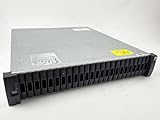
- Includes (24) X357A, 3.8TB 12Gbps, 2.5" SAS, Solid-State Drives with DS224C -24 bay enclosure, 2 x IOM12, MiniSAS HD cables, rackmount rail kit, bezel - everything needed for installation. Professionally Tested and Reset to Factory Specifications!
- All our Disk Drives have been Certified by our in-house Technicians. Professionally packed for safe and secure shipping to your facility. SSD drives 100% Health - Full Warranty!
- Please contact us if you require a different drive size or part than what we offer here. We can probably accommodate your needs.
The architecture separates metadata services from the data path. NetApp’s stated design goal is to let metadata, bandwidth and capacity scale independently while remaining under one namespace. In principle, that separation is meant to support high metadata concurrency and large-scale data access without tying all three dimensions to the same scaling limit.
What the headline numbers mean—and do not mean
- More than 100 TB/s aggregate throughput: NetApp describes this as an architecture-level throughput claim. It should not be read as a result every installation or workload will achieve.
- Zettabyte-scale file system: NetApp describes Novus as designed for zettabyte-scale capacity. This is a scale claim, not evidence that a customer deployment currently stores a zettabyte.
- Very large GPU environments: the design is aimed at environments where data feeding and metadata scale are material constraints. The announcement does not establish performance for every GPU configuration or application.
NetApp Chief Product Officer Syam Nair summarized the motivation this way: “AI factories struggle and GPU economics collapse when data can’t keep up.” NetApp CEO George Kurian was quoted in event coverage saying, “Most GPUs are not fed data at the rates that they need to be fed.” These statements describe the problem NetApp is targeting; they are not independent validation of Novus performance.
Rank #2
- Complete Storage Solution: Includes (24) X425A-R6 1.2TB NetApp SAS Drives with DS2246 24 bay enclosure, QSFP SAS cables, rackmount rail kit, bezel - everything needed for installation. Ownership Removed - Professionally Tested and Reset to Factory Specifications
- Certified Disk Drives: All Disk Drives have been Certified by in-house Technicians, Ownership Removed and professionally packed for safe and secure shipping to your facility
- Customizable Configuration: Different drive sizes or parts available to accommodate your specific storage needs, IOM12 controllers also available
- High Capacity Storage: 29TB total storage capacity with twenty-four 1.2TB 10K SAS drives providing reliable enterprise-level performance
- Dual Redundancy Design: Features dual power supplies and dual IOM6 controllers for enhanced reliability and continuous operation in mission-critical environments
What Keystone Sovereign adds
Keystone Sovereign is an add-on to NetApp Keystone storage as a service. Its reported controls focus on operational governance: European-based support and escalation, European-controlled access management, and clearer documentation of telemetry and data flows. Initial pilots were reported for Germany and France.
Those controls address sovereignty and jurisdiction concerns: where data and operations reside, who can access them, and which support jurisdiction applies. The announcement does not position Keystone Sovereign as a replacement for Novus’s throughput architecture. A buyer could evaluate both if the project has both performance and governance requirements.
How the two offerings address different constraints
| Question | Novus | Keystone Sovereign |
|---|---|---|
| Primary target | Storage performance, metadata concurrency and namespace scale (NetApp, 2026) | Data sovereignty and operational-control concerns (NetApp event coverage, 2026) |
| Relevant claim or control | More than 100 TB/s aggregate throughput and zettabyte-scale design, as claimed by NetApp | European-based support and escalation, European-controlled access management, and documented telemetry and data flows, as reported |
| Relationship to the other offering | Targets the data-feeding and scale layer | Add-on to Keystone storage as a service; targets governance rather than throughput |
| Evidence noted in the launch coverage | Vendor technical material; Omdia work is described in NetApp’s announcement as observed testing and modeling | Initial pilots reported for Germany and France |
| What the announcement does not establish | Broad independent customer benchmarks or results for every workload | Availability and controls beyond those reported for the initial pilots |
The distinction matters in evaluation: a sovereignty control does not demonstrate that a storage path can feed a GPU cluster at a specified rate, and an aggregate throughput claim does not establish where data is handled or who can access it.
What the evidence supports
The available launch material and event coverage support describing Novus’s architecture and NetApp’s stated targets, as well as the reported focus of Keystone Sovereign’s controls. They do not establish a broad independent customer benchmark for Novus or a regulator- or standards-body finding about either offering.
NetApp’s announcement describes Omdia’s work as observed testing and modeling. That provenance is different from an independent, broadly representative set of customer production results. For a deployment decision, ask for the exact workload, configuration, test method and measured results behind any performance figure, and distinguish observed results from modeled or target values.
Where AI Data Engine fits
NetApp also expanded AI Data Engine capabilities around heterogeneous data discovery. That matters because teams can be blocked by not knowing what data they have or how ready it is for AI, even if storage bandwidth is sufficient. NetApp described a six-month no-cost data-mapping offer; its current eligibility and terms should be confirmed with NetApp because event-era offer details may change.
Best Value
- Includes (24) X343A-R6 1.8TB NetApp SAS Drives, DS224C -24 bay enclosure, dual IOM12, MiniSAS HD cables and rackmount kit - everything needed for installation. Professionally Tested and Reset to Factory Specifications! Full Warranty!
- All our Disk Drives have been Certified by our in-house Technicians. Professionally packed for safe secure shipping to your facility.
- Please contact us if you require a different drive size or parts than what we offer here. We can probably accommodate your needs.
How to assess whether either offering fits
Start with the actual constraint rather than the product headline. If accelerators are waiting on data, test the storage path and metadata behavior with the intended workload. If sovereignty requirements govern the project, validate operational controls and jurisdiction explicitly. If both constraints apply, evaluate each layer separately and then confirm that the combined deployment meets the project’s requirements.
- Throughput: request workload-specific measurements, not only an aggregate architecture figure.
- Metadata scaling: test the file and metadata operations the application actually generates at expected concurrency.
- Multi-tenancy: establish how performance and controls behave when multiple teams or workloads share the environment; the launch claims cited here do not state those results.
- Deployment model: confirm what is available in the relevant geography and whether it is a service, an installed architecture, or a combination for the proposed design.
- Sovereignty controls: document data location, telemetry flows, administrative access, escalation paths and support jurisdiction for the specific service configuration.
- Evidence quality: separate vendor claims, modeled outcomes, observed tests and customer production results.
Can Novus and Keystone break the AI bottlenecks?
They address different bottlenecks, and the announcements make a plausible case for evaluating them together when a project needs both high-scale data access and tighter operational sovereignty controls. They do not establish that the pair, or either product alone, will deliver a particular GPU utilization level, throughput result or compliance outcome in a customer environment. Those outcomes depend on the workload, configuration, geography and verified controls.
Quick Recap
Product prices and availability are accurate as of the date/time indicated and are subject to change. Any price and availability information displayed on Amazon at the time of purchase will apply.

