
NASA’s Pandora spacecraft launched on Jan. 11, 2026, and completed commissioning before beginning science observations, NASA reported on Aug. 25, 2026. The small telescope is designed to study the atmospheres of at least 20 known exoplanets while measuring the activity of the stars that can distort those observations.
What is NASA’s Pandora spacecraft?
Pandora is a NASA small space telescope mission focused on characterizing exoplanet atmospheres and monitoring the host stars those planets orbit. NASA Goddard Space Flight Center leads the mission. Lawrence Livermore National Laboratory provides project management and engineering, with other institutions contributing detectors, spacecraft systems, data processing, operations, and science. NASA’s mission page describes the spacecraft and its partners.
The telescope is approximately 45 centimeters (17 inches) in diameter and made of aluminum, according to NASA’s Feb. 10, 2025 launch-service announcement. It is a small mission built to make extended, repeated observations rather than discover planets by surveying the sky.
How does Pandora study exoplanet atmospheres?
Pandora observes transiting planets—worlds that pass in front of their stars from our viewpoint. During a transit, a small amount of starlight filters through the planet’s atmosphere. Atmospheric molecules absorb particular wavelengths, leaving patterns that scientists can analyze to learn about the atmosphere.
Quick wins for a faster PC:
Scan for outdated or missing drivers - takes under a minuteDriver Scan →Repair Windows errors before they cause bigger problemsFix Now →Fix the driver behind crashes, sound loss and screen glitchesFind Drivers →#1 Best Overall
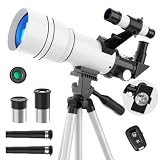
- First Telescope for Beginners----Equipped with a 70mm large-aperture objective lens and fully multi-coated glass, this telescope captures more light to deliver bright, sharp images. Beginners can easily enjoy vivid details of the lunar surface, distant mountains, cityscapes, and natural scenery with enhanced color contrast and reduced glare.
- 15X-150X for Lunar Exploration----Experience the night sky with multiple viewing options, equipped with a 300mm focal length, two eyepieces (6mm & 20mm), and a 3X Barlow lens. The lower 15X magnification provides a wider field of view for quick target spotting, while the 150X lets kids and astronomy beginners focus on finer moon’s craters, or spot bright planets like Jupiter and Saturn at specific times of the year.
- Tool-Free & Effortless Setup----Designed for frustration-free assembly, this refractor telescope can be set up by adults or kids 8-12 in minutes without any tools. It includes a durable, adjustable tripod that extends up to 45 inches, allowing comfortable horizontal and vertical tracking from your backyard patio, balcony, or living room window.
- Phone Adapter & Wireless Remote----Easily capture and share photos of the planets, wildlife and distant scenery using the included phone holder and wireless remote. The portable telescope also comes with a 5x24 finderscope for easier target location (Note: Inverted image in the finderscope is normal).
- Portable Gift & Worry-Free Support----Featuring lightweight gift packaging and a portable design, it's a thoughtful choice for birthdays, Christmas, camping, and outdoor exploration. We back your gift with a detailed manual for easy setup. If you encounter any issues like missing parts, shipping damage, or difficulty achieving a clear image, our technical support team is ready to ensure a perfect stargazing experience.
The host star can complicate that reading. Starspots and other stellar activity change the light and may imitate or obscure atmospheric signals. Pandora addresses this by collecting near-infrared data from the star and transiting planet while also measuring the host star in visible light. The simultaneous visible and near-infrared observations help scientists distinguish changes associated with the star from signals associated with the planet. NASA outlines this approach on its mission page and in its Aug. 25, 2026 science update.
What does the spacecraft bus do?
The spacecraft bus is the structural and systems platform that supports Pandora’s instruments. It handles the spacecraft’s navigation, power, communications, and data acquisition. In other words, the telescope gathers the measurements, while the bus provides the core systems needed to operate the spacecraft and collect and transmit its data.
Rank #2

- 【Superior Optical System, See More Details】Equipped with a 90mm aperture and 600mm focal length, this telescope gathers ample light to reveal detailed lunar surface textures. Fully coated glass lenses minimize reflections, protect your eyes, and deliver crisp, high-contrast views for a clear and comfortable stargazing experience
- 【Powerful Magnification – Versatile Options】This telescope for adults high powered includes two interchangeable eyepieces (25mm and 10mm) and a 3× Barlow lens, offering 24×–180× magnification. Whether observing lunar details or watching birds and landscapes, you can easily select the optimal magnification. For first-time use, start with the 25mm eyepiece
- 【Beginner-Friendly & Comfortable Experience】Designed with user convenience in mind, this telescope includes clear instructions for quick assembly. Use the 3×24 finderscope to easily locate celestial objects, and the 45° diagonal mirror keeps images upright, reducing neck and eye strain for a more comfortable viewing experience
- 【Portable & Multifunctional】Comes with an adjustable tripod (29–49 in) for stable and flexible viewing. Lightweight design allows all accessories to be neatly stored in a carrying case for easy transport. Includes a phone adapter to capture photos and videos, letting you share your stargazing moments with ease
- 【Elegant Packaging & 2-Year Warranty】Comes in a beautifully designed package with excellent quality, making it a perfect gift for astronomy enthusiasts and children. Also perfect for birthdays, holidays, and educational giftsWe offer a 2-year warranty, and if you have any questions about the product or service, our expert team is available 24/7 to provide technical support
NASA announced on Jan. 16, 2025 that Pandora’s bus was complete. The agency later documented a photograph of the fully integrated spacecraft taken May 19, 2025, after environmental testing at Blue Canyon Technologies. Those milestones mark the progression from a completed spacecraft platform to an integrated spacecraft that had undergone testing; they do not, by themselves, indicate that it was already collecting science data. See NASA’s bus-completion announcement and the NASA mission page.
When did Pandora launch, and is it taking science data?
Pandora launched to low Earth orbit on Jan. 11, 2026. NASA subsequently reported that the mission acquired a full signal after its first ground pass. That early communications milestone was followed by commissioning—the checkout period before the spacecraft begins its planned science work. On Aug. 25, 2026, NASA reported that Pandora had completed commissioning and begun science observations. The mission is therefore no longer merely being assembled or tested: it has started observing its targets. NASA’s science update gives the current status.
What’s actually slowing this PC down?
Pick the symptom - the matching free tool is one click away.
Rank #3

- Superior Optics: 400mm(f/5.7) focal length and 70mm aperture, fully coated optics glass lens with high transmission coatings creates stunning images and protect your eyes. Perfect full positive telescope for astronomers to explore stars and moon.
- Magnification: Come with two replaceable eyepieces and one 3x Barlow lens.3x Barlow lens trebles the magnifying power of each eyepiece. 5x24 finder scope with mounting bracket and cross-hair lines inside make locating objects easily.
- Wireless Remote: This refractor telescope includes one smart phone adapter and one Wireless camera remote to explore the nature of the world easily through the screen and take amazing celestial images.
- Adjustable Tripod: This telescope allows for many different viewing positions with a adjustable aluminum alloy tripod and a carry bag, the telescope and tripod can fit inside the bag for easy traveling and storage.
- Satisfaction: Buy with confidence from a leading manufacturer.
What will Pandora observe?
NASA’s launch-service announcement says Pandora’s one-year primary mission will observe at least 20 known exoplanets. It plans to visit each target 10 times, with each visit lasting 24 hours and including a transit. This extended cadence gives the team repeated opportunities to measure both the planet-star system and changes in the host star. The schedule is a planned observing program, not a report of completed observations or confirmed atmospheric detections.
Pandora’s purpose is atmospheric characterization, not a headline-grabbing count of newly discovered planets. Its measurements are intended to improve interpretation of atmospheric signals by accounting for stellar activity. As of NASA’s Aug. 25, 2026 update, the mission had begun science observations; the cited official updates do not report a validated atmospheric composition result or a headline-ready detection statistic.
Rank #4

- Exceptional Optical for Day & Night: Features a 300mm focal length, 70mm aperture and Fully Multi-Coated optical glass, maximizing light transmission for ultra-sharp images. Enjoy crisp daytime views of wildlife and mountains, or explore celestial wonders such as moon craters and lunar eclipses.
- 150X Magnification for Moon & Planet Viewing: Powerful 15x–150x magnification – Includes two telescope eyepieces (20mm for wide view & 6mm for detail) plus a 3X Barlow lens, allowing the refractor telescope to deliver 15X and 150X magnification. Perfect for observing Jupiter, Saturn’s rings, and bright stars in your backyard or campsite.
- Phone Adapter & Stable Tripod: Comes with a 5x24 finderscope to locate targets quickly, a sturdy telescope tripod, a universal phone adapter, and a wireless camera remote. Easily capture clear, stable photos and videos of the planets or scenery without shake to share with friends and family.
- Beginner-Friendly Telescope for Kids: Designed for kids, beginners, and adults with a quick setup (no tools required). Includes a star chart that helps users learn the night sky. Excellent hands-on tool to spark kids' interest in astronomy, foster practical skills, and create memorable family stargazing experiences.
- Astronomy Gift with Lifetime Maintenance: Packed in an attractive color gift box, this ultra-lightweight telescope is tailored for camping, road trips, and outdoor adventures away from city lights. Complete with all essential accessories and backed by our lifetime Maintenance for total peace of mind. This is the ideal gift for astronomy enthusiasts of adults and kids.
Why Pandora’s approach matters
Atmospheric measurements can be difficult to interpret when the star itself changes. Pandora’s combination of simultaneous visible and near-infrared measurements, together with long observations of individual targets, is designed to help separate stellar effects from planetary signals. NASA project scientist Knicole Colón said Pandora can observe targets for extended periods at multiple wavelengths, an approach that high-demand flagship missions such as Webb cannot regularly provide. This makes Pandora a complement to larger observatories: its role is to build a clearer picture of selected planet-star systems, not to replace broader or higher-capability observatories.
Quick Recap
Best Value

- START OBSERVING IN MINUTES – Automatic alignment and motorized Alt-Az with precise GoTo; manual fine-focus control for sharp stars and planetary detail. No polar alignment or calibration
- UNISTELLAR-EXCLUSIVE EYEPIECE TECHNOLOGY – Premium eyepiece viewing plus advanced digital imaging for a comfortable, natural experience. Observe via eyepiece or on your phone/tablet
- LARGER 114 MM APERTURE – f/4, 450 mm focal length, 34.2 × 45.6 arcmin FOV; limiting magnitude ~18.2 for deeper galaxies/nebulae and richer planetary detail
- ADVANCED FEATURES & CITIZEN SCIENCE – RAW/FITS export, 5,000+ object catalog, 37-million-star database, precise GoTo; participate in NASA & SETI campaigns (occultations, exoplanet transits)
- TECH SPECS – QUICK RECAP – Mount: Motorized Alt-Az; GoTo: one-click; Mirror: 114 mm; Focal length: 450 mm; f/4; Field of view: 34.2 × 45.6 arcmin; Limiting magnitude: 18.2; Pixel size: 2.9 µm; Resolving power: 1.23″; Sampling: 1.33″/px; Compatibility: iOS & Android; Connectivity: Wi-Fi; Battery life: up to 9 h; Storage: 64 GB; Tripod: included
Product prices and availability are accurate as of the date/time indicated and are subject to change. Any price and availability information displayed on Amazon at the time of purchase will apply.
Recommended Free Tools

