
Quick wins for a faster PC:
Fix the driver behind crashes, sound loss and screen glitchesFind Drivers →Clear out junk files and repair common Windows errorsFree Scan →Scan for outdated or missing drivers - takes under a minuteDriver Scan →Mozilla Thunderbolt is an open-source, cross-platform AI client—not a new foundation model. Organizations can deploy the client on their own infrastructure, connect models from providers they choose, and use it for chat, search, research, and automation. However, the current project is still under active development: authentication and search remain dependencies, and there is no public inference endpoint or bundled model.
What Mozilla Thunderbolt is
Thunderbolt is the user-facing application layer for working with AI. It is intended for organizations that want control over deployment, data handling, and model selection instead of committing to one hosted AI service. The project describes itself as open source, cross-platform, and deployable on premises, with interfaces listed for the web, iOS, Android, macOS, Linux, and Windows.
Mozilla’s project tagline is “AI You Control: Choose your models. Own your data. Eliminate vendor lock-in.” In practical terms, that means Thunderbolt coordinates access to models and workflows; it does not supply a proprietary large language model of its own.
Can you run Thunderbolt entirely offline?
Not yet. “On your own infrastructure” describes a deployment option, not a guarantee that every feature works without network services.
Outdated Drivers Are Slowing You Down
One free scan finds every outdated or missing driver and matches the right update for your exact hardware.Free scan · exact hardware matchPC Slower Than It Used to Be?
A free scan shows the junk files, broken settings and background clutter dragging Windows down - then fixes them in one click.Free scan · Windows 10 & 11#1 Best Overall

- All-in-One AI Learning Lab Powered by Raspberry Pi & Multi-LLMs. Turn Raspberry Pi (5 / 4B / 3B+ / 3B / Zero 2W) into a complete AI learning lab with support for multi-LLMs like ChatGPT, Gemini, Grok, DeepSeek, Qwen, Doubao, and Ollama. Includes Pan-Tilt HAT,10-axis (10DOF) module, camera, and high-quality components. Learn AI through guided video lessons created with educator Paul McWhorter. (Raspberry Pi not included)
- Build Fun Multi-Modal AI Projects with Voice, Vision & Sensors. Combine sensors, breadboard circuits, Multi-LLMs, voice recognition, and camera vision to create engaging multi-modal AI projects. Learn STT and TTS through hands-on programming, turning abstract AI concepts into interactive projects you can see, hear, and control—perfect for AI beginners
- AI Vision Tracking with YOLO, OpenCV, MediaPipe & Pan-Tilt HAT. Create intelligent vision projects using OpenCV and MediaPipe to detect and track objects, colors, and human movements. The Pan-Tilt HAT allows your projects to actively follow targets, helping learners understand how AI vision and motion work together in real systems
- Fusion HAT+ Power System with Voice AI Interaction. The Fusion HAT+ provides power, safe shutdown, and simplified hardware control via a unified Python library. With the Fusion HAT+ featuring a built-in speaker and microphone, easily build AI voice interaction projects by combining Multi-LLMs with sensors and electronic components
- Step-by-Step Learning with Video Lessons & Technical Support. Includes a structured, project-based curriculum with clear documentation, sample code, and video tutorials created with Paul McWhorter. Backed by responsive technical support and an active community, this kit helps beginners confidently progress from Python basics to AI and interactive projects
The current project documentation says authentication and search are still dependencies. Search can be disabled in the application, but authentication remains a dependency in the current design. Mozilla describes fully offline-first operation as an eventual goal rather than a feature that is complete today.
There is also no public inference endpoint. Anyone deploying Thunderbolt must configure a model provider, whether that provider runs locally or is accessed through an API.
How models connect to Thunderbolt
Thunderbolt separates the client from the model runtime. The repository recommends two software runtimes for free local inference:
Rank #2

- Includes Raspberry Pi 5 with 2.4Ghz 64-bit quad-core CPU (8GB RAM)
- Includes 128GB Micro SD Card pre-loaded with 64-bit Raspberry Pi OS, USB MicroSD Card Reader
- CanaKit Turbine Black Case for the Raspberry Pi 5
- CanaKit Low Noise Bearing System Fan
- Mega Heat Sink - Black Anodized
- Ollama: a local model-serving runtime that Thunderbolt can use as a provider.
- llama.cpp: another local inference runtime supported as an option in the project’s guidance.
These are runtimes, not models, computers, or bundled hardware. You still need to obtain compatible model files, run the chosen runtime, and provide the connection details Thunderbolt requires.
Thunderbolt also allows API keys for OpenAI-compatible providers. That approach sends inference requests to an external service operated by the provider, so the organization must evaluate its own data, security, residency, and compliance requirements.
Local runtime versus an API provider
| Decision | Local inference with Ollama or llama.cpp | Provider API |
|---|---|---|
| Where inference runs | On infrastructure operated by your organization or its chosen host | On the provider’s service |
| What you configure | A runtime, model files, networking, capacity, and Thunderbolt provider settings | An API key, endpoint details, usage controls, and Thunderbolt provider settings |
| Operational responsibility | Your team operates the runtime and supporting infrastructure | The provider operates the inference service; your team manages account and integration controls |
| Offline status in current Thunderbolt | Inference can be local, but authentication and (unless disabled) search remain dependencies | Inference itself depends on the provider’s network service |
The project provides no benchmark showing that one option is faster, more accurate, or cheaper than the other. The meaningful trade-off is control and operational workload, not a documented performance ranking.
Rank #3
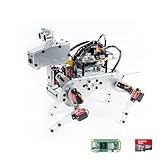
- Raspberry Pi AI Robot: powered by Raspberry Pi (5/4B/3B+/3B/Zero 2W), features 12 servos and sensors for vision, hearing, and touch. Integrated with ChatGPT-4o, it responds to complex queries. With app control and FPV, users can manage and see its view in real-time. It supports Python programming
- Realistic Movements: 12 powerful servos enable 32 actions, including walking, sitting, standing, shaking its head, wagging its tail, and performing playful tricks, closely mimicking a real and providing an engaging experience
- Rich Sensor Suite for Interactive Experiences: features ultrasonic, touch, gyroscope, sound, camera, speaker and microphone. These provide it with advanced hearing, vision, and touch, enabling it to see, detect obstacles, respond to touch, and recognize sounds, making interactions highly engaging
- Engaging Interactions with ChatGPT-4o: with ChatGPT-4o enables voice interactions and visual recognition, making it smarter and more responsive. Users can have natural conversations, solve math problems via the camera, and interpret gestures, creating diverse and fun interactions
- Comprehensive Learning Resources and Support: offers detailed online documentation, video tutorials, prompt technical support, and an active forum community, ensuring beginners can easily complete all projects and enjoy a great experience
Thunderbolt and Haystack are different layers
Launch coverage in Ars Technica reported that Thunderbolt is built on Haystack. That does not mean Haystack is the Thunderbolt application or a model.
- Thunderbolt is the client experience for chat, search, research, and automation.
- Haystack is the open-source orchestration framework underneath, used to compose agent pipelines, retrieval-augmented generation, and other AI workflows.
This layered design lets the client present a unified product while the orchestration framework handles parts of the workflow logic.
What self-hosting involves
The repository’s development instructions use Docker to start PostgreSQL and PowerSync, then run the backend and frontend. For self-hosted deployments, the project points users toward Docker Compose or Kubernetes documentation.
Rank #4

- AI-Powered Raspberry Pi Smart Car — PiCar-X: PiCar-X brings AI learning to life — powered by Openclaw and multi-LLMs including ChatGPT, Gemini, Grok, DeepSeek, Qwen, Doubao, Ollama (Local LLMs), and compatible with many more AI platforms. Featuring OpenCV, MediaPipe, TTS & STT, PiCar-X enables true AI vision and voice interaction — it can see, listen, talk, drive and think like an intelligent companion. Ideal for students (10+), educators, and engineers, PiCar-X is the perfect gateway to explore AI, robotics, and machine learning on Raspberry Pi 5/4/3B+/3B/Zero 2W (Raspberry Pi not included)
- Engaging Interactions with Multi-LLMs: PiCar-X, powered by Openclaw and multi-LLMs — including ChatGPT, Gemini, Grok, DeepSeek, Qwen, Doubao, and Ollama (Local LLMs) — and compatible with many other AI platforms, supports voice interaction and visual recognition to make the robot smarter and more responsive. Users can enjoy natural AI conversations, solve math problems through the camera, and interpret gestures, unlocking a world of diverse and fun AI-driven interactions
- Feature-rich and Adaptable: PiCar-X offers engaging applications like line following and obstacle avoidance, supports TTS (Text-to-Speech) and STT (Speech-to-Text) for interactive voice control, and includes a camera for video and vision recognition. It also comes with various sensors, while its customizable design enables a wide range of creative AI and robotics projects
- Versatile Programming Options: Catering to users of all skill levels, PiCar-X supports both Python and Scratch programming languages, allowing for flexible learning and skill development
- Simplified Assembly & Support: PiCar-X is perfect for beginners, yet learning with experienced users is recommended for best results. It comes with easy assembly instructions and forum support for smooth project completion
Those instructions show that self-hosting is an intended use case; they are not a promise that deployment will be simple for every organization. A real rollout still requires decisions about identity, secrets, networking, storage, backups, monitoring, model capacity, updates, and support ownership.
Independent reader supportYour contribution helps us test, update, and keep practical guides available for everyone.Project maturity and enterprise positioning
Thunderbolt’s README describes the project as under active development. Its current target is enterprise customers deploying on premises, and it says the project is preparing for enterprise production readiness. That wording is important: it does not establish that Thunderbolt is already production-ready for every organization.
The project lists enterprise features, support, and field engineering as part of its offering, but the reviewed material does not provide an independent security audit, reliability results, hardware compatibility list, pricing, or hands-on performance test. Teams should validate those areas directly before committing a production workload.
Recommended Free Tools
Who should evaluate Thunderbolt now?
Good fit for an early evaluation
- Organizations that want an open-source client they can host themselves.
- Teams with staff capable of operating databases, authentication, containers, and model-serving runtimes.
- Enterprises that need to compare local inference with OpenAI-compatible provider APIs.
- Developers interested in Haystack-based agents, retrieval, and workflow automation through a client interface.
Reasons to wait or limit the scope
- You require a completely offline product today.
- You need a turnkey model and inference service with no provider configuration.
- Your organization cannot yet take responsibility for self-hosted operations.
- You require independently verified security, compatibility, uptime, or cost data before testing.
What the April 2026 launch means
Launch coverage dated April 16, 2026 introduced Thunderbolt as Mozilla’s open-source AI client for organizations seeking control over models and deployment. The repository remains the more relevant source for current capabilities and caveats because its documentation can change as development continues.
The Bottom Line
Bottom line: Thunderbolt is a promising open-source client for organizations that want to assemble an AI stack on their own infrastructure. It gives you a choice of local runtimes such as Ollama or llama.cpp, or OpenAI-compatible providers, but it is not a foundation model and is not fully offline today. Treat it as an actively developed enterprise-oriented project to evaluate, not as a finished replacement for a managed AI platform.
Quick Recap
Product prices and availability are accurate as of the date/time indicated and are subject to change. Any price and availability information displayed on Amazon at the time of purchase will apply.

