
Conductive copper tape can form the wires in a simple paper circuit: run it from a battery’s positive terminal, through an LED, and back to the negative terminal to make a complete loop. The details that matter most are using tape suited to your folds and overlaps, orienting the LED correctly, and keeping every connection firm. This guide covers a low-voltage paper-art project—not household wiring or general-purpose electrical work.
What makes a paper circuit work?
A circuit needs an unbroken conductive path from a power source, through a device that uses electrical energy, and back to the source. Science World describes a complete circuit as “an uninterrupted path for electrons to flow from an energy source (i.e. battery or household power), through a device and back to the source.” In a paper project, copper tape provides that path, the battery supplies power, and the LED is the device, or load.
A break anywhere in the loop stops the current. A short circuit is an unintended path that lets current bypass the device; if the battery’s two sides are connected directly by tape, the LED may not be in the useful path at all. Plan a route that passes through the LED before returning to the battery. Science World’s paper-circuit lesson explains complete circuits, short circuits, and series and parallel layouts.
What materials do you need?
- Paper or cardstock.
- Conductive copper tape.
- One LED.
- A coin-cell battery.
- A way to hold the battery against the tape, such as a binder clip or folded paper.
- Optional craft supplies for decorating the project.
These are the core materials for a basic single-LED build. The dimensions in published activities are examples, not universal requirements: Science World lists 50 cm of 6 mm adhesive copper tape and a 3 V coin cell, either a 2032 or CR1220, for its activity. NASA’s helicopter activity instead specifies a 1/4-inch strip of double-sided conductive copper foil tape at least 16.25 inches long, two 5 mm LEDs, and a CR2032 battery. Those project-specific lists do not guarantee that any tape, LED, and battery combination will work together.
Quick wins for a faster PC:
Fix the driver behind crashes, sound loss and screen glitchesFind Drivers →Clear out junk files and repair common Windows errorsFree Scan →#1 Best Overall

- Strong Adhesive - Kirecoo copper tape [2inch, 33FT], The copper foil tape conductive adhesive is super sticky and is protected with an easy peel backing which make it can be used on most surfaces & is able to withstand all weather conditions.
- Highly Conductive - Our copper foil uses a highly conductive material with low resistance, has dual conductivity so current will flow through both sides and the adhesive. No need to worry that the copper tape conductive adhesive will reduce the effectiveness between components, making our emi shielding foil a excellent option for electrical projects, repairs and even paper circuits. Excellent alternative to conductive paints.
- EMI & RFI Shielding - This copper foil tape with conductive adhesive Shielding electric guitar to avoid interference, shield the pickup and control cavities of a guitar. Prevent radiating and interfering, making it an ideal guitar shielding tape option. Perfect for any guitar builder/ luthier.
- Good helper for gardening - This copper tape can for slugs. You can wrap copper tape around the base of small plants Works for keeping slugs & snail away! Seedlings to protect plants. This was the perfect eco friendly solution!
- Creative Decoration - Our copper tape is a desirable choice for decorating your home, making personalized wall vinyl’s, jewellery, stainless glass & more that will come in handy for various DIY & Creative projects. Also perfect for solder, birthday light card, paper circuit or repair such as LCD monitor mobile phone.
Coin-cell safety: Coin cells can cause severe harm if swallowed. Keep them away from young children and supervise children using them; do not leave loose cells within reach. The Lunar and Planetary Institute says its activity is not for children under 3 and calls for adult supervision with young children. Science World also warns that coin cells are extremely dangerous if swallowed.
Which side of copper tape conducts?
“Copper tape” does not describe one universal electrical construction. NASA distinguishes double-sided conductive copper foil tape, which conducts on both sides, from single-sided tape, which conducts on only one side. Adhesive conductivity is a separate detail: the Lunar and Planetary Institute specifies tape with conductive adhesive, while the University of Illinois’ CREDC lists both conductive-adhesive and non-conductive-adhesive tape as options.
Rank #2

- Package Included: This set includes 4 rolls of copper foil tape, each measuring 6mm/0.23 inches in width and 15m/49.2 feet in length, totaling 60m/196.8 feet.
- Strong Adhesion: This copper foil tape features a high-performance adhesive that securely bonds to a wide range of surfaces and cables. Supports manual twisting, bending, and tearing—no tools required for installation. Quickly peels off the backing paper for clean, smooth application every time.
- Dual-Sided Conductivity: Constructed with pure copper material and conductive adhesive, our copper foil tape offers dual-sided conductivity. It ensures stable current transmission while providing effective grounding. Ideal for creating solderable connection points and continuous circuit paths in repairs and electrical circuits.
- High-Efficiency Electromagnetic Shielding: Crafted from premium materials, this Pure Copper Foil Tape delivers exceptional electromagnetic interference (EMI) shielding performance, effectively protecting sensitive electronic equipment. It maintains strong adhesion and stable performance across diverse climates and environmental conditions.
- Widespread Application: This versatile copper foil tape is perfect for both creative and practical uses. In the garden, it creates an effective barrier to protect seedlings and plants from slugs and snails. For DIY projects, it’s ideal for crafting custom wall art, jewelry, paper circuits, and stained glass. It also provides strong, conductive adhesion for soldering, electrical repairs, and educational STEM activities, making it a go‑to material for makers and hobbyists.
Before building, check the product listing or datasheet for both face conductivity and whether the adhesive conducts. This matters at overlaps, folds, and tabs: a connection that looks physically joined may not make electrical contact if the relevant surface or adhesive is nonconductive. Choose a design that matches the tape rather than assuming every overlap will conduct.
For a first project, avoid crossing traces. The classroom guides establish the circuit concepts but do not provide one universal crossing technique; an insulating layer is a design concept, not a guaranteed construction method for every tape or paper combination.
Do these 3 things before closing this tab:
1Fix the driver behind crashes, sound loss and screen glitches2Repair Windows errors before they cause bigger problems3Scan for outdated or missing drivers - takes under a minuteRank #3
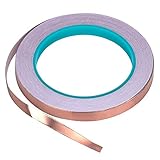
- [CONDUCTIVE ADHESIVE] – Double-sided Conductive means both sides of this tape will carry current so whether it's soldering, grounding or minor repairs, our tape will do the job, and do it well.The tape is also ideal for transformer, mobile phone, computer, PDA, PDP, and LCD monitor, PC, copier etc.
- [PERFECT FOR STAINED GLASS MAKERS] – Our tape has strong adhesive and is a great surface for soldering onto when creating your stained glass pieces.21.8yards has quick peal paper backing, making it easier to work with and providing a neater finish.
- [GREAT FOR EDUCATION AND CRAFTS] – The tape is an ideal size for creating paper circuits, a fun and easy way to introduce children to electronics. Malleable tape with strong adhesive can be moulded to most surfaces giving unlimited potential for craft projects.
- [EMI SHIELDING]– If you want to protect your small electronics from electromagnetic interference, our highly conductive tape is the quick and easy solution.
- [BE ATTENTION !!!] – Safety overrides all else , i hope you guys do it carefully no matter where the tape will be used in.
How do you connect the LED and battery?
- Sketch one closed route. Mark where the battery’s positive and negative terminals will meet the tape, then leave a gap in the route for the LED. Ensure the intended path goes through the LED.
- Lay the tape smoothly. Apply tape along the route, using continuous pieces where practical. Press it down firmly and avoid wrinkles, gaps, or loose ends.
- Bridge the gap with the LED. LEDs are polarized. In the Science World activity, the long lead connects to positive and the short lead to negative. If your LED has trimmed leads, use its markings or product instructions to identify polarity.
- Secure the LED leads. Make sure each lead touches its own side of the circuit without the two sides touching each other. Smithsonian’s technical guide recommends reinforcing delicate LED connections with another piece of copper tape over the LED lead and trace.
- Put the battery into the loop. Bring the positive and negative ends of the tape into contact with the matching battery terminals. A binder clip or folded paper can help hold the battery in place; check that it presses both contacts firmly without letting them touch each other directly.
- Test before decorating. If the LED lights, the loop is complete. Test the basic circuit before adding folds or decorations that could loosen a contact.
NASA’s project guide and the Lunar and Planetary Institute’s Electric Moon activity illustrate how tape and paper can be adapted to different project layouts. Smithsonian’s technical guide covers continuous tape turns and delicate LED connections.
Series and parallel: what changes when you add LEDs?
A series circuit places loads along one path; a parallel circuit gives loads separate branches. The distinction affects how a break behaves, but it does not by itself tell you whether a particular set of LEDs will work with a particular coin cell.
Rank #4

- ADEQUATE COPPER FOIL TAPE - Each roll is 50mm x 10m; Wide copper foil tape can wrap the cable, machine component, connection, fan, extendable antenna, computer component fully.
- ADHESIVE TAPE WITH GOOD FLEXIBILITY - The dual conductive tape can be twisted, bent, tore easily, enable you to use them by hand, no need to apply with other tool, one fit most of cables.
- COPPER FOIL TAPE - The copper tape can EMI shielding in electric machine to protect your electronics devices from electromagnetic interference.
- ARTS & CRAFTS- Copper conductive adhesive tape can be applied to stained glass, outdoor garden and home interior decorations.Copper foil tape also can paper circuits, electrical repairs, soldering, grounding.
- ARTS & CRAFTS- Copper conductive adhesive tape can be applied to craft, stained glass, outdoor garden and home interior decorations.Copper foil tape also can paper circuits, electrical repairs, soldering, grounding.
| Layout | Current paths | What a break can do | Design consideration |
|---|---|---|---|
| Series | One path through the loads | A break in that path interrupts the circuit for all loads on it. | Check that the specific LEDs and battery suit the arrangement. |
| Parallel | Separate branches | A break in one branch can affect that branch without necessarily breaking the others. | Check the actual components; the guides do not give a universal LED-combination rule. |
LED voltage and resistance can vary by color. Smithsonian gives red LEDs at 2 V and green or blue LEDs at 3 V as examples in its activity; those are examples, not guaranteed specifications for every LED. Adding LEDs does not automatically work with one coin cell. Smithsonian’s Engineering Circuits activity and Science World’s lesson introduce both arrangements.
Independent reader supportYour contribution helps us test, update, and keep practical guides available for everyone.Why won’t my LED light?
- Check the battery. Confirm it is oriented so its positive and negative terminals meet the intended contacts. If possible, test it with a known-working circuit or battery tester.
- Check LED polarity. Reverse the LED once to test whether it was backwards. Science World’s instructions put the long lead on positive and the short lead on negative.
- Look for an open connection. Inspect the whole route for a gap, loose battery contact, weak overlap, lifted tape, or wrinkled section. Smooth the tape and press contacts firmly; reinforce a fragile LED connection.
- Look for a shortcut. Make sure the positive and negative sides have not been joined by tape around the LED. The intended loop must pass through the LED rather than bypassing it.
- Swap in known-working parts. Test with another LED or battery if available before rebuilding the layout. Berkeley’s teacher guide recommends checking the LED and battery and smoothing the tape when troubleshooting.
Berkeley’s paper-stories teacher guide and the Smithsonian technical guide cover common checks such as tape continuity, component condition, and LED direction.
Free tools Windows power users keep installed
One-click scans. No signup required.
Best Value

- High Conductive Foil Tape: Our copper foil tape boasts outstanding conductivity, ensuring stable and reliable connections for your electronic projects, guaranteeing smooth signal transmission.
- Extraordinary Length: The size of foil tape is 0.25inchx82.5FT. Compared to other products, our copper tape conductive adhesive comes in longer lengths, providing you with more material to complete various projects, without being limited by length.
- Corrosion Resistance:Copper tape for soldering has high corrosion resistance, resisting the erosion of environmental factors such as moisture and chemicals. This property of foil tape helps extend the lifespan of stained glass.
- Easy Peel Design: With its unique design, our copper tape is easy to peel and leaves no residue, making your work more efficient and clean.
- Versatile Applications: Our conductive tape finds extensive applications in electronics fabrication, circuit repair, arts and crafts, and more, making it an indispensable tool in your projects.
What can you safely use this technique for?
These instructions apply to low-voltage, battery-powered paper projects such as cards and classroom art. They do not establish that craft copper tape is a substitute for insulated wire, or that this method is suitable for household wiring or other higher-voltage work. Follow the battery and component instructions for the specific project, and keep coin cells secured and supervised around children.
Quick Recap
Product prices and availability are accurate as of the date/time indicated and are subject to change. Any price and availability information displayed on Amazon at the time of purchase will apply.

