
iTechGuides is reader-supported. When you buy through links on our site, we may earn an affiliate commission. As an Amazon Associate I earn from qualifying purchases. Learn more
Liquid cooling is usually the better fit for high-density AI racks, while air cooling remains the simpler and often cheaper choice for moderate loads or facilities with spare CRAC/CRAH capacity. The right decision depends on rack power, heat-rejection equipment, retrofit constraints, water strategy, maintenance capability and the reliability level you must achieve.
Liquid systems move heat from processors into a controlled coolant loop, reducing the amount of heat dumped into the room. They can support denser deployments and lower fan energy, but add pumps, coolant distribution units (CDUs), heat exchangers, piping, leak controls and commissioning work. Air systems avoid liquid-leak risk and are easier to service, yet become difficult to scale when accelerator power exceeds the practical capacity of room air.
What “liquid versus air” means in an AI data centre
The comparison is about the complete heat path, not just the component attached to a GPU. Every design must move heat from silicon to the facility’s final heat-rejection system while keeping equipment within its allowable temperature and humidity range.
Quick wins for a faster PC:
Clear out junk files and repair common Windows errorsFree Scan →Fix the driver behind crashes, sound loss and screen glitchesFind Drivers →Repair Windows errors before they cause bigger problemsFix Now →In a conventional air-cooled room, server fans push air through heat sinks. Hot exhaust enters the room, returns to computer room air-conditioning or air-handling equipment, and is cooled before being supplied again. A direct-liquid system places a cold plate on the processor or accelerator. A water or water-and-glycol loop carries heat to a CDU, where a heat exchanger transfers it to the facility loop. The facility loop then rejects heat through chillers, dry coolers, cooling towers or another approved method.
#1 Best Overall

- T2 copper base plate,401W/m.k high thermal conductivity ,Strengthen theral conductivity,Increase heat dissipation area.0.3MM jet microchannel toiprove heat absorption area UP to 44 waterways,increasing the water area to 10723.993mm².
- Matte texture craftsmanship,using high-quality aluminum material,with sandwich installation providing all-round protection.Ultra high wind pressu reand airflow can quickly dissipate heat through hin/thick cold pipes,effectively improving the heat dissipation and cooling of the water cooling system.
- Adopting high-performance split type water cooling pump to provide powerful power for the water cooling system.
- Ensure to with stand installation pressure while using a copper base thickness of 0.35mm,effectively reduce the thermal resistance of copper lpates and improve thermal conductivity efpciency.Made of all metal material that is not easily damaged,deformed,or aged,ensure the stability of heat dissipation performance and bave a long service life.
- Using EPMD material braided bube,it has good heat resistance and furability,can operate stably for a long time in high load working environments,ensuring performance and material quality.
The U.S. Department of Energy Federal Energy Management Program describes the distinction precisely: “Direct liquid cooling systems transfer the heat generated by the IT equipment directly to a recirculating chilled water loop rather than transferring the heat to the room air and then moving the heat from the air to the chilled water loop.” That shorter heat path is the main reason liquid becomes attractive as AI rack density rises.
How the main cooling architectures work
Air cooling
Air cooling uses server fans, heat sinks, room air distribution, CRAC or CRAH units, and a heat-rejection plant. It is mature, familiar to facilities teams and compatible with a wide range of servers. Containment systems can keep hot and cold air separated, improving predictable inlet temperatures and reducing bypass air.
Its limitation is heat capacity per unit of airflow. As accelerator boards consume more power, the room needs larger air volumes, tighter supply temperatures, more fan power and, eventually, additional air handlers or chilled-water capacity. Cable trays, raised floors, structural loads and aisle geometry can constrain those upgrades.
PC Slower Than It Used to Be?
A free scan shows the junk files, broken settings and background clutter dragging Windows down - then fixes them in one click.Free scan · Windows 10 & 11Outdated Drivers Are Slowing You Down
One free scan finds every outdated or missing driver and matches the right update for your exact hardware.Free scan · exact hardware matchDirect-to-chip liquid cooling
Direct-to-chip designs attach cold plates to high-power CPUs, GPUs or other accelerators. A secondary loop circulates coolant through those plates and back to a CDU. The CDU normally includes pumps, controls, filtration and a heat exchanger that separates the IT coolant loop from the facility water loop.
Rank #2
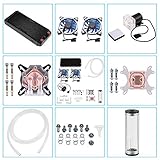
- 【Professional Water Cooling Kit】This liquid CPU cooler kit provides a 240mm heat sink within screw pack+2pcs LED fan+universal CPU block within 4pcs screws+universal GPU Block within 4pcs screws+cylindrical water reservoir (Including screw pack+2pcs plastic bracket+2pcs metal bracket)+transparent hose water pump with shock pad+a set of water pipe connectors,hose clamps and plugs
- 【High Performance】The CPU/GPU block is constructed with a copper base to provide exceptional heat transfer and cooling performance.The extreme performance fans offer a high air static pressure with lower noise. 9W 600L / H G1/4 Thread size High quiet water Pump,high stability,long lasting.Easy and intuitive installation and setup,set your fan and pump speeds to their lowest possible noise level while still keeping your system exceptionally cool
- 【Super Water Circulation Cooling System】240mm Heat Sink: Provide the excellent heat dissipation, as you need for highly overclocked desktop processors.160mm high capacity cylindrical water reservoir is manufactured from transparent acrylic so that the circulation system is visible.Upgraded flexible anti-explosion, hoses enable a space-saving installation and exceptional durability
- 【Universal Water Cooling Block】The CPU water cooling block made of copper and transparent plexiglass suitable for / Platform,the 0.8MM parallel waterway G1/4 universal thread GPU water cooling block made of copper and POM high temperature materials support 9.5mm ID / 12.7mm OD PU tube,or 10mmID/16mmOD solid tube,or 8mmID/12mmOD silicon tube.Complete Accessories,you don't have to worry about installation at all
- 【Quality Service】This liquid CPU cooler kit will dramatically improve heat dissipation experience, especially in terms of stability, silence, efficiency, and convenience.If this product has any quality problems or you have any questions about this product, you can us at any time. We have a professional customer service team that will provide you with the best service. will do our best to solve your problem in time, please rest assured to buy
Most direct-liquid servers still use some air cooling for memory, storage, power supplies and other components. The room therefore needs a residual air system, but its required capacity can be much lower than for an entirely air-cooled rack.
Rear-door heat exchangers
A rear-door heat exchanger replaces or supplements the server rack door with a liquid-cooled coil. Exhaust air passes through the coil before entering the room, removing a substantial portion of rack heat without modifying every server. This approach can be useful when a facility is being retrofitted and the existing servers cannot accept cold plates.
Rear-door units still require piping, CDUs or facility-water connections, condensate control where applicable, door weight management and sufficient clearance for service. They are a bridge between conventional air and direct-to-chip designs rather than a universal substitute for either.
Immersion cooling
Immersion places servers in a dielectric fluid, either in a single-phase bath or a two-phase system. It is a separate architecture with different fluid compatibility, sealing, maintenance, lifting and warranty requirements. Drives, cables, seals and service procedures must be validated for the chosen fluid. Do not treat immersion as a minor variation of direct-to-chip cooling when planning procurement or operations.
Rank #3

- Minimalist design,pure design structure brings comfortable visual experience,enhances MOD personalized layout,fully showcases the beauty of hardwre.
- T2 copper material bottom plate,with a high thermal conductivity coefficient of 401W/m. k,enhances thermal conductivity and improves heat dissipation area.0.03 jet microchannel enhances heat dissipation and provides strong heat dissipation capability for water cooling system.
- High temperature aluminum welding with high thermal conductivity efficiency. The contact area between the 11 water channels ,effectively enhancing the heat dissipation capacity. Ultra high wind pressure and air volume can penetrate thin/thick cold exhaust pipes. Quickly remove heat and efficiently improve the heat dissipation and cooling of water cooling systems.
- Adopts a high-performance split type water cooling pump,providing strong power for the water cooling system. Speed:7000 RPM,head flow rate:7M 450L/H. While ensuring installation pressure,using a copper bottom thickness of 0.35mm effectively reduces the thermal resistance value of the copper plate and improves thermal conductivity efficiency. Surface passivation treatment to prevent oxidation. Passivation increases thermal resistance,slightly higher temperature.
- Using EPDM material woven tube,it has good heat resistance anddurability. Can operate stably for a long time in high load working environments,ensuring performance and material assurance.
Efficiency: where liquid cooling gains are real
Higher rack density
Liquid transports heat more effectively than air, so a rack can carry more accelerator power without forcing a proportional increase in airflow. This is especially valuable for tightly packed training or inference clusters where several high-power GPUs share a rack.
Density is a design variable, not a guaranteed outcome. The achievable rack load depends on cold-plate design, coolant temperature, flow rate, manifold capacity, CDU sizing, facility-water temperature and the heat-rejection plant. Ask vendors for a complete rack-level thermal envelope rather than a processor-only claim.
Lower fan and air-handler work
When liquid removes most processor heat, server fans can run more slowly and room air handlers can be smaller or operate at lower airflow. That can reduce parasitic electricity use. The saving is partly offset by CDU pumps, control valves and any additional facility pumps, so measure the whole cooling chain.
Do these 3 things before closing this tab:
1Clear out junk files and repair common Windows errors2Scan for outdated or missing drivers - takes under a minute3Repair Windows errors before they cause bigger problemsSupply-temperature opportunities
Liquid loops may be able to operate at temperatures that permit more hours of dry cooling or economiser operation, depending on the cold plates, humidity conditions and equipment limits. Warmer water can reduce chiller lift, but only if the IT hardware and control strategy allow it. Raising supply temperature without checking dew-point protection, corrosion limits and manufacturer specifications can create condensation or reliability problems.
Rank #4

- All-in-one Custom Cooling Kit: Comes with 2×420mm aluminum radiator, 24V water pump, 6 cooling fans, 24V power supply, water manifold, tubes, clamps and screws for full liquid cooling loop assembly.
- Dual 420MM Aluminum Radiator: Enlarged heat dissipation area with dense fins greatly improves thermal efficiency for high power CPU, GPU and workstation equipment.
- Stable 24V Circulation System: Matched 24V water pump and dedicated power supply offer steady, high-flow coolant circulation, supported by water manifold for balanced liquid distribution.
- Powerful Cooling Airflow: Equipped with six cooling fans to boost heat exhaust, effectively lower hardware temperature during overclocking, gaming and heavy graphic rendering.
- Complete Installation Accessories: Pre-matched silicone tubes, anti-leak clamps and mounting screws enable quick assembly, compatible with most full-tower cases supporting 420mm radiators.
PUE and WUE must be considered together
Power usage effectiveness (PUE) captures total facility energy divided by IT energy. Water usage effectiveness (WUE) tracks water consumption relative to IT energy. A closed secondary liquid loop can reduce evaporative losses inside the IT circuit, but the site may still consume water if heat is rejected through cooling towers. A dry cooler can reduce operational water use while increasing electrical demand in hot weather.
Compare seasonal PUE and WUE for the actual climate, load profile and heat-rejection equipment. A liquid system that looks efficient at full load may have different results at low utilisation, when pumps and controls continue running while IT heat output falls.
Cost: capital, operating expense and total ownership
What an air-cooled deployment typically needs
- CRAC or CRAH units, chillers or packaged cooling equipment.
- Supply and return air paths, containment, dampers and controls.
- Server fans and heat sinks sized for the equipment load.
- Electrical capacity for compressors, fans and pumps.
- Maintenance access for filters, belts, coils, valves and refrigeration equipment.
If the building already has adequate air-side capacity, reusing it can make air cooling the lowest-capital option. The apparent saving disappears if new high-density racks require major chiller, duct, floor, containment or electrical upgrades.
What liquid cooling adds
- CDUs with pumps, heat exchangers, filtration, sensors and controls.
- Supply and return piping, rack manifolds, quick-disconnects and isolation valves.
- Cold plates, hoses or rear-door coils compatible with the server platform.
- Leak detection, drip containment, automatic isolation and drain or fill points.
- Water-treatment or coolant-quality equipment and a commissioning programme.
- Spare pumps, valves, sensors, hoses and other components with defined replacement intervals.
The International Energy Agency’s 4E review identifies high initial cost, standardisation and long-term reliability as adoption considerations. Liquid projects also require engineering and commissioning expertise that may not exist in an air-only facility.
Best Value

- Complete Custom Water Cooling Kit: Packed with 240mm aluminum radiator, 12V DDC pump, 2 cooling fans, silicone tube, clamps and screws, all essential accessories integrated for one-stop PC liquid cooling setup.
- Efficient 240MM Aluminum Radiator: High-density fin structure enhances thermal conductivity, rapidly dissipates heat from CPU/GPU to maintain low temperature during overclocking and heavy gaming tasks.
- Stable 12V DDC Water Pump: Offers consistent coolant circulation with low noise and minimal vibration, ensures smooth water loop operation for long-duration stable cooling performance.
- Leak-Proof & Durable Pipeline Set: Soft silicone tubes cooperate with matched hose clamps to avoid coolant leakage, resistant to aging and common PC cooling fluids for extended service life.
- Easy Universal Installation: Equipped with full mounting screws and standard-size accessories, fits most PC cases supporting 240mm radiators, friendly for both new DIYers and experienced PC modders.
Operating-cost trade-offs
| Cost area | Air cooling | Liquid cooling |
|---|---|---|
| Energy | Fan, air-handler, chiller and containment energy can rise sharply with density. | Lower room-air work may be offset by CDU and loop-pump energy. |
| Water | Depends mainly on the site’s heat-rejection plant; air itself does not eliminate tower water use. | Closed IT loops limit internal evaporation, but towers or evaporative heat rejection can still consume water. |
| Maintenance | Filters, fans, coils, compressors, dampers and refrigerant systems require service. | All air-side maintenance remains, plus coolant testing, pumps, valves, manifolds and leak controls. |
| Expansion | Adding dense racks may trigger new air handlers, chillers or containment work. | Expansion depends on CDU capacity, pipe routes, floor loading and available facility-water flow. |
| Downtime exposure | Work is familiar and often isolated to air-handling equipment. | Draining, flushing or modifying a loop can require planned maintenance windows. |
A practical total-cost method
- Define the IT forecast. Record current and planned rack power, accelerator mix, utilisation profile and expected refresh dates.
- Map the existing plant. Document available chilled-water flow, supply temperature, chiller capacity, electrical headroom, floor loading and pipe routes.
- Price the complete heat path. Include CDUs, manifolds, controls, containment, commissioning, spares, water treatment and any structural or electrical work.
- Model part-load operation. Compare pump, fan, chiller and cooling-tower energy at the loads you will actually run, not only at design peak.
- Assign reliability costs. Include leak-response equipment, staff training, spare inventory, testing and the financial impact of a planned or unplanned outage.
- Set a review horizon. Compare capital plus energy, water, maintenance and replacement costs over the expected server life and facility expansion schedule.
Reliability and leak prevention
Liquid-specific failure modes
| Failure mode | What can happen | Controls |
|---|---|---|
| Hose or fitting leak | Coolant reaches equipment, floor or cable pathways. | Double-check couplings, drip trays, leak sensors, isolation valves and documented inspection. |
| Pump failure | Flow falls and chip temperatures rise quickly. | N+1 pumps where justified, flow and pressure alarms, automatic workload throttling and tested bypasses. |
| Blocked filter or manifold | Some cold plates receive insufficient flow. | Filtration, differential-pressure monitoring, flushing and balanced manifold design. |
| Coolant degradation | Corrosion, deposits, biological growth or loss of thermal performance. | Defined chemistry limits, sampling, compatible materials and controlled top-up procedures. |
| Control or sensor error | Valves or pumps operate outside the safe thermal envelope. | Independent alarms, fail-safe states, calibrated sensors and change control. |
Designing a leak-response system
- Detect early. Place sensing cable or point sensors beneath CDUs, manifolds, rack connections and other credible leak paths. Integrate alarms with the building-management and incident systems.
- Isolate the smallest section. Provide labelled valves so one rack or manifold can be shut off without removing an entire row from service.
- Contain the fluid. Use trays, raised thresholds, sealed penetrations and a documented drainage route. Keep electrical distribution and network paths out of likely drip zones.
- Stop heat production safely. Define automatic or operator-triggered actions for pump loss, low flow, high temperature and leak alarms. A controlled workload reduction is safer than an abrupt thermal trip.
- Practise recovery. Train technicians to isolate, drain, repair, refill, purge air, verify chemistry and return equipment to service without introducing contamination.
Air-cooling reliability
Air cooling removes liquid-leak risk but has its own single points of failure: fan motors, belts, compressors, control boards, dampers, filters and chilled-water valves. Hot-aisle or cold-aisle containment can fail through open doors, missing blanking panels or poorly sealed cable openings. Monitor server inlet temperature, differential pressure, fan speed and CRAC/CRAH alarms rather than relying only on room averages.
Redundancy is a system property
N+1 CDUs do not guarantee resilience if all units share one electrical bus, one chilled-water header or one control network. Check redundancy at pumps, power, valves, heat exchangers, networked controls and the final heat-rejection plant. Verify that maintenance can be performed without dropping below the thermal limit for the remaining IT load.
Water, climate and heat rejection
Liquid cooling does not automatically mean “waterless.” The IT loop may be sealed, yet the facility can still use substantial water in evaporative cooling towers. Conversely, an air-cooled data centre connected to a water-cooled chiller plant also has a water footprint. The meaningful comparison is the entire site boundary.
Free tools Windows power users keep installed
One-click scans. No signup required.
- Dry coolers: minimise operational water use but can require more fan energy and larger equipment during hot periods.
- Cooling towers: can reject heat efficiently but consume makeup water and require blowdown management.
- Hybrid systems: switch between dry and evaporative modes according to ambient conditions, water availability and electricity prices.
- Warm-water designs: may reduce chiller lift if chip and coolant limits permit, but require careful dew-point and material compatibility controls.
Use local weather data, utility tariffs, water restrictions and seasonal IT loads when evaluating options. A design optimised for a cool, dry climate may not deliver the same PUE or WUE in a hot, humid region.
Which architecture fits your situation?
| Situation | Likely starting point | Reason and condition |
|---|---|---|
| Existing room has spare CRAC/CRAH and moderate rack loads | Air cooling | Reuse of installed infrastructure can minimise capital and operational complexity. |
| New AI hall with very high accelerator density | Direct-to-chip liquid | Moves hotspot heat directly to a CDU and preserves rack density without extreme airflow. |
| Mixed legacy servers and a small number of dense racks | Hybrid air plus rear-door or direct liquid | Targets the highest loads while retaining existing air service for conventional racks. |
| Retrofit cannot modify server boards | Rear-door heat exchangers | Removes exhaust heat at the rack boundary, subject to piping, door weight and service clearances. |
| Specialised environment with validated fluid-compatible hardware | Immersion | Can provide high heat-transfer capability, but requires a distinct service and warranty model. |
Deployment roadmap for a liquid-cooled AI cluster
- Set thermal and business requirements. Specify rack power, accelerator type, inlet-temperature limits, availability target, expansion rate, water constraints and acceptable maintenance windows.
- Survey the facility. Confirm floor loading, overhead or underfloor routes, access paths, electrical capacity, chilled-water quality, pipe connection points and drainage.
- Select the architecture. Decide between direct-to-chip, rear-door, immersion or a hybrid. Document which components remain air-cooled.
- Validate hardware compatibility. Obtain manufacturer approval for cold plates, hoses, coolant chemistry, quick-disconnects and any warranty conditions. Check memory, storage, power-supply and networking thermal limits.
- Size the CDU and distribution. Calculate flow, pressure drop, heat load, pump redundancy, heat-exchanger approach temperature and manifold balancing. Leave capacity for the next expansion phase.
- Engineer safety systems. Place leak sensors, isolation valves, containment, alarms, emergency procedures and safe drain/fill points before equipment arrives.
- Commission in stages. Pressure-test and flush piping, verify water quality, calibrate sensors, test failover and run a partial-load thermal test before connecting the full cluster.
- Prove operational procedures. Simulate pump loss, leak alarm, sensor failure, power transfer and controlled workload reduction. Record response times and corrective actions.
- Baseline performance. Capture rack inlet temperatures, coolant supply and return temperatures, flow, pump power, fan power, facility energy and water use. Use these readings for later capacity and efficiency decisions.
Operations and maintenance checklist
Daily or continuous monitoring
- Rack inlet and outlet temperatures, coolant supply and return temperatures.
- Flow, pressure, differential pressure and pump status for every active loop.
- Leak sensors, drip trays, CDU alarms and valve position.
- Server fan speed, accelerator throttling and workload errors.
- Facility PUE and WUE trends, with ambient conditions attached.
Scheduled maintenance
- Inspect couplings, hoses, manifolds, trays and sensor wiring.
- Sample coolant for chemistry, particles, corrosion indicators and biological activity according to the fluid supplier’s limits.
- Replace or clean filters and verify differential-pressure alarms.
- Exercise isolation valves and confirm that labelled valves match the as-built drawings.
- Test pump and power redundancy under a controlled maintenance window.
- Review spare pumps, sensors, hoses, valves and compatible coolant stock.
Keep an updated loop diagram, valve schedule, coolant safety data, contact list and recovery runbook at the facility and in the change-management system. Unrecorded modifications are a common cause of slow leak response and incorrect isolation.
Troubleshooting common problems
Accelerator temperatures rise while room conditions look normal
- Check coolant flow and differential pressure at the affected manifold.
- Look for a closed valve, blocked filter, trapped air or an unbalanced branch.
- Confirm CDU supply temperature and heat-exchanger operation.
- Check whether workload or firmware changes increased power beyond the original thermal design.
A leak alarm activates but no liquid is visible
- Treat the alarm as genuine until the sensor and cable are inspected.
- Isolate the smallest loop section and reduce IT load according to the runbook.
- Check condensation, sensor placement and recent maintenance activity.
- Do not reset repeatedly without identifying the cause; intermittent alarms can precede a larger leak.
Air-cooled racks show uneven inlet temperatures
- Verify containment doors, blanking panels and cable openings.
- Check CRAC/CRAH airflow, filter condition and damper positions.
- Look for recirculation, bypass air or racks exceeding the aisle’s design load.
- Redistribute equipment or add targeted cooling only after airflow measurements confirm the constraint.
Procurement questions that prevent expensive surprises
- What rack power and coolant temperature are guaranteed, and under what inlet and ambient conditions?
- Which components are factory-tested as a complete system, and which interfaces are the operator’s responsibility?
- What coolant chemistry, filtration level, materials and refill process are required?
- How are leaks detected, isolated and reported to the building-management system?
- Can pumps, CDUs, controls and heat exchangers be maintained without taking the full cluster offline?
- What spare parts have defined lead times, and which parts are proprietary?
- How does liquid installation affect server warranty, field service and decommissioning?
- What commissioning data will be delivered for flow, pressure, temperatures, energy and water use?
Bottom line
Choose liquid cooling when AI rack density, expansion plans or room-air limits make conventional airflow the bottleneck. Choose air cooling when loads are moderate and existing CRAC/CRAH capacity can be reused without major upgrades. For mixed environments, a staged hybrid approach can cool the densest racks with liquid while preserving air service for the rest.
The winning design is the one that meets thermal, cost, water and availability targets across its full lifecycle. Evaluate the CDU, pumps, piping, controls, heat rejection, maintenance skills and failure procedures alongside the servers; comparing only the cold plate or only the chiller will give a misleading result.
Recommended Free Tools
Quick Recap
Product prices and availability are accurate as of the date/time indicated and are subject to change. Any price and availability information displayed on Amazon at the time of purchase will apply.

