
Quick wins for a faster PC:
Clear out junk files and repair common Windows errorsFree Scan →Fix the driver behind crashes, sound loss and screen glitchesFind Drivers →Repair Windows errors before they cause bigger problemsFix Now →iTechGuides is reader-supported. When you buy through links on our site, we may earn an affiliate commission. As an Amazon Associate I earn from qualifying purchases. Learn more
The once-uncertain claim that LG Display to expand Tandem WOLED panel sizes with a 39-inch 5K ultrawide and 4K option in 2026 is now partly true: the 39-inch panel became LG Electronics’ UltraGear evo GX9, model 39GX950B-B, while the separate 27-inch 4K panel remains a teased or planned option without fully documented commercial specifications.
That distinction matters because LG Display develops panels, while LG Electronics sells finished monitors. The December 2025 roadmap described panel sizes and technology; later announcements confirmed a retail GX9 with 5120 × 2160 resolution, 165Hz at native 5K2K, a 330Hz Wide Full HD mode, and market-specific pricing.
Key takeaways
- The 39-inch LG Display Tandem WOLED concept became the LG UltraGear evo GX9, model 39GX950B or 39GX950B-B.
- The GX9 has a 5120 × 2160 5K2K resolution, 21:9 aspect ratio, 1500R curve, and approximately 143 PPI.
- Native 5K2K operation is specified at 165Hz; the 330Hz mode uses the lower Wide Full HD resolution.
- LG Canada announced a CAD$2,199.99 starting MSRP and early-May 2026 availability, while a US announcement reported US$1,799.99 and April 7, 2026 pre-orders.
- The separate 27-inch high-PPI panel was interpreted as a 4K Tandem WOLED product, but its final model, price, refresh rate, brightness, and availability remain undocumented in the retrieved first-party evidence.
What did LG Display actually announce?
LG Display announced a panel roadmap, not a complete LG Electronics monitor launch. In a December 2025 report ahead of CES 2026, the company’s teasers pointed to a 39-inch 5K ultrawide panel and a separate 27-inch high-pixel-density panel. The report described the 27-inch panel as a likely 4K option, but noted that LG Display had not confirmed its exact resolution, refresh rate, brightness, price, monitor partners, or launch timing.
Recommended Free Tools
The same report placed the new sizes alongside existing Tandem WOLED monitor panels, which were primarily 27-inch 1440p products with 280Hz or 540Hz refresh rates. The original roadmap therefore established the direction of the panel technology without establishing which finished monitors buyers would eventually be able to purchase. Notebookcheck’s December 2025 coverage records those original qualifications.
#1 Best Overall

- The World’s First 39" 5K2K OLED Gaming Monitor - This 39-inch 5K2K (5120×2160) UltraGear hits the sweet spot of size, resolution, and speed. The wide 21:9 format and 1500R curve expand your field of view, while the dense pixel count delivers crisp detail across every scene in the games you love.
- AI Upscaling to 5K2K—No GPU Upgrade Required - UltraGear evo’s built-in processor uses AI Upscaling to enhance content toward the display’s 5K2K resolution. It analyzes the source signal to improve detail and clarity—helping games and video look sharper without requiring a GPU upgrade.
- Next-Gen Brilliance with 4th Gen RGB Tandem OLED - 4th Gen Primary RGB Tandem OLED delivers up to 335 nits typical brightness with improved power efficiency. Its advanced 4-stack RGB structure enhances contrast, sharpens detail, and keeps color precise across every frame.
- UL-Verified for a "Perfect" Visual Experience - Perfect Black: UL-verified Perfect Black delivers true black levels to enhance perceived brightness and contrast, whether it's bright or dark around you. Perfect Color and 100% Color Fidelity- UL verified to deliver accurate color expression even under varying lighting conditions, from low light to bright ambient environments. UL-verified Perfect Reproduction ensures game content is faithfully rendered on screen, preserving intended color and detail. This certification reflects real-world content accuracy.
- Deeper Detail with VESA DisplayHDR True Black 500 - VESA DisplayHDR True Black 500 reveals rich blacks and nuanced shadow detail—even in dark scenes. Combined with a 1.85M:1 contrast ratio, up to 99.5% (typical) DCI-P3 color, and Delta E≤2 accuracy, visuals appear vivid, precise, and true to the creator’s intent.
Is the 39-inch Tandem WOLED monitor a real product?
Yes. LG Electronics turned the 39-inch concept into the UltraGear evo GX9, identified as model 39GX950B or 39GX950B-B. LG’s Canadian announcement describes the GX9 as a 39-inch curved OLED gaming monitor using fourth-generation Primary RGB Tandem OLED, the company’s product terminology for the architecture commonly called Tandem WOLED in industry coverage.
LG Electronics Canada announced pre-orders on May 1, 2026, with retail availability stated for early May. LG’s official GX9 product page is the appropriate reference for the Canadian model rather than the earlier panel-roadmap reports.
What are the confirmed LG UltraGear GX9 specifications?
The following specifications come from LG Electronics Canada’s announcement. Regional model suffixes, menus, included accessories, and availability can differ, so buyers should check the product page for their country before ordering.
| Feature | Confirmed GX9 detail |
|---|---|
| Model | LG UltraGear evo GX9, 39GX950B / 39GX950B-B |
| Panel size | 39 inches |
| Resolution | 5120 × 2160, commonly called 5K2K |
| Aspect ratio | 21:9 |
| Curvature | 1500R |
| Pixel density | 143 PPI |
| Native-resolution refresh | 165Hz at 5120 × 2160 |
| Dual-mode refresh | 330Hz at Wide Full HD |
| Response time | 0.03ms GtG |
| HDR certification | VESA DisplayHDR True Black 500 |
| Variable refresh rate | NVIDIA G-SYNC Compatible and AMD FreeSync Premium Pro |
| Video connections | DisplayPort 2.1 UHBR20 and HDMI 2.1 |
| USB-C | USB-C with up to 90W power delivery |
| Brightness listed by LG Canada | Up to 335 nits typical brightness |
LG’s Canadian announcement supplies the model, display modes, ports, HDR certification, and brightness information in one place. Read LG Electronics Canada’s pricing and availability announcement for the market-specific specifications.
How does the GX9’s 5K2K resolution compare with 3440 × 1440?
A 5120 × 2160 monitor provides substantially more desktop detail than a conventional 3440 × 1440 ultrawide. The GX9’s resolution contains approximately 11.06 million pixels, compared with approximately 4.95 million pixels for 3440 × 1440, so 5K2K has roughly 2.24 times as many pixels.
| Display format | Pixel count | Practical implication |
|---|---|---|
| 5120 × 2160 5K2K | Approximately 11.06 million | More room for timelines, documents, applications, and detailed game scenes |
| 3440 × 1440 ultrawide | Approximately 4.95 million | Easier for a graphics card to drive, but lower desktop detail |
At 39 inches, the GX9’s 143 PPI is close to the density of a 32-inch 4K monitor. That makes the GX9 a sharper productivity display than a 39-inch 3440 × 1440 screen, particularly for text, code, spreadsheets, and interface controls. The extra pixels also impose a much heavier graphics workload.
The pixel-count comparison and 143 PPI figure are reported in the original roadmap coverage and reflected in LG’s later product announcement. The original 5K2K panel report provides the relevant comparison with 3440 × 1440 displays.
The Tool Desk
Outbyte Driver Updater FREEFix the driver behind crashes, sound loss and screen glitchesFind Drivers →Outbyte PC Repair FREERepair Windows errors before they cause bigger problemsFix Now →What does the GX9’s 165Hz and 330Hz dual mode mean?
The GX9 offers 165Hz at its full 5120 × 2160 resolution and 330Hz at the lower Wide Full HD resolution. The 330Hz figure does not mean that the monitor runs at 330Hz while displaying native 5K2K.
| Mode | Resolution | Best suited to | Main trade-off |
|---|---|---|---|
| High-detail mode | 5120 × 2160 | Single-player games, simulation, creative work, and general desktop use | Requires substantially more GPU performance |
| High-refresh mode | Wide Full HD | Competitive games where frame rate and motion responsiveness matter most | Much lower image detail than native 5K2K |
The dual-mode design lets one display switch between an expansive, detailed ultrawide image and a lower-resolution competitive mode. Actual refresh rates depend on the graphics card, connection, game, settings, cable, and monitor configuration. DisplayPort 2.1 UHBR20 and HDMI 2.1 provide modern connectivity, but a DisplayPort 2.1 port alone does not guarantee that every graphics card and cable combination will achieve the maximum mode.
Buyers should treat 165Hz at 5120 × 2160 as the GX9’s high-detail specification and 330Hz at Wide Full HD as a separate gaming mode. LG’s announcement includes the GX9’s refresh-rate and connection qualifications.
What does Tandem WOLED mean on the GX9?
Tandem WOLED refers to an OLED architecture that stacks organic-emitting structures to improve efficiency, brightness potential, and longevity compared with earlier OLED approaches. LG Display previously used the name Primary RGB Tandem OLED, while LG Electronics describes the GX9 implementation as fourth-generation Primary RGB Tandem OLED.
Rank #2

- 39” OLED Display with 21:9 Aspect Ratio - With a large 39” display, 21:9 aspect ratio and a dramatic curved OLED screen, you’ll feel like you’re actually in the game. Experience next-level gaming performance with LG UltraGear OLED.
- 800R Curved Screen - This UltraGear OLED monitor's dramatic and steep 800R curve draws you in with game play by extending the periphery to feel like you're surround by the action.
- 240Hz Refresh Rate - Gear up for smooth gameplay with an ultra-fast 240Hz OLED display. The faster speed lets you respond quickly to opponents and stay a step ahead of the competition.
- 0.03ms Response Time - Enjoy smoother scenes with less lag or ghosting thanks to LG UltraGear OLED's nearly instantaneous 0.03ms (GtG) response time.
- Display HDR True Black 400 & 1.5M:1 Contrast Ratio - DisplayHDR True Black 400 displays rich blacks and vivid color. The benefit of the 1.5M:1 Contrast Ratio for gaming and streaming content, is impeccable image detail in dark scenes for a stunning visual experience.
“Tandem WOLED” and “Primary RGB Tandem OLED” should not be treated as proof that every panel using the terminology performs identically. Panel size, subpixel arrangement, coating, electronics, thermal design, brightness limits, firmware, and refresh modes can all change the experience of a finished monitor.
Coverage around the 39-inch panel also highlighted an RGB-stripe layout. That layout may affect text rendering and perceived color edges, but the retrieved dossier does not contain independent testing of the GX9’s text clarity, color accuracy, uniformity, or subpixel behavior. Buyers who use the monitor for professional color-critical work should wait for measurements rather than relying on architecture names alone.
How bright is the GX9?
The GX9’s brightness figures need measurement context. TechRadar reported a 1500-nit small-window peak figure during the earlier panel discussion, while LG Canada later listed up to 335 nits of typical brightness for the finished monitor. Those figures are not equivalent measurements: a small highlight peak and sustained or typical screen brightness describe different conditions.
The GX9 carries VESA DisplayHDR True Black 500 certification, but the certification and peak figure do not establish the monitor’s full-screen sustained brightness. Independent testing is still needed to assess HDR highlight behavior, automatic brightness limiting, uniformity, and real-world performance. TechRadar’s earlier report explains the 1500-nit peak-brightness context, while LG Canada’s later announcement lists the typical-brightness claim.
What’s actually slowing this PC down?
Pick the symptom - the matching free tool is one click away.
What is the 27-inch 4K Tandem WOLED option?
The 27-inch option is less certain than the GX9. LG Display teased a separate 27-inch high-PPI Tandem WOLED panel, and industry coverage interpreted the panel as a likely 4K or Ultra HD product. The initial teaser did not explicitly establish a 3840 × 2160 resolution.
| Detail | Status of the 27-inch option |
|---|---|
| Panel size | Teased as 27 inches |
| OLED technology | Described or interpreted as Tandem WOLED |
| 4K resolution | Strong industry interpretation, not fully specified in the initial teaser |
| Final model number | Not established in the retrieved first-party evidence |
| Finished monitor brand | Not established in the retrieved first-party evidence |
| Refresh rate | Not established |
| Brightness and coating | Not established |
| Price and availability | Not established |
The careful conclusion is that LG Display planned or explored a 27-inch high-PPI Tandem WOLED panel, widely understood to be a 4K panel, but the retrieved evidence does not support presenting a specific shipping 27-inch LG Tandem WOLED monitor as confirmed. The original report preserves the uncertainty around the 27-inch panel.
Is LG’s 27-inch GM9 the teased 4K OLED monitor?
No. LG Electronics’ 27-inch UltraGear GM9 is a separate 5120 × 2880 Mini LED monitor, not an OLED display and not the teased 27-inch Tandem WOLED panel. The GM9’s 5K resolution and Mini LED backlight should not be used as evidence that the 27-inch Tandem WOLED option has launched.
This is an important product-category distinction: LG Display’s panel roadmap, LG Electronics’ GX9 OLED monitor, and LG Electronics’ GM9 Mini LED monitor are related only through the broader 2026 display-product story. LG Canada’s announcement identifies the GM9 as a 5120 × 2880 Mini LED product.
How much does the GX9 cost, and where is it available?
The GX9’s price depends on the market. An April 7, 2026 US announcement reported a US price of US$1,799.99 and said pre-orders began that day. LG Electronics Canada announced a CAD$2,199.99 starting MSRP on May 1, 2026, with early-May Canadian retail availability.
| Market | Price signal | Date and availability information |
|---|---|---|
| United States | US$1,799.99 | Reported April 7, 2026; pre-orders began April 7 |
| Canada | CAD$2,199.99 starting MSRP | Announced May 1, 2026; early-May retail availability stated |
Prices, stock, taxes, retailer discounts, and model suffixes can vary by country. The US price appears in the April 7 US announcement carried by Fidelity; the Canadian price and timing appear in LG Canada’s May 1 announcement.
Is the GX9 good for productivity and creative work?
The GX9 is potentially well suited to users who want one large horizontal workspace with sharper text than a typical 34-inch 3440 × 1440 ultrawide. The 5120 × 2160 canvas can accommodate a video timeline, preview window, browser, spreadsheet, code editor, or multiple documents without the relatively coarse pixel density of a 39-inch 3440 × 1440 panel.
Rank #3
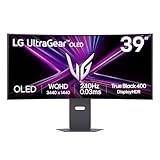
- The 240Hz OLED Gaming Monitor That’s Ahead of the (800R) Curve — 39" WQHD OLED with a steep 800R curve and up to 1300-nit (APL 1.5%) peak brightness pulls you into the action; 240Hz and 0.03ms (GtG) keep gameplay fast and fluid.
- Up to 240Hz & 0.03ms – Outrageous OLED Gaming Speed — Respond faster and track targets with near-instant pixel transitions that cut lag and ghosting for competitive play.
- Ultimate Frame Sync: FreeSync Premium Pro & G-SYNC Compatible — Tear-free, stutter-free visuals across PC and next-gen consoles for consistently smooth frames.
- Bright Picture, Deep Blacks, Brilliant Detail — OLED delivers up to 98.5% DCI-P3, 1.5M:1 contrast, and DisplayHDR True Black 400 for cinematic color and shadow detail.
- The 800R Curve: Surround Yourself in the Action — A dramatic 800R wrap enhances peripheral vision for deeper immersion in every scene.
USB-C with up to 90W power delivery can also simplify laptop use by carrying display output and charging through one connection, although the GX9’s port selection may not replace a full laptop dock for users who need many peripherals or network connectivity. OLED contrast and black levels can benefit video and image work, but professional users should verify calibration, color management, coating, and uniformity through independent reviews.
The 1500R curve is less aggressive than the 800R curvature used by some very large ultrawide monitors, but the GX9 remains a physically large display. Check desk width, viewing distance, monitor-arm capacity, and desk depth before buying. A curved screen can also be a poor fit for users who need geometry that appears flat or who regularly share the display with people sitting off-axis.
What are the main OLED trade-offs?
OLED remains a workload-dependent choice. Varied gaming, video, and creative content generally places less repetitive stress on the same interface elements than an always-visible desktop, taskbar, spreadsheet, or developer environment. LG lists OLED Care features, but the supplied evidence does not include independent long-term burn-in testing or a verified durability result.
| GX9 strength | Corresponding limitation |
|---|---|
| Sharp 5K2K ultrawide workspace | Higher GPU demand than 3440 × 1440 |
| 165Hz at native resolution | Native 5K2K is not the 330Hz mode |
| 330Hz competitive mode | 330Hz uses Wide Full HD rather than 5120 × 2160 |
| OLED contrast and black levels | Static desktop use requires burn-in-aware habits |
| 39-inch immersive format | Requires considerable desk space and may not suit flat-panel users |
| USB-C with 90W power delivery | May not provide every port offered by a dedicated dock |
Should you buy the GX9 or wait?
Buy the GX9 if you specifically want a 39-inch 21:9 OLED ultrawide with near-4K-class pixel density, can drive 5120 × 2160 effectively, value both 165Hz high-detail gaming and a lower-resolution 330Hz mode, or need USB-C laptop connectivity in a large multitasking display.
Wait if your priority is a 27-inch 4K OLED, if you need independent measurements of text clarity, coating, uniformity, HDR brightness, or burn-in behavior, or if you require a refresh rate higher than 165Hz at native resolution. Waiting may also make sense for buyers hoping that additional monitor brands adopt the same or a related LG Display panel with different firmware, coatings, stands, ports, or warranty terms.
Use this buyer checklist
- Confirm that your graphics card and cable can support the desired 5120 × 2160 refresh mode.
- Decide whether 165Hz at native resolution matters more than 330Hz at Wide Full HD.
- Measure desk width and depth and verify the load rating of any monitor arm.
- Consider whether your daily work includes static taskbars, spreadsheets, code windows, or other persistent elements.
- Check the exact regional model, warranty, return policy, and current price before ordering.
- Wait for independent testing if color accuracy, text rendering, sustained HDR brightness, or burn-in behavior is central to the purchase.
Frequently Asked Questions
Is the LG GX9 a 330Hz 5K monitor?
No. The LG UltraGear evo GX9 runs at 165Hz at its native 5120 × 2160 5K2K resolution; its 330Hz mode uses the lower Wide Full HD resolution.
Did LG launch the 27-inch 4K Tandem WOLED monitor?
The retrieved evidence confirms a 27-inch high-PPI Tandem WOLED panel teaser, but it does not establish a final commercial model, monitor brand, price, refresh rate, or availability. The 27-inch option should therefore be described as teased or planned rather than confirmed retail hardware.
What is the difference between LG Display and LG Electronics in this story?
LG Display develops and supplies display panels, while LG Electronics sells finished monitors such as the UltraGear evo GX9. A panel roadmap does not automatically identify the final monitor’s firmware, ports, coating, stand, warranty, or performance.
What does 5K2K mean on the LG GX9?
5K2K means the monitor has a 5120 × 2160 resolution in a 21:9 ultrawide format. The GX9 is not a 5120 × 2880 full-5K display.
Free tools Windows power users keep installed
One-click scans. No signup required.
The Bottom Line
The 39-inch Tandem WOLED story moved beyond a panel teaser: LG Electronics’ UltraGear evo GX9 is a real 5120 × 2160 OLED ultrawide with 165Hz native-resolution operation, a 330Hz Wide Full HD mode, and market-specific 2026 pricing. The separate 27-inch 4K Tandem WOLED panel remains less certain, so buyers seeking a compact 4K OLED should wait for a named product and first-party specifications.
Quick Recap
Product prices and availability are accurate as of the date/time indicated and are subject to change. Any price and availability information displayed on Amazon at the time of purchase will apply.

