
Quick wins for a faster PC:
Scan for outdated or missing drivers - takes under a minuteDriver Scan →Clear out junk files and repair common Windows errorsFree Scan →Fix the driver behind crashes, sound loss and screen glitchesFind Drivers →The four containers I would rebuild first depend on the services I actually run; there is no universal top-four list. For this recovery plan, assume the server itself is gone, but I still have off-host copies of my application data and the files or settings needed to recreate each container. I would restore services in dependency order, then bring back the applications with the greatest outage and data-loss costs.
First, separate rebuilding containers from recovering their data
A container can often be recreated from its image and run configuration. Its persistent data is a separate recovery job. Docker’s backup guidance says that changes in attached volumes are not included when an image is committed, and that volume data needs its own backup. It also recommends retaining the options used to create containers or using a Docker Compose file so the configuration can be recreated after reinstallation. Docker’s backup and restore guidance is specifically about Docker Desktop; its VM-file paths should not be applied automatically to every Linux Docker Engine server.

So my priority is not simply “which containers do I miss most?” It is “which services must return first, what state do they depend on, and can I restore that state reliably?” My order below is a framework for a personal list, not a claim that these are the right four containers for everyone. Replace the examples with services you actually operate.
How I’d choose my four
I would rank real services using five questions. The answers make the order explainable and expose what must be ready before each restore.
#1 Best Overall
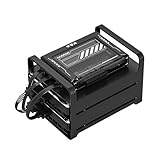
- 【Build Your Own NAS & Homelab — Not Just Storage】 More than a traditional NAS, ZimaBlade 7700 is a flexible x86 mini server for building your own homelab, personal cloud, or Docker host. Perfect for DIY NAS, self-hosting, container apps, and even retro systems — not limited like typical ARM-based NAS devices.
- 【x86 Platform — Broad Compatibility, Real Freedom】 Powered by an Intel quad-core x86 processor, it runs a wide range of operating systems and software with native compatibility. Ideal for Linux, Docker, CasaOS, and more — designed for flexibility and experimentation rather than locked-down appliance use.
- 【16GB RAM for Smooth Multi-Service Workloads】 Handle file sharing, media streaming, backups, and multiple lightweight services at once. Optimized for low-power, always-on operation — a great fit for home labs and personal servers running 24/7.
- 【Smooth 4K Media Streaming — Plex Direct Play Ready】 Stream your personal media library smoothly with Plex and similar media servers. Supports 4K playback on compatible devices via direct play, delivering a reliable home media experience without the need for heavy transcoding.
- 【Complete 2-Bay NAS Kit — Ready to Build】 Includes power supply, 16GB RAM, metal drive cage for 2 HDD/SSD, and dual SATA cables — everything you need to start building your own NAS right out of the box.
- Outage impact: What stops working for people or systems if this service stays down?
- Data at risk: Does it own important persistent state, or can I recreate it from configuration?
- Dependencies: Does another service need this one first, such as name resolution, authentication, or storage?
- Backup confidence: Is there a recent, usable copy of both the service’s data and its deployment settings?
- Restore time and uncertainty: Can I bring it back from a documented recipe, or would I be reconstructing it by guesswork?
These are practical decision criteria inferred from Docker’s advice to preserve run configuration and back up volumes separately, and Home Assistant’s advice to keep backups beyond the device. They are not a vendor scoring system or a published ranking. In your own list, write down the actual container name, what it does, what it persists, what it depends on, and the minimum steps to restore it.
The four containers I’d put on my list
The entries below are roles to fill with services from your own stack, not claims about containers I personally run. Since no specific stack is established here, naming four actual applications or asserting a personal ranking would be misleading. Use the sequence as a decision template: dependency-heavy infrastructure generally comes before services that rely on it, while irreplaceable data can move an application higher.
Rank #2

- Server-Class Home Server Built for 24/7 Workloads - Designed as a purpose-built home server rather than general-purpose SBCs, Mini PCs, entry NAS systems, or routing-only devices. As a compact, pocket-sized single board server platform, ZimaBoard 2 1664 combines x86 architecture, quad-core performance up to 3.6GHz, 16GB DDR5 memory, and 64GB eMMC storage for reliable always-on home servers, homelabs, and self-hosted workloads.
- PCIe 3.0 x4 Expansion for Real Server Builds - Built as a server-class platform with native PCIe expansion, ZimaBoard 2 features a full PCIe 3.0 x4 slot for high-speed, low-latency upgrades beyond USB-based limitations. Supports 10GbE NICs, NVMe adapters, GPUs, and AI accelerators to build scalable home servers, homelabs, and advanced self-hosted systems—offering greater expansion flexibility than typical SBCs, Mini PCs, and entry-level NAS devices.
- Native Dual SATA & Dual 2.5GbE Networking - Built with server-class storage and networking I/O, ZimaBoard 2 integrates dual SATA ports for direct HDD/SSD connectivity and dual 2.5GbE Ethernet for high-throughput, low-latency networking. This architecture enables reliable DIY NAS, fast storage, routing, and multi-service home server deployments—while avoiding USB-based performance constraints common in ARM SBCs, Raspberry Pi–based setups, Mini PCs, and entry-level NAS devices.
- ZimaOS Preinstalled + Wide OS Compatibility - Comes preinstalled with ZimaOS for a clean, ad-free private cloud experience—centralized file dashboard, automatic backups, P2P downloads, private photo/video sharing, 500+ plug-ins, and secure on-device AI that keeps your data at home. Also supports TrueNAS, Proxmox, Debian, Ubuntu Server, pfSense, OpenWrt, and Linux containers, making it perfect for Plex media servers, Pi-hole, firewalls, backups, Docker labs, home-cloud services, and multi-service deployments.
- All-in-One NAS, Router, Docker & Homelab Server - Replace multiple devices with one low-power. ZimaBoard 2 can serve as a NAS, router, Docker host, firewall, media server, or homelab node—delivering a flexible, open alternative to ARM SBCs, Mini PCs, and entry-level NAS systems.
1. The service other containers depend on
Start with the service whose absence blocks the rest of your stack. Depending on your setup, that might be local name resolution, authentication, a shared database, or another foundational service. Choose only one that you actually run and that is genuinely on the recovery path for other services.
- Why it may come first: A dependent container can be healthy but unreachable or unable to authenticate while its prerequisite is down.
- Record before failure: Its Compose service definition or equivalent run options, persistent storage location, required secrets, network attachments, and any external dependencies.
- Minimum restore path: Restore its data if needed, recreate the container with the saved configuration, verify that the dependency is reachable, then proceed to services that use it.
2. The service that manages or automates your environment
If a container controls devices, runs scheduled jobs, or automates important household or business workflows, its outage cost may justify an early restore. Whether it belongs at number two depends on what it depends on and how disruptive downtime is in your environment.
Rank #3
- Server-Class Home Server Built for 24/7 Workloads - Designed as a purpose-built home server rather than general-purpose SBCs, Mini PCs, entry NAS systems, or routing-only devices. As a compact, pocket-sized single board server platform, ZimaBoard 2 832 combines x86 architecture, quad-core performance up to 3.6GHz, 8GB DDR5 memory, and 32GB eMMC storage for reliable always-on home servers, homelabs, and self-hosted workloads.
- PCIe 3.0 x4 Expansion for Real Server Builds - Built as a server-class platform with native PCIe expansion, ZimaBoard 2 features a full PCIe 3.0 x4 slot for high-speed, low-latency upgrades beyond USB-based limitations. Supports 10GbE NICs, NVMe adapters, GPUs, and AI accelerators to build scalable home servers, homelabs, and advanced self-hosted systems—offering greater expansion flexibility than typical SBCs, Mini PCs, and entry-level NAS devices.
- Native Dual SATA & Dual 2.5GbE Networking - Built with server-class storage and networking I/O, ZimaBoard 2 integrates dual SATA ports for direct HDD/SSD connectivity and dual 2.5GbE Ethernet for high-throughput, low-latency networking. This architecture enables reliable DIY NAS, fast storage, routing, and multi-service home server deployments—while avoiding USB-based performance constraints common in ARM SBCs, Raspberry Pi–based setups, Mini PCs, and entry-level NAS devices.
- ZimaOS Preinstalled + Wide OS Compatibility - Comes preinstalled with ZimaOS for a clean, ad-free private cloud experience—centralized file dashboard, automatic backups, P2P downloads, private photo/video sharing, 500+ plug-ins, and secure on-device AI that keeps your data at home. Also supports TrueNAS, Proxmox, Debian, Ubuntu Server, pfSense, OpenWrt, and Linux containers, making it perfect for Plex media servers, Pi-hole, firewalls, backups, Docker labs, home-cloud services, and multi-service deployments.
- All-in-One NAS, Router, Docker & Homelab Server - Replace multiple devices with one low-power, fanless system. ZimaBoard 2 can serve as a NAS, router, Docker host, firewall, media server, or homelab node—delivering a flexible, open alternative to ARM SBCs, Mini PCs, and entry-level NAS systems.
- Why it may rank highly: A working automation service can be more consequential than a merely convenient user interface.
- Record before failure: Its configuration directory, database or other persistent state, integrations, credentials, and any hardware or network access it requires.
- Minimum restore path: Recreate prerequisite services first, restore the saved configuration and data, then check that integrations reconnect and automations are enabled as intended.
Home Assistant is one concrete example, not a required pick. Its Linux Container instructions mount a persistent configuration path at /config, require Docker Engine 23.0.0 or later, and state that Docker Desktop will not work for this install. The guide also notes that Compose can help as commands grow more complex and can support restart behavior. Follow the product-specific instructions for the deployment you use: Home Assistant’s Linux installation guide.
3. The service holding the most valuable application data
Put the container with the greatest cost of lost or stale data near the top, even if it is not a foundational dependency. That might be a database or an application that stores records you cannot easily recreate. Do not assume that saving an image, Compose file, or container definition preserves this state.
- Why it may rank highly: A failed application can be rebuilt; missing or inconsistent data may be much harder to recover.
- Record before failure: Which volumes or bind mounts contain state, how they are backed up, how current the last successful copy is, and any restore order the application requires.
- Minimum restore path: Recreate the required storage and service configuration, restore the appropriate data copy, then validate the application before allowing dependent services to write to it.
4. The user-facing service with the highest outage cost
Use the final slot for the application people need most once its prerequisites are available. Its rank should reflect actual use and consequences, not how familiar or easy it is to deploy.
- Why it may rank here: Restoring it gives users a working service after the foundations and critical state are available.
- Record before failure: The image and version, deployment settings, mounted data paths, secrets, network or proxy settings, and any linked database or identity service.
- Minimum restore path: Confirm its dependencies are healthy, restore its persistent state, recreate it from the saved recipe, and test a real user workflow.
Keep a recovery copy that survives the server
A backup stored only on the failed host is not a dependable recovery copy. Home Assistant’s general backup guidance says backups are stored locally by default, recommends a copy on another system and ideally an off-site copy, and warns that a device-local copy may be difficult to access after the system crashes. It recommends scheduled backups, including a daily schedule, but the right frequency depends on how much recent data you can afford to lose. Home Assistant’s backup guidance describes its own backup system; apply the broader storage lesson to your services without assuming their backup formats or schedules are identical.
The Tool Desk
Outbyte Driver Updater FREEScan for outdated or missing drivers - takes under a minuteDriver Scan →Outbyte PC Repair FREEClear out junk files and repair common Windows errorsFree Scan →Best Value

- [Native x86 Power — Run Apps Without Limits] Powered by Intel x86 architecture, ZimaBlade runs Plex, Nextcloud, Home Assistant and more natively — no compatibility issues, no workarounds, no frustration. Enjoy full software freedom beyond ARM-based systems.
- [3-Minute Setup with CasaOS — No Learning Curve] Get your personal server online in minutes with CasaOS. Install apps with one click in a clean visual interface — no SSH, no command line, just simple and intuitive control.
- [PCIe x4 Expansion — Grow Beyond a Single Use Case] Equipped with PCIe 2.0 x4 for flexible expansion. Add NVMe storage, 2.5GbE networking, or other modules — start as a media server, evolve into something more as your needs grow.
- [Fanless Silent Design — Built for 24/7 Living Spaces] Fully passive cooling with ultra-low noise. Runs quietly around the clock with no fan wear or vibration — perfect for your desk, living room, or bedroom.
- [Your Data, Your Control — Private by Design] Keep your data local and fully under your control. No cloud dependency, no third-party access — ideal for personal files, media libraries, and self-hosted services.
For encrypted Home Assistant backups, keep the emergency kit and recovery key somewhere separate from the server and the backup itself. The restore process requires the key, so an encrypted archive without accessible recovery material may not be usable. Home Assistant also says a full backup includes its configuration, share, manually installed or created apps, SSL material, and media; those contents are specific to Home Assistant, not a description of every Docker container’s backup.
Quick Recap
Pre-failure recovery checklist
- Keep Compose files or an equivalent record of image versions, run options, environment settings, networks, and restart behavior outside the server.
- Inventory each container’s named volumes and bind mounts; back up the persistent data separately from the image and deployment recipe.
- Store at least one usable backup copy on another system, with an off-site copy where practical.
- Store encryption keys and emergency recovery material separately from both the host and the backup archive.
- Write down the restore order, dependencies, and validation check for each critical service.
- Practice restoring a service from the saved files and backup, so the procedure is not being invented during an outage.
Product prices and availability are accurate as of the date/time indicated and are subject to change. Any price and availability information displayed on Amazon at the time of purchase will apply.

