
Recommended Free Tools
Yes. An ESP32-S3 can act as a wired USB Human Interface Device (HID), including a keyboard, mouse, or a device with custom reports. The most direct documented route is Espressif’s TinyUSB-based USB Device Stack for ESP-IDF, which includes a keyboard-and-mouse example. You’ll need a board whose USB connector is wired for native USB device operation, and you must account for its USB configuration and endpoint limits.
What you need before you start
- An ESP32-S3 development board with a connector wired to its USB OTG data signals. Espressif identifies GPIO 20 as D+ and GPIO 19 as D−; confirm the wiring for your exact board in its schematic or board guide. A port labeled “USB” is not, by itself, proof that it is the native USB device port. See Espressif’s ESP32-S3 USB Device Stack documentation.
- A data-capable USB cable and a computer to use as the USB host.
- ESP-IDF if you want to follow Espressif’s documented stack and example. Arduino-ESP32 also describes USB device-mode capability for supported chips such as the ESP32-S3, but the general documentation does not establish a particular HID library’s setup or version-specific calls.
Start with Espressif’s keyboard-and-mouse example
Espressif’s USB Device Stack is built around TinyUSB and integrates it with ESP-IDF. The official peripherals/usb/device/tusb_hid example demonstrates keyboard and mouse behavior: it sends keyboard press and release events and moves a mouse in a square trajectory after connecting to a USB host. Use the ESP-IDF v6.0 USB Device Stack page to locate the example and check instructions against the ESP-IDF release you are using.
- Identify the board’s native USB OTG connector and connect it to the host with a data-capable cable.
- Build and run the official
tusb_hidexample in your ESP-IDF environment. - Confirm that the host recognizes the device and observe the example’s keyboard and mouse behavior.
- Adapt the example’s application behavior and, if needed, its HID report definitions for your project. Validate the result with the intended host and application.
The example is a starting point, not a universal recipe for every board or host. The exact descriptor and report format must match the data your firmware sends and what the host-side software expects.
Choose between standard HID, custom HID, and vendor-specific USB
Standard keyboard or mouse
Use conventional HID behavior when the host should interpret reports as keyboard input or pointer movement. Begin with Espressif’s keyboard-and-mouse example, then verify your modified firmware on the computer and application that will use it.
#1 Best Overall

- 🔥【Dual Mode & High Performance】 The ESP32-S3 development board features integrated dual-core xtensa 32-bit LX7 microprocessor, clock speed up to 240 MHz, with 16MB Flash and 8 MB PSRAM. Perfect for Arduino IoT projects requiring stable wireless communication with ultra-low power consumption.
- 🔧【Easy Programming & Debugging】 Equipped with dual USB Type-C ports, this ESP32-S3 board supports both USB and UART modes for effortless programming, firmware flashing, and debugging.
- 🌐【Versatile Wireless Connectivity】 Built-in Wi-Fi (2.4GHz) and Bluetooth 5.0 (LE) dual-mode ensure seamless connectivity with a wide range of smart devices, making it ideal for IoT, smart homes projects.
- 🚀【Flexible Download Options】 Supports dual download methods — USB direct download or USB-to-serial download — offering flexibility and convenience for different development needs.Ideal for beginners and developers working with ESP32-S3.
- 🔋【Advanced Power-Saving Modes】 Designed for energy-efficient applications, with 3.3V SPI voltage, the ESP32-S3 board supports multiple low-power modes, allowing you to extend battery life based on different usage scenarios.
Custom HID reports
Custom HID lets you define reports for your own controls or data exchange while using the HID class. You need a report descriptor that describes the reports, firmware that sends and receives data in the described format, and host software that understands those reports. The official documentation confirms HID support, but does not provide a ready-made descriptor for every custom device or guarantee acceptance by every host application.
Vendor-specific functions
If your project needs a custom USB protocol outside ordinary HID behavior, Espressif also documents vendor-specific USB functions. This is a separate design choice from custom HID: select HID when HID semantics suit the device and its host-side consumer; consider a vendor-specific function when the protocol requires something else. Confirm host-side support for the approach you choose.
Rank #2

- ESP32-S3-DevKitC-1-N16R8 SPI voltage: 3.3v, ESP32-S3-DevKitC-1 is an entry-level development board equipped with Wi-Fi + Bluetooth module ESP32-S3
- Most of the I/O pins on the module are broken out to the pin headers on both sides of this board for easy interfacing. Developers can either connect peripherals with jumper wires or mount ESP32-S3-DevKitC on a breadboard.
- The ESP32-S3-DevKitC development board equipped with ESP32-S3-DevKitC-1-N16R8, a general-purpose Wi-Fi + Bluetooth LE MCU module that integrates complete Wi-Fi and Bluetooth LE functions.
- ESP32-S3-N16R8 cable can be used: USB Type A to Type-C cable or CC cable Note the distinction between the commonly used USB A port to Type-C cable that can only be charged, which cannot be used for communication between YD-ESP32-S3 and the host.
- USB-to-UART Port and ESP32-S3 USB Port (either one or both), default power supply (recommended)
Composite devices
A composite device combines USB functions, such as HID with another interface. Espressif documents composite-device support, but every proposed combination must fit the available endpoint resources and the selected stack configuration. Do not assume that a particular CDC-plus-HID arrangement will work without checking its interface and endpoint requirements.
Choose a framework and plan USB logging
| Approach | When it fits | What to check |
|---|---|---|
| ESP-IDF USB Device Stack / TinyUSB | You want Espressif’s documented USB device stack and its keyboard-and-mouse example. | Check your ESP-IDF release, USB configuration, and endpoint and interface requirements. |
| Arduino-ESP32 USB device mode | You already work in Arduino and want to investigate USB device mode. | Arduino documentation establishes high-level device-mode capability for supported chips such as ESP32-S3, but does not establish a particular HID library, release, or setup procedure. Verify the library and board configuration you plan to use. |
On ESP32-S3, USB_SERIAL_JTAG and USB_OTG share a PHY. Arduino’s USB documentation warns against enabling USB-OTG (TinyUSB) together with CDC On Boot. Decide how the project will use native USB and obtain serial logs before selecting those settings. See Espressif’s Arduino-ESP32 USB Host API documentation for the shared-PHY and configuration warning.
Quick wins for a faster PC:
Fix the driver behind crashes, sound loss and screen glitchesFind Drivers →Repair Windows errors before they cause bigger problemsFix Now →Scan for outdated or missing drivers - takes under a minuteDriver Scan →Rank #3

- 【Low-power performance】: The AYWHP ESP32-S3 Core development board integrates a 2.4 GHz Wi-Fi and Bluetooth 5 (LE) dual-mode communication module, perfect for Arduino Internet of Things (IoT) projects.
- 【Simple programming and debugging】: The ESP32-S3 module makes it easy to program and burn in your ESP32-S3 board via dual USB Type-C ports, with a choice of USB or UART modes.
- 【Multiple Power Saving Modes】: The ESP S3 development board supports multiple low-power modes, which can be configured according to different application scenarios to provide longer battery life.
- 【Dual download modes】: The ESP S3-1 module supports both USB direct connection download and USB to serial port download, providing more flexibility and convenience.
- 【Diverse connectivity options】: The ESP32-S3-1 supports dual-mode Wi-Fi and Bluetooth 5.0 (LE) connectivity for a wide range of smart devices, making it ideal for Internet of Things (IoT) applications.
Check the endpoint limit for multi-interface designs
Espressif’s ESP-IDF v6.0 documentation specifies a maximum of six endpoints for the ESP32-S3 USB device stack: five IN/OUT endpoints and one IN endpoint. This is a resource limit, not a promise that every six-endpoint interface combination is supported automatically. Count the needs of your intended interfaces and confirm that the selected stack configuration can accommodate them before designing around a composite device. See the ESP-IDF v6.0 USB Device Stack documentation.
Independent reader supportYour contribution helps us test, update, and keep practical guides available for everyone.USB HID instead of Bluetooth
USB HID is a wired option: the ESP32-S3 connects to a host through its native USB device connection and a data-capable cable. Use it when a cable and a compatible USB host fit the project. This article covers USB device operation; it does not establish Bluetooth setup or compare the two transports.
Quick Recap
Best Value
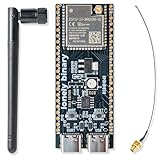
- 【GOLD EDITION — IMMERSION GOLD PCB】The Lonely Binary Gold Edition features a black PCB with lead-free immersion gold (ENIG) plating and clear silkscreen — the signature finish of the Lonely Binary Gold Edition line. RoHS-compliant.
- 【16MB FLASH + 8MB PSRAM】Large memory capacity for OTA updates, large programs, and AI/ML tasks — more headroom than 4MB boards for data-intensive IoT and automation projects.
- 【EXTERNAL IPEX ANTENNA】External IPEX antenna can be positioned for extended WiFi and Bluetooth signal coverage — for remote applications like weather stations, robots, or enclosed builds.
- 【DUAL USB TYPE-C PORTS】Separate power and data ports for macOS, Windows, and Linux. Power via USB-C (5V) or VIN pin (5–12V); do not exceed 5V on the USB-C ports.
- 【FLEXIBLE PROTOTYPING PINS】2x40-pin GPIO headers compatible with breadboards and sensors. Supports external ToF sensors via I2C for distance sensing.
Rank #4
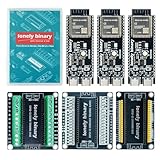
- 【ESP32-S3 PERFORMANCE】Dual-core 240MHz processor with 16MB Flash and 8MB PSRAM for IoT, AI, and machine learning projects.
- 【WIRELESS CONNECTIVITY】Onboard antenna for 2.4GHz WiFi and Bluetooth 5.0 LE — for smart home devices, no external antenna needed.
- 【LEAD-FREE GOLD EDITION DESIGN】Immersion gold (ENIG) plating for durability and conductivity. Lead-free, RoHS-compliant — for long-term prototyping.
- 【PRE-SOLDERED, PLUG-IN DESIGN】ESP32-S3 boards come with pre-soldered headers and plug directly into the included expansion and terminal boards — no soldering required.
- 【MULTI-PLATFORM COMPATIBILITY】Works with C++, MicroPython, ESP-IDF, Raspberry Pi, and STM32 — with online tutorials for quick start. Power via USB-C (5V) or VIN pin (5–12V); do not exceed 5V on the USB-C ports.
Common reasons the device does not work
- The computer does not detect the board: Check that the selected connector is wired to GPIO 20 (D+) and GPIO 19 (D−), and that the cable supports data. Board connectors and routing vary.
- USB mode or serial logging conflicts with the project: Review the USB-OTG and CDC On Boot settings and the shared USB_SERIAL_JTAG/USB_OTG PHY before changing configuration.
- A custom device appears but the host application does not use its data: Check that the report descriptor, transmitted report format, and host-side consumer agree. HID enumeration alone does not ensure an application understands custom reports.
- A composite design fails to fit: Recheck the endpoint and interface requirements against the documented six-endpoint maximum and the chosen stack configuration.
Official documentation
- Espressif ESP-IDF v6.0: USB Device Stack – ESP32-S3 — stack architecture, HID and composite support, GPIO wiring, example, and endpoint capacity.
- Espressif Arduino-ESP32: USB API — overview of USB device-mode capability in Arduino-ESP32.
- Espressif Arduino-ESP32: USB Host API — shared-PHY and configuration guidance relevant to USB mode selection.
Product prices and availability are accurate as of the date/time indicated and are subject to change. Any price and availability information displayed on Amazon at the time of purchase will apply.

