
Yes. A Ryzen 9 3900X can often run cooler with a modest negative voltage offset, but reducing its power limits or enabling Eco Mode may be a more predictable way to cut heat and fan noise. First check the cooler, airflow, and workload; then change one setting at a time and test it. Avoid assuming that Curve Optimizer guides for newer Ryzen CPUs apply to every 3900X motherboard.
Are your 3900X temperatures actually too high?
AMD specifies a maximum operating temperature (Tjmax) of 95°C for the Ryzen 9 3900X. That is a limit, not a target that every system should reach. A sustained heavy workload below that limit is generally within the processor’s specified operating range; repeated readings at 95°C alongside falling performance deserve investigation. See AMD’s Ryzen 9 3900X specifications.
Interpret readings in context. Idle, brief boost spikes, gaming, and a sustained all-core render are different workloads, and CPU package temperature is not necessarily the same as an individual core reading. Room temperature, case temperature, cooler and paste, airflow, motherboard settings, and background activity all affect results. Compare the same sensor under the same workload and conditions before and after a change; a momentary voltage or temperature peak by itself does not establish a fault.
Short temperature spikes can occur as Ryzen changes frequency and voltage in response to bursts of work. A fan curve that reacts immediately to every spike may add noise without improving sustained cooling. Judge temperature over a representative workload interval, and use fan hysteresis if your motherboard supports it.
#1 Best Overall
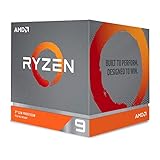
- The world's most advanced processor in the desktop PC gaming segment
- Can deliver Ultra-fast 100 plus FPS performance in the world's most popular games
- 12 Cores and 24 processing threads, bundled with the AMD Wraith Prism cooler with color controlled LED support
- 4.6 GHz max Boost, unlocked for overclocking, 70 MB of game Cache, DDR 3200 support. OS Support-Windows 10 - 64-Bit Edition, RHEL x86 64-Bit, Ubuntu x86 64-Bit. Operating System (OS) support will vary by manufacturer
Check cooling and establish a stock baseline first
Before tuning, record your BIOS version, cooler, room temperature, fan speeds, and the memory profile in use. Photograph or export your existing BIOS settings so you can restore them. For a useful comparison, use the same monitoring software, sensor, workload, and test duration at stock and after each adjustment.
- Check cooler mounting pressure and contact, thermal-paste coverage and condition, and whether protective film was removed.
- Confirm that the CPU fan or liquid-cooler pump is operating as expected; clear dust and check intake and exhaust airflow.
- Consider whether a hot GPU or closed case is heating the air supplied to the CPU cooler.
- Check for background applications that poll hardware frequently. AMD notes that RGB and monitoring utilities can raise idle temperatures through constant polling.
- Look for motherboard performance-enhancement defaults, fan-curve settings, and BIOS or chipset-driver updates relevant to your system.
AMD recommends checking the cooling solution, mounting, thermal paste, airflow, BIOS, and stock configuration when investigating temperature or performance issues. Its troubleshooting guidance also recommends accounting for background applications and system configuration: AMD CPU performance and temperature troubleshooting.
At stock settings, note idle temperature after about 10 minutes, a normal game or application, and a 10-minute all-core workload. Also record package power and effective clocks, not just temperature. Use a longer test later for stability; a short baseline is for comparison, not proof that a configuration is stable.
Choose the tuning method that matches your goal
“Undervolting” can refer to different controls. A negative voltage offset is the usual choice when you want automatic boosting to remain active. Eco Mode or lower PPT/TDC/EDC limits more directly restrict power and can suit a hot room or quiet-fan target. A fixed all-core voltage and frequency is a more substantial change to normal boost behavior.
Rank #2
- Makes work processing morestable and reliable
- Replace the old or damaged CPU directly.Ensure that the computer can run smoothly and improve work efficiency when processing these tasks
- This cpu gaming slot is small in size and light in weight, which can be easily carried around your computer.
- Improve the overall performance of the system and ensure the stability and security of data processing
- A stable CPU can ensure long-term stable operation of the computer, reducing the risk of system crashes or data loss caused by hardware issues
| Method | Temperature and performance behavior | Stability risk | Best fit |
|---|---|---|---|
| Negative Vcore offset | Temperature change varies; automatic boosting is generally retained until the offset is excessive. | Medium | General-purpose tuning while retaining boost. |
| Eco Mode | Restricts peak package power and may reduce multicore performance. | Low to medium | Reducing heat and noise in a hot room or quiet system. |
| Lower PPT/TDC/EDC limits | Constrains package power or current; automatic frequency scaling remains active, with performance effects dependent on workload. | Low to medium | A controlled power or thermal target. |
| Fixed all-core frequency and voltage | Can lower temperatures substantially, but may reduce single-core boost and idle flexibility. | Medium to high | Users prioritizing consistent all-core performance. |
| Improve cooler mounting or airflow | Effect depends on the hardware problem; no CPU performance penalty when cooling improves. | Low | A poorly mounted cooler, dust, or inadequate airflow. |
| Leave stock | Retains the processor’s intended automatic behavior without tuning-related stability risk. | Lowest | Temperatures and noise are acceptable. |
Negative Vcore offset: preserve automatic boost
A negative offset lowers the voltage the processor requests while leaving automatic frequency behavior in place. Lower voltage can reduce power and heat, but the CPU may use some added thermal headroom to boost more aggressively. As a result, the temperature drop may be smaller than expected. An offset that is too aggressive can cause crashes, WHEA hardware errors, application faults, clock stretching, or reduced performance.
Eco Mode or lower PPT/TDC/EDC: prioritize heat and noise
PPT is the package/socket power limit; TDC is the sustained current limit; EDC is the peak current limit. These controls can limit power more directly than an offset while retaining automatic frequency scaling. The trade-off is that multicore performance may fall, particularly in workloads that use all cores. AMD’s Ryzen Master documentation describes these PBO controls and notes that available controls vary by processor and platform: AMD Ryzen Master CPU controls.
Eco Mode is another lower-power option, subject to motherboard support. AMD’s Ryzen 3000 reference guide describes Eco Mode for this processor generation: AMD Ryzen Master reference guide.
Fixed all-core voltage and frequency: use only for a specific reason
A manual all-core setting can suit users who value predictable performance in sustained multicore workloads, but it is not the default recommendation for a general desktop. It can sacrifice single-core boost and idle behavior, and a voltage-frequency combination stable on one 3900X may fail on another. If you choose this approach, begin with motherboard defaults for load-line calibration and validate the exact frequency and voltage thoroughly.
Rank #3

- The world's best gaming desktop processor that can deliver ultra-fast 100+ FPS performance in the world's most popular games
- 12 Cores and 24 processing threads, based on AMD "Zen 5" architecture
- 5.6 GHz Max Boost, unlocked for overclocking, 76 MB cache, DDR5-5600 support
- For the state-of-the-art Socket AM5 platform, can support PCIe 5.0 on select motherboards
- Cooler not included
Apply a modest negative offset safely
Menu names and locations differ by ASUS, ASRock, Gigabyte, MSI, chipset, and BIOS revision. A typical path is:
- Enter BIOS/UEFI, switch to Advanced Mode if necessary, and locate CPU Core Voltage, Vcore, or a similarly named control under CPU, Tweaker, or AMD Overclocking settings.
- Choose Offset mode, set the sign to Negative (-), and enter 0.025 V as a cautious first test.
- Save and reboot. Check that Windows starts normally, then run a short all-core benchmark and several short single-threaded runs. Watch for crashes, freezes, reboots, application errors, WHEA errors, and unexpectedly low effective clocks.
- Compare performance, package power, effective clocks, and temperature with your stock baseline. If stable, you can test the next step, such as −0.050 V and then −0.075 V.
- Stop when errors appear, performance falls, or further temperature improvement becomes negligible. Restore the last stable setting rather than pursuing the lowest possible voltage.
Those offset values are starting points for experimentation, not guaranteed settings. Silicon quality, BIOS, memory settings, load-line behavior, and cooling affect stability. Do not jump straight to an aggressive offset such as −0.100 V or lower: a setting that passes a quick all-core run may fail during light-load boost transitions. If your BIOS does not offer a clearly identified offset control, do not substitute an arbitrary manual voltage; consult the motherboard manual or use supported power-limit controls instead.
Try Eco Mode or power limits if the offset is not worthwhile
If an offset causes instability or provides little benefit, restore CPU voltage to Auto before trying another method. You can look for Precision Boost Overdrive under a path similar to BIOS/UEFI → Advanced → AMD Overclocking → Precision Boost Overdrive, then select an advanced or manual mode to adjust PPT, TDC, and EDC. The exact menu and available controls depend on the motherboard and firmware.
Alternatively, AMD Ryzen Master may expose Tuning → Control Mode → Eco Mode on a supported system. Test the result in both multicore and lightly threaded tasks. Neither route guarantees a particular temperature reduction; cooler capacity, ambient temperature, airflow, workload, and firmware all affect the outcome. BIOS settings are preferable for a final persistent configuration because they do not depend on Windows software loading at startup.
Recommended Free Tools
Rank #4

- The world's fastest 12 core processor for mainstream desktop, with 24 procesing threads
- Can deliver ultra-fast 100Plus FPS performance in the world's most popular games
- Cooler not included, liquid cooler with 280mm or larger radiator recommended
- 4.7 GHz Max Boost, unlocked for overclocking, 70 MB of Gamecache, DDR-3200 support
- For the advanced Socket AM4 platform, can support PCIe 4.0 on X570 and B550 motherboards. Maximum Temperature-95°C
Test stability beyond one benchmark
No single stress test proves a setting stable. A steady all-core load can miss problems that appear during short boosts, idle transitions, or normal desktop activity. AMD also cautions that automatically derived Curve Optimizer values depend on the duration and nature of the built-in test and should be checked against the user’s own workloads: AMD Curve Optimizer FAQ.
- Quick screen: Run an all-core benchmark for 10–15 minutes, several short single-threaded runs, and a game or application you regularly use.
- Extended check: Run a longer all-core stress session and several hours of mixed normal use, including short bursts of activity.
- Transition checks: Open and close applications, browse, play video, and test sleep and wake. These can expose instability that a constant load misses.
- Watch for: Blue screens, sudden reboots, application crashes, WHEA-Logger errors, hardware errors reported by monitoring software, clock stretching, or performance below stock despite lower temperatures.
- If you also changed RAM or Infinity Fabric: test memory stability separately; CPU tuning alone cannot validate those changes.
Keep the setting only if it is stable in your own workloads and provides a meaningful noise or temperature benefit without an unacceptable performance loss. Compare the same sensor before and after; peak VID, Vcore, SVI2 voltage, and package voltage are not interchangeable readings.
Recover if the system becomes unstable
If Windows still boots
- Return to the last stable profile, or set the negative offset to a smaller value.
- If errors continue, restore CPU voltage to Auto and return PBO or power limits to their defaults.
- If Ryzen Master applied the setting, turn off the tuning profile if Windows remains usable, reboot, and disable automatic profile application. Restore BIOS defaults if the problem persists.
- Retest before making another adjustment.
If the computer will not boot
- Power the system off completely.
- Clear CMOS using the procedure in your motherboard manual; this restores firmware defaults.
- Boot with default settings, then re-enable only necessary memory settings.
- Reapply a less aggressive CPU adjustment only after the system is working at defaults.
AMD documents that Curve Optimizer can be disabled by setting it to Off and applying the change; a restart may be required. The exact recovery controls differ across Ryzen Master versions and platforms.
Do not assume Curve Optimizer applies to every 3900X
Many Curve Optimizer guides target newer Ryzen generations. AMD’s current Ryzen Master documentation says the feature may not be available on every CPU and that controls vary by processor and platform. A 3900X BIOS may expose it, but availability is motherboard- and firmware-dependent; validate any such setting independently. If the option is absent, use a voltage offset or power-limit tuning instead. See AMD’s Curve Optimizer documentation and its Ryzen Master User Guide.
Windows Errors? Fix Them Before They Spread
Repair common Windows errors and clear accumulated junk for a smoother, more stable PC - no reinstall needed.Free scan · no reinstallCrashes, No Sound, or Screen Glitches?
Random freezes, missing sound and display glitches usually trace back to one bad driver. Find and replace yours safely.Free scan · under a minuteWarranty and tuning risk
AMD warns that modifying stock CPU, memory, current, and voltage settings carries risks, and its product warranty does not cover damage caused by overclocking. AMD also says PBO operation outside factory specifications can invalidate its product warranty and may affect system-manufacturer or retailer warranties. Warranty rights and consumer protections differ by region; see AMD’s Ryzen Master “Before You Begin” guidance.
Quick Recap
Product prices and availability are accurate as of the date/time indicated and are subject to change. Any price and availability information displayed on Amazon at the time of purchase will apply.

