
Do these 3 things before closing this tab:
1Clear out junk files and repair common Windows errors2Scan for outdated or missing drivers - takes under a minute3Repair Windows errors before they cause bigger problemsA surprising sensor reading does not, by itself, mean the sensor is faulty. First confirm that you and the device are measuring the same quantity, in the same units, at the same time and place; then check setup, stabilization, wiring, and the data path before comparing the sensor with a suitable reference. Calibrate or adjust only after you have established a repeatable discrepancy and found the procedure for that specific sensor.
Start by defining what seems inaccurate
Write down the measured quantity, sensor and board model, firmware or software version if relevant, units, observed value and timestamp, and what you expected to see. Record the basis for that expectation: a specification, a reference instrument, or another source. Note the sensor’s location, power state, and any recent change to the build, environment, or sample.
Check the sensor’s datasheet and build instructions for its measurement range, stated accuracy, warm-up or response time, placement requirements, and calibration method. A DIY sensor should not be expected to match an unrelated household display or a remote reading taken at a different time or location. The instruments may measure different things, use different units, or be experiencing different conditions.
Check the installation and conditions before calibration
Inspect the setup for conditions that could affect the measurement. Which checks matter depends on the sensing technology; heat, moisture, airflow, and contamination do not affect every sensor in the same way.
Recommended Free Tools
#1 Best Overall
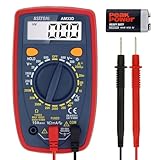
- Additional Tips - The following incorrect operations may cause the multimeter not to show results: Firstly, the plugs of test leads are not fully inserted or not inserted into the correct sockets. Secondly, the manual rotary switch is not placed in the correct position. In addition, this meter can not test all AC Current and below 100mV AC Voltage. Please check the user manual carefully before measurement.
- Versatile Digital Multimeter - Accurately measures AC/DC Voltage, DC Current, Resistance, and Diode. This Multimeter is a really useful tool for solving industrial and household electrical issues. Suitable for Household Outlets, Fuses, Batteries (including Vehicles), Automotive Circuit Troubleshooting, Charging Systems, Testing electronics in Cars etc.
- Troubleshooting with Accuracy - This Multimeter has a sampling speed of 2 times per second; Built-in a backlight LCD display with 3 ½ digits (1999 count) 0.6”, and high polarity including negative and positive readings.
- Ensures Safety - Double fuse is anti-burn and protects from overloading. The silicone cover can protect the multimeter from failing damage and prevent electric shocks. And low battery indication will be displayed when battery power is low.
- Ease of Use - Support Data Hold and Continuity Buzzer. Includes Convenient feature like LCD Backlit Screen makes it easy to use in dimly light areas. Batteries/Set of Test Leads/User Manual are Included.
- Confirm that the sensor is installed in its intended orientation and environment. Check for nearby heaters or cooling sources, direct sunlight, drafts, enclosure heating, or a temperature gradient.
- Look for water, condensation, dust, contamination, blocked inlets, or other obstructions. Do not assume a cleaning method is safe for the sensing element.
- Check power, connectors, probes, cables, and wiring for loose connections, damage, or disconnection. Confirm the supply is stable if the design depends on it.
- Verify the selected units and expected range. Check that the display or log shows a current value rather than a stale reading or incorrectly processed data.
Field-instrument guidance from the U.S. Geological Survey includes checking instrument condition and connectors. Vaisala’s RFL100 guidance advises checking for interference and moisture, and allowing the sensor to stabilize before calibration or adjustment.
Allow the sensor and sample to settle
Give the device time to settle after power-on, moving it, changing the environment, or changing the sample. Use the manual’s specified warm-up or response time rather than applying a universal waiting period. If a probe is wet, follow its manufacturer’s instructions; Vaisala advises allowing its probe to dry before proceeding.
Rank #2
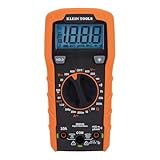
- VERSATILE FUNCTIONALITY: Measures AC/DC voltage up to 600V, 10A DC current, 2MΩ resistance; additional features include continuity, diode test and battery test
- LEAD-ALERT PROTECTION: LEDs on the meter illuminate to indicate proper test lead placement, enhancing accuracy and safety during measurements
- BACKLIT DISPLAY: LCD shows clear readings in low-light conditions for enhanced visibility
- BATTERY TEST: Battery test mode can be used for checking if batteries are working
- CONVENIENT FEATURES: Test lead holders on the back of the meter, kickstand and optional magnetic hanger (Cat. Nos. 69445 or 69417) for hands-free operation
Compare readings under fair conditions
Use a calibrated reference instrument or recognized standard appropriate to the quantity and the accuracy you need. Put the sensor and reference in the same place, compare them at the same time and under the same conditions, and wait for both to settle. Confirm that they measure the same quantity and that their units are compatible. A plausible-looking consumer display is not automatically a trustworthy reference.
The EPA Air Sensor Guidebook describes comparison with a calibrated reference or standard as an approach to calibration. For temperature checks in its field-measurement context, the USGS recommends comparison with a NIST-certified or NIST-traceable digital thermometer. That thermometer example is specific to temperature; it is not a universal reference for other sensor types.
What’s actually slowing this PC down?
Pick the symptom - the matching free tool is one click away.
Rank #3

- Versatile Digital Multimeter - Accurately measures AC/DC Current, AC/DC Voltage, Capacitance, Frequency, Duty Cycle, Resistance, Diode, Continuity and Temperature.
- Thoughtful Design - Support Data Hold, Large LCD Backlit Screen, Auto Shut-off and Kickstand make the process of measurements easier. Professional level is reflected in some features include Auto-Ranging capability, and True RMS for measuring both AC Current and Voltage.
- Suitable For Many Occasions - This Multimeter is a golden partner to help to troubleshoot a variety of automotive and household electrical problems safely and accurately.
- Ensure Safety - Double ceramic fuse is anti-burn and protects from overloading,and it will be more secure and reliable; F400mA/600V and F10A/600V explosion-proof ceramic fuse tubes can protect the multimeter effectively.
- Additional Tips - Please take off the cap before using the test leads. Check the manual for more usage information.
Repeat the comparison and record the difference, along with the conditions. If practical, compare at more than one point within the sensor’s intended range. Agreement at one point, or a correction that removes a difference there, does not show that the device is accurate elsewhere. A one-point offset may suit some applications, but it is not a general calibration procedure; see Adafruit’s sensor-calibration guide for educational examples.
Check the history, not just one reading
Inspect or plot readings over time. Look for gradual drift, sudden jumps, outliers, a value that never changes, missing data, or an implausible range. Note whether changes track temperature, humidity, device heating, or an operating cycle. This can help distinguish an environmental response from a sensor, connection, or logging problem.
Rank #4

- Accurately Test Full Features: Accurately measures AC/DC voltage, DC current, resistance, continuity test, diode and batteries.
- High Quality & Safety :Our multimeter is designed to safely and accurately troubleshoot a variety of automotive and household electrical problems. Overload Protection on all ranges to ensure long-term service life,Low Battery Indication, Audible continuity sensor checks that the circuit or wires conduct electricity. Double insulation with a good angled stand for hand free use.
- EASY TO USE: 2.7"Large Backlit LCD Display, Data Hold, Easy to Read Large Back-light Screen forvisibility in dimly light areas. Our mutimeter tester is widely used in Car repair, Homeuse, Schools, laboratories, Families and factories, suitable for Car Drivers, Beginners,Professional Electricians, Housewives, Students Use.
- Nice Protective Orange Shell with Stand Built: Our digital multimeter can be hand held or stood using its fold out stand. Removable thick rubber cover is made of kind of non-slip slightly soft plastic that will help with drop protection & minor bumps protection.
- 2 YEARS Quality Guarantee & Included 9V Battery: The compartment lid at the back is easy to remove. Battery/Set of Test Leads/User Manual are Included.They guarantee against faulty materials and workmanship for 2 years-giving you total peace of mind. If there is any issue within24 months of your purchase, we will replace it for vou with no doubt.
For air sensors, EPA guidance discusses collocation and periodic checks as ways to evaluate agreement and change over time. Its quality-assurance guidance also warns against relying solely on automatic quality checks: automated checks can miss subtle problems or flag real events as bad data. Review readings in context, and do not transfer air-pollution sensor methods wholesale to unrelated DIY sensor types. See the EPA’s Quality Assurance for Air Sensors for that air-sensor context.
Independent reader supportYour contribution helps us test, update, and keep practical guides available for everyone.Understand calibration and adjustment before changing a value
Calibration is comparison of a device’s output with a known reference. Adjustment is changing the instrument or its reported measurement to correct it. Vaisala’s RFL100 user guide makes the distinction explicitly: calibration compares the output to a known reference; correcting the reading is adjustment.
Best Value

- VERSATILE FUNCTIONALITY: Measures AC/DC voltage up to 600V, 10A AC/DC current, 50MΩ resistance; additional features include continuity, temperature, capacitance, frequency/duty cycle and diode test
- LEAD-ALERT PROTECTION: LEDs on the meter illuminate to indicate proper test lead placement, enhancing accuracy and safety during measurements
- BACKLIT DISPLAY: LCD shows clear readings in low-light conditions for enhanced visibility
- ACCURATE MEASUREMENTS: Auto-ranging and True Root Mean Squared (TRMS) technology provides precise and accurate measurements
- CONVENIENT FEATURES: Test lead holders on the back of the meter, kickstand and optional magnetic hanger (Cat. Nos. 69445 or 69417) for hands-free operation
Establish that the mismatch is repeatable before changing a setting. Then use the procedure for the specific sensor, circuit, or firmware, and record the original reading and the change. A software offset may align the display under one condition while leaving gain error, nonlinearity, drift, or sensitivity to environmental conditions untouched. An offset is not proof that the underlying sensor has been repaired or is accurate across its range. For example, AcuRite’s reading-calibration instructions describe an offset for its own products; that method should not be assumed to apply to a DIY design.
Clean, repair, replace, or stop relying on the reading
Clean the sensor only as its manufacturer permits. Solvents, abrasion, water, or heat can damage sensing surfaces. If the design uses a detachable probe, cable, connector, or power supply, test or replace it only as the device’s manual allows.
If a valid reference comparison still shows the sensor outside its stated specification, or the sensor is visibly damaged or fails its specified calibration procedure, consult the maker or a qualified technician. Do not rely on a suspect reading for consequential decisions while the problem is unresolved. For safety-critical gas monitors, OSHA’s advice on direct-reading portable gas monitors is specific to that equipment: harsh conditions and sensor degradation can cause inaccurate readings or failure, and service or replacement should follow the maker’s instructions. Those procedures are not general repair guidance for hobby sensors.
Quick Recap
Product prices and availability are accurate as of the date/time indicated and are subject to change. Any price and availability information displayed on Amazon at the time of purchase will apply.

