
Simulate home automation by defining what the system senses, writing explicit rules for those inputs, and showing how the rules change modeled outputs. A room thermostat is a useful example: temperature and presence determine whether a heating relay should be on. That model can demonstrate the automation logic; it does not establish that a physical Arduino device, its wiring, sensors, wireless connection, or Matter setup will work.
What an Arduino home-automation simulation should show
A useful simulation makes three parts visible: the inputs, the decision rule, and the resulting outputs. For a thermostat, the inputs can be room temperature and whether someone is present; the rule decides whether to request heat; and the output can be a modeled relay state plus a displayed temperature or status.
- Inputs: temperature in degrees and a presence state such as present or absent.
- Rule: a clearly stated condition that combines the readings with a chosen setpoint.
- Outputs: an on/off heating-relay indicator and, optionally, a display value or mode.
Choose valid input ranges and decide what should happen when a reading is missing or implausible. Do not assign a sensor accuracy unless the specific hardware documentation establishes it. A simulator can help you exercise the logic with different modeled values, but that is not evidence that it reproduces real sensor tolerances or electrical behavior.
Build a thermostat model in a few explicit steps
- Set the scenario: model one room and a heating relay. Treat the relay as a visual or logical output, not as a connection to mains-powered equipment.
- List inputs: provide a temperature value and a presence state. Specify their units and acceptable values, and define a safe response for absent or implausible readings.
- Write the rule in plain language: for example, use a setpoint chosen for the demonstration; request heat only when the room is below that setpoint and someone is present. This example threshold is a project choice, not a universal thermostat standard.
- Translate the rule into Arduino-style logic: evaluate the inputs and set a modeled relay state to on or off. Keep the conditions readable so you can see why the state changed.
- Show the result: display the temperature, presence state, and relay state. Change one input at a time and check that the output follows the stated rule, then try combinations such as an absent occupant or an invalid reading.
The Arduino Matter Smart Thermostat tutorial is a physical reference design for this kind of model: it describes temperature and proximity modules with a relay, ambient-temperature reporting, remote setpoint changes, temperature limits, and operating modes. Its documented behavior belongs to that physical design; it is not evidence that a particular simulator supports or has tested those components or features.
Quick wins for a faster PC:
Scan for outdated or missing drivers - takes under a minuteDriver Scan →Repair Windows errors before they cause bigger problemsFix Now →#1 Best Overall

- Complete Project-Based Learning Path – Build 13 progressive projects (LED blink → button control → PIR motion sensor → music playback → motorized doors/windows → SK6812 RGB lighting → fan control → LCD display → gas alarm → temperature/humidity monitor → RFID door unlock → Morse code access → WiFi control → mobile APP remote control). Each project builds on the previous one, ensuring you understand both the electronics and the programming logic behind every smart home feature.
- Master Two Industry-Standard Languages – Learn to code in both Arduino C++ and MicroPython with 13 detailed tutorials for each language. Compare how the same hardware behaves under different programming approaches – a valuable skill for any aspiring engineer. Perfect for classrooms teaching multiple coding languages or self-learners who want flexibility.
- Build a Real WiFi-Controlled Smart Home – Assemble the wooden house structure and integrate sensors to create a functioning smart home system. Control lights, fans, door servos, and RGB lighting directly from your mobile APP (iOS/Android) . Experience how IoT works in real life – from manual control to automated responses based on temperature, humidity, motion, and gas detection.
- Comprehensive Online Wiki with No Guesswork – Our detailed online tutorials (also accessible via the packaging) include wiring diagrams, full code explanations, and step-by-step assembly guides for every project. Whether you're a complete beginner or a teacher preparing lessons, the structured content eliminates confusion and helps you succeed from project 1.
- Everything You Need to Get Started – (TIPS: Batteries are NOT Included)This kit includes the ESP32 development board, expansion board, wooden house parts, all sensors and modules (DHT11, PIR motion, gas sensor, RFID, SK6812 RGB, servo motors, fan, LCD1602, etc.), and connection cables. NOTE: 6x AA batteries are required (NOT Included). The kit is unassembled – you'll build it yourself following our online tutorials, making the learning experience truly hands-on.
Choose a simulator by checking its actual support
There is no product-by-product simulator comparison established here, so it would be misleading to name a best Arduino simulator or promise that a particular board, library, sensor, display, or protocol is available. Before building around a tool, check its current documentation for the capabilities your model needs:
- Does it support the target Arduino board, or only a different board or a generic code environment?
- Can it represent the inputs and outputs you need, such as temperature, presence, a relay indicator, or a display?
- Does it support the protocol if the project is meant to explore connected-device behavior?
- Can you inspect input values and output changes well enough to debug the rule?
- Does it require physical hardware, or can the project run virtually?
A community post titled “How to Make Home Automation with Arduino in Proteus with Lcd Display” reflects one way readers phrase this project, but the title does not verify Proteus compatibility or the correctness of a particular build: community post. Confirm any Proteus-specific board, component, and library support in the simulator’s own documentation before relying on it.
Rank #2

- All-in-One Starter Kit for Beginners: Part of the Powered by Arduino program, this kit includes an original Arduino UNO R4 WiFi, 300+ high-quality components, 50+ hands-on projects (30 basic, 13 fun, and 8 IoT), and 100+ free video lessons co-created with renowned educator Paul McWhorter. Designed for beginners ages 8+, it provides a complete, step-by-step path to learn Arduino, electronics, coding, and IoT. RoHS compliant for added safety and quality, it also makes a thoughtful gift for tech enthusiasts, students, and aspiring makers for birthdays, holidays, and special occasions
- Powerful Arduino Uno R4 WiFi Board: Upgraded from the Arduino Uno R3, the Arduino Uno R4 WiFi features a 32-bit processor, more memory, and built-in WiFi and Bluetooth, enabling connection to third-party apps for more interactive and practical projects.
- 300+ Components for Endless Possibilities: With 300+ components and sensors, this kit is perfect for portable projects. It features step-by-step tutorials, open-source code, and compatibility with other Arduino boards like Uno R3 and Nano, offering endless customization and learning opportunities.
- Engaging Projects for Every Skill Level: Featuring 50 projects (30 basic, 13 fun, 8 IoT) with IoT app integration like Arduino IoT Cloud , this kit supports Arduino C++ programming, making it perfect for students, teachers, and engineers to learn, code, and create at any skill level.
- Dedicated Support for Beginners: Alongside online resources and video tutorials, SunFounder provides technical support and troubleshooting forums to help beginners solve programming challenges with ease.
Virtual Matter development is not Arduino-board simulation
Google’s Matter developer documentation describes a Matter Virtual Device Development Environment for running virtual Matter devices without additional hardware, along with related development tools. That is relevant if your aim is to explore Matter device behavior. The documentation does not establish that this environment runs Arduino sketches or emulates a specific Arduino board, so treat it as a separate virtual-device option rather than an Arduino simulator.
For a connected project using Home Assistant, its Matter integration documentation describes the controller/server arrangement and setup requirements. It recommends Home Assistant OS with the Matter app as the supported path, while other installation approaches have constraints. Setup details can change, so consult the current documentation when configuring a system. Matter devices may use Wi-Fi or Thread; Thread devices need access to a Thread network and border router.
Rank #3
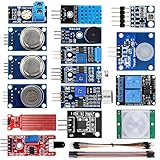
- SMART HOME LEARNING KIT--This kit combines the most common electronic components of smart home projects,developed specially for those beginners who are interested in Arduino and raspberry pi DIY.
- THE PROFESSIONAL SMART HOME KIT--This has 16 sensors modules and delicately selected sensors to detect temperature, humidity, sound, light, infrared, motion, flame,vibration,digital touch, air pressure and many other commonly-used sensors modules.
- THE MOST COMPLETE SMART HOME KIT--This universal kit are compatible for Arduino UNO R3 / Mega2560 / Mega328 /Nano / Raspberry Pi, it could DIY 16 projects according to your need.
- HIGH QUALITY GUARANTEE--We eliminate many old-fashioned sensors which have low reliability and duplicate function as other sensor in the kit, the kookye modules sensor kits are choosed carefully for our user.
- DETAILED TUTORIAL ON OUR WEBSITE--Our website provide step-by-step instruction, detailed circuit connection graph/video, verified sample code and library package which can save lot of user's research time and speed up the learning progress.
What a code-level simulation cannot establish
A modeled input and output are useful for checking whether your rule behaves as intended under chosen test values. They do not demonstrate that a complete smart-home installation will behave the same way. The sources cited here do not establish that a named Arduino simulator reproduces:
- real sensor tolerances, faulty wiring, or electrical failures;
- wireless range or reliability;
- device commissioning, including Matter setup;
- interoperability with a particular controller, network, or other smart-home product.
Before using a physical prototype, verify actual sensor readings and wiring, check relay ratings and safe installation requirements, test wireless connectivity, and complete Matter commissioning and interoperability checks for the equipment and platform you intend to use. Do not connect a simulated relay concept directly to a hazardous load without appropriate hardware and safe installation practices.
Rank #4

- TURN CODE INTO REAL-WORLD RESULTS — Follow 22+ guided lessons to make LEDs blink, read temperature and distance, move servo and stepper motors, control an LCD and respond to joystick or IR input; ideal for a family weekend build, homeschool unit, coding club or STEM classroom
- MORE PROJECT VARIETY IN ONE ORGANIZED KIT — Includes the UNO R3 controller, LCD1602 with pre-soldered header, breadboard power module, ultrasonic and DHT11 sensors, joystick, IR receiver and remote, SG90 servo, stepper motor, relay, DC motor, fan blade, displays, LEDs, buttons, resistors and jumper wires
- START WITHOUT SOLDERING — Plug-in modules, a solderless breadboard and the pre-soldered LCD help beginners focus on wiring, code and testing; the illustrated component list makes it easier to find each part and move from one lesson to the next
- LEARN THE LOGIC, THEN CREATE YOUR OWN — Use Arduino IDE and the included example code to understand digital input and output, analog sensing, timing, motor control and display functions, then change thresholds, speeds and sequences for alarms, environmental monitors, reaction games and motion projects
- CLEAR SETUP SUPPORT FOR FIRST-TIME BUILDERS — Download the latest tutorial and code, select the UNO board and correct computer port, check component polarity and breadboard rows, and keep power-module input at 9V or below; younger learners should work with an experienced adult
Optional physical follow-up with Arduino Matter hardware
If the goal grows from modeling logic into building a Matter-oriented physical prototype, Arduino documents the Nano Matter board and a thermostat tutorial using Nano Matter with Modulino temperature, proximity, and relay modules. Arduino’s Matter Discovery Bundle store page describes a kit containing a Nano Matter board, Nano Connector Carrier, and three Modulino nodes: Latch Relay, Distance, and Thermo. The page also describes a seven-chapter curriculum for building Matter-enabled devices. This is an optional hardware path, not a prerequisite for simulating the automation rule.
Quick Recap
Best Value

- MULTI-FUNCTIONAL SMART HOME KIT - The coding kit is based on the ESP32 Internet of Things and integrates multiple sensors to achieve automation, voice control, app wireless control and intelligent management. The kit project fully applies all sensors and modules, such as LED, RFID, LCD, RGB, Button, Laser, Voice recognition module, raindrop, light, human infrared sensor, DHT11 temperature and humidity sensor, ESP32 controller board, 2 servos, etc. Turn The idea Into A Practical Application!
- ENTRY-LEVEL CODING KIT FOR BEGINNERS - Detailed online tutorial includes guidance, two different sample code - Scratch and Arduino, and 18 class of project-based learning. Designed for learning electronics and programming in a simple and fun way. The kit contains 12 projects to learn about the basics of different modules like buttons, LEDs, sensors, etc., and understand the application of IoT and sensing technology in home, cultivate technological innovation and problem-solving abilities.
- SMART AND SOUND-CONTROLLED FEATURES - Enjoy a futuristic experience with sound-controlled lights, color light, doors, laser and window — all in one kit! Also with automatic mode and APP control mode, so all you can learn coding LED shine, adjustable RGB lighting, open and close laser, door, window, temperature and humidity measure, rain alarm, human sensing and more functions. Tips: You need to prepare a computer to upload code to it and 6 AA batteries to power it.
- CREATIVE & DURABLE KIT - Our kits use environmentally friendly plywood and easy-to-use 3D cutting templates for safe assembly; All parts are clearly labeled and built straight forward. Unleash your creativity and create unique works by painting and building your smart home devices according to your own interests and hobbies. The finished product are very suitable for display on a table, shelf or showcase in a children's bedroom, playroom or study area.
- THROUGHTFUL STARTER KIT - This Kit is ideal for kids aged 10+ as a demo in internet of things class,summer camps,science clubs,hands-on center,and generally for anything related to the STEM education. Also great for anyone that's into learning Arduino, electronic, factory automation and coding. Christmas|Chanukah|Easter| kit for aspiring engineers and adults.
Product prices and availability are accurate as of the date/time indicated and are subject to change. Any price and availability information displayed on Amazon at the time of purchase will apply.

