
To set a CPU fan curve, open your motherboard’s BIOS or UEFI fan-control page, select the header that the CPU cooler fan uses, choose the correct PWM or DC mode, and make fan speed rise with CPU temperature. Save the change, boot into your operating system, and check that the fan responds and CPU temperatures remain appropriate under your usual workloads. Menu names and curve controls vary by motherboard.
Before changing the curve
Find the manual or support page for your exact motherboard model; firmware layouts and available options differ. ASUS calls its controls Q-Fan, GIGABYTE uses Smart Fan 6, and other boards may use labels such as Hardware Monitor, Fan Control, or Smart Fan. ASUS describes Q-Fan controls in its UEFI BIOS EZ MODE GUI Introduction; GIGABYTE documents Smart Fan 6 on its A620M H and B650M H support pages.
- Identify which motherboard header the CPU cooler fan uses, usually CPU_FAN. If a second cooler fan is connected to CPU_OPT, or fans run through a splitter or hub, determine which header actually controls them.
- Check whether the fan has a 3-pin or 4-pin connector. Motherboard guidance should determine whether it uses DC or PWM control; do not assume a fan’s connector or behavior based only on its label.
- If an external controller or pump is involved, establish whether the fan is controlled by that device or by the motherboard header.
ASUS’s Q-Fan overview shows selecting a fan or connector before editing its settings. ARCTIC’s Fan Settings in UEFI also advises matching the firmware setting to the fan type.
Set the CPU fan curve in BIOS or UEFI
- Enter firmware setup. Restart the PC and press the startup key shown by the system or motherboard maker. The key and timing vary, so follow the prompt or the board manual.
- Open the fan controls. Look for Q-Fan, Smart Fan 6, Hardware Monitor, Fan Control, or a similarly named page. If the firmware has an easy or advanced mode, use the mode that exposes fan settings.
- Select the CPU fan header. Choose CPU_FAN or the header verified to control the cooler fan. On a board that lets you choose a connector, confirm the selection before adjusting the curve.
- Choose the control mode. Use Auto if your board supports reliable detection; otherwise select PWM for a compatible 4-pin fan or DC for a 3-pin fan, following the motherboard and fan guidance. ASUS documents Auto, PWM, and DC options for supported controls in its ROG STRIX B450-F GAMING II BIOS Manual.
- Choose a profile or manual control. Standard, Silent, Turbo, Full Speed, and Manual may be available, but names and behavior are board-specific. For a custom curve, edit its points so fan duty increases as the CPU temperature rises. ASUS’s Q-Fan documentation illustrates a rising manual curve; its graph is an interface example, not a universal set of temperatures or speeds.
- Adjust response timing if needed. Some boards expose step-up and step-down settings. A longer step-up interval can delay a speed increase, while a short interval can make brief CPU temperature changes more audible. Tune these controls only if you observe unwanted surging or delayed response. ASUS describes CPU fan step timing in the board BIOS manual.
- Apply and save. Use the firmware’s Apply or Save & Exit option. ASUS’s Q-Fan controls show Apply and Exit, and its BIOS provides Save & Exit; other boards may use different labels.
Choose a profile or build a custom curve
There is no safe universal set of fan-curve points established by the cited manuals. CPU, cooler, fan, case airflow, workload, and firmware all affect the appropriate curve. A profile is a useful starting point, but confirm its behavior on your system rather than treating its name as a guarantee of a particular noise or temperature.
Quick wins for a faster PC:
Scan for outdated or missing drivers - takes under a minuteDriver Scan →Repair Windows errors before they cause bigger problemsFix Now →#1 Best Overall
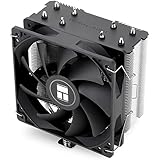
- [Brand Overview] Thermalright is a Taiwan brand with more than 20 years of development. It has a certain popularity in the domestic and foreign markets and has a pivotal influence in the player market. We have been focusing on the research and development of computer accessories. R & D product lines include: CPU air-cooled radiator, case fan, thermal silicone pad, thermal silicone grease, CPU fan controller, anti falling off mounting bracket, support mounting bracket and other commodities
- [Product specification]AX120R SE; CPU Cooler dimensions: 125(L)x71(W)x148(H)mm (4.92x2.8x 5.83 inch); Product weight:0.645kg(1.42lb); heat sink material: aluminum, CPU cooler is equipped with metal fasteners of Intel & AMD platform to achieve better installation
- 【PWM Fans】TL-C12C; Standard size PWM fan:120x120x25mm (4.72x4.72x0.98 inches); fan speed (RPM):1550rpm±10%; power port: 4pin; Voltage:12V; Air flow:66.17CFM(MAX); Noise Level≤25.6dB(A), the fan pairs efficient cool with low-noise-level, providing you an environment with both efficient cool and true quietness
- 【AGHP technique】4×6mm heat pipes apply AGHP technique, Solve the Inverse gravity effect caused by vertical / horizontal orientation. Up to 20000 hours of industrial service life, S-FDB bearings ensure long service life of air-cooler radiators. UL class a safety insulation low-grade, industrial strength PBT + PC material to create high-quality products for you. The height is 148mm, Suitable for medium-sized computer case
- 【Compatibility】The CPU cooler Socket supports: Intel:1150/1151/1155/1156/1200/1700/17XX/1851,AMD:AM4 /AM5; For different CPU socket platforms, corresponding mounting plate or fastener parts are provided
| Control choice | Typical trade-off | What to check |
|---|---|---|
| Silent | Generally targets lower fan speed; exact behavior depends on the board. | Confirm the fan speeds up as CPU temperature rises and cooling remains adequate during normal workloads. |
| Standard | A general-purpose profile; implementation is board-specific. | Observe noise and temperature behavior before deciding whether to keep it. |
| Turbo or Full Speed | Prioritizes cooling response or maximum fan speed, depending on the board. | Expect more fan noise; check whether the setting is appropriate for regular use. |
| Manual | Lets you set temperature-to-duty behavior yourself. | Use a rising curve and validate it under the workloads the PC normally handles. |
ASUS lists Standard, Silent, Turbo, Full Speed, and Manual options in its Q-Fan controls. The ROG STRIX B450-F GAMING II BIOS Manual says, “We suggest raising your fan/pump duty to 100% if your CPU temperature exceeds 75°C.” That is guidance for that specific motherboard manual, not a universal threshold for every CPU, cooler, or board.
Verify the curve after boot
Check fan RPM and CPU temperatures after restarting, including while the PC handles the work it normally does. The fan should respond to rising CPU temperature rather than remaining fixed at one speed. If temperatures climb unusually, the fan fails to respond, or cooling appears inadequate, return to firmware and choose a more conservative profile while you troubleshoot. A curve that behaves well at idle alone has not been validated for heavier workloads.
Rank #2
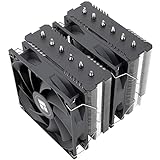
- [Brand Overview] Thermalright is a Taiwan brand with more than 20 years of development. It has a certain popularity in the domestic and foreign markets and has a pivotal influence in the player market. We have been focusing on the research and development of computer accessories. R & D product lines include: CPU air-cooled radiator, case fan, thermal silicone pad, thermal silicone grease, CPU fan controller, anti falling off mounting bracket, support mounting bracket and other commodities
- [Product specification] Thermalright PA120 SE; CPU Cooler dimensions: 125(L)x135(W)x155(H)mm (4.92x5.31x6.1 inch); heat sink material: aluminum, CPU cooler is equipped with metal fasteners of Intel & AMD platform to achieve better installation, double tower cooling is stronger((Note:Please check your case and motherboard for compatibility with this size cooler.)
- 【2 PWM Fans】TL-C12C; Standard size PWM fan:120x120x25mm (4.72x4.72x0.98 inches); fan speed (RPM):1550rpm±10%; power port: 4pin; Voltage:12V; Air flow:66.17CFM(MAX); Noise Level≤25.6dB(A), leave room for memory-chip(RAM), so that installation of ice cooler cpu is unrestricted
- 【AGHP technique】6×6mm heat pipes apply AGHP technique, Solve the Inverse gravity effect caused by vertical / horizontal orientation, 6 pure copper sintered heat pipes & PWM fan & Pure copper base&Full electroplating reflow welding process, When CPU cooler works, match with pwm fans, aim to extreme CPU cooling performance
- 【Compatibility】The CPU cooler Socket supports: Intel:115X/1200/1700/17XX AMD:AM4;AM5; For different CPU socket platforms, corresponding mounting plate or fastener parts are provided(Note: Toinstall the AMD platform, you need to use the original motherboard's built-in backplanefor installation, which is not included with this product)
Troubleshoot common fan-curve problems
The fan stays at full speed
- Confirm automatic or smart control is enabled for the selected header.
- Check that PWM or DC matches the fan and board guidance.
- Verify whether the fan connects to a motherboard header or a separate controller that may bypass firmware control.
ARCTIC’s UEFI fan-settings guidance covers matching control mode to fan type.
The fan does not spin at low temperature
Check whether the board has fan-stop behavior or a minimum-speed limit. Some firmware offers a low-speed warning threshold; consult the manual for the selected profile and verify that the fan starts again as temperature rises. ASUS documents speed-limit and profile controls in the ROG STRIX B450-F GAMING II BIOS Manual.
Rank #3
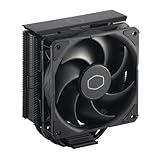
- Cool for R7 | i7: Four heat pipes and a copper base ensure optimal cooling performance for AMD R7 and Intel i7.
- Quiet Cooling Fan: SickleFlow 120 Edge with Dynamic PWM control (690–2,500 RPM), designed for low noise and peak cooling performance.
- Simplify Brackets: Redesigned brackets simplify installation on AM5 and LGA 1851|1700 platforms.
- Versatile Compatibility: 152mm tall design offers performance with wide chassis compatibility.
- Easy Installation: Easy to install with included thermal paste for hassle-free setup and optimal cooling performance.
The fan repeatedly surges and slows
Review the curve for abrupt changes and, if available, adjust step-up or step-down response timing. Change one setting at a time and check temperatures under the same workload after each adjustment; longer ramp timing can soften reactions to short spikes but can also delay a speed increase.
The curve does not control the connected fan
Recheck the selected header, splitter or hub wiring, and any pump or external controller. Firmware controls are generally tied to a particular motherboard header, so a curve for CPU_FAN may not govern a fan connected elsewhere. ASUS’s Q-Fan documentation shows connector selection, while GIGABYTE’s Smart Fan 6 support page illustrates that controls depend on the board.
Quick Recap
Rank #4

- 【Perfect Match】The PC fan can be used not only as a case fan, but is also suitable for use with a cpu cooler to create a cooling effect together, which can take away the dry heat from the case and the high temperature generated by the CPU in operation, allowing for maximum cooling; Ideal for cases, radiators and CPU coolers.
- [Excellent LED light] The high-brightness LED atomizing argb fan blade can effectively reflect the light, making the ARGB lighting effect softer, and it matches the cooler and case more perfectly. Up to 17 modes of light effects with ARGB support, color can be managed and synchronized through the port on motherboard.
- 【High Performance Cooling Fan】 Automatic speed control of the motherboard through the 4PIN PWM fan cable interface, which can determine the speed according to the temperature of the motherboard, with a maximum speed of 1550RPM. Configured with up to 55cm of cable for PWM series control of fans, ideal for cases and CPU coolers.
- 【Silent Fan Size】 Model: TL-C12C-S X3, Size: 120*120*25mm, Speed: 1550RPM±10%, Noise ≤ 25.6dBA Connector: 4pin pwm, Current: 0.20A, Air Pressure: 1.53mm H2O, Air Flow: 66.17CFM, Higher air flow for improved cooling performance.
- 【Quality Bearings】The carefully developed quality S-FDB bearings solve the problem of pc cooling fan blade shaking in lifting mode, keeping fan noise to a minimum while providing maximum cooling performance when needed and extending the life of the fan.
Product prices and availability are accurate as of the date/time indicated and are subject to change. Any price and availability information displayed on Amazon at the time of purchase will apply.

