
You can run a 24/7 Bollywood instrumental stream by sending a continuously looping audio-and-video program from FFmpeg to YouTube Live over RTMPS. The hard parts are not just the command: you need rights for every recording and visual, a source that will not stop at the end of a file, a stable host and connection, and a recovery plan for failures. Use the guide below to build and test that chain; do not assume a YouTube archive will preserve an uninterrupted 24-hour stream.
Before you start: clear the music and visuals
Do not stream a track just because it is instrumental, available online, or included in a purchased copy. You need the necessary rights for the intended livestream uses and territories, including applicable rights from artists, labels, publishers, and other royalty participants. Make sure the permission also covers any archive you intend to keep.
- Confirm that your license or permission explicitly covers livestreaming on YouTube in the territories where you plan to broadcast.
- Confirm that it covers the visual material too, including album art, film imagery, and animated loops.
- Ask the relevant rights holder whether your channel must be added to a Content ID allowlist, and complete that process before going live.
- Keep written records of permissions, covered tracks, territories, dates, and any allowlisting confirmation.
YouTube scans live streams for third-party content matches. A stream may be interrupted, replaced by a placeholder, or terminated if matching content remains. Even if you have a license, a rights holder’s Content ID system may interrupt the stream unless the channel is allowlisted when required.
Choose how the program will repeat
One pre-rendered audio-and-video file
For the simplest FFmpeg workflow, render a single program file that already contains both the instrumental audio and its visual. This avoids handling separate audio and video inputs during the live session. You can make the file from licensed tracks and an original or cleared static, animated, or video visual. Check transitions, audio levels, aspect ratio, and the end-to-start join before using it continuously.
#1 Best Overall

- Compatible with Nintendo Switch 2’s new GameChat mode
- Auto-Light Balance: RightLight boosts brightness by up to 50%, reducing shadows so you look your best—compared to previous-generation Logitech webcams (1)
- Privacy with a Slide: The integrated webcam cover makes it easy to get total, reliable privacy when you're not on a video call
- Built-In Mic: The built-in microphone lets others hear you clearly during video calls
- Easy Plug-And-Play: The Brio 101 works with most video calling platforms, including Microsoft Teams, Zoom and Google Meet—no hassle; it just works
A playlist or changing set of tracks
A playlist gives you more control over rotation, but you must define what happens at every track boundary and when the last item ends. Make sure every track and visual has the required rights. Test the complete playlist, including the transition from its final item back to its first; do not assume a playlist file or player will loop itself forever.
A static visual can reduce source complexity compared with an animated or video background, while a moving visual may be more engaging but takes more encoding resources. The visual format alone does not establish whether a channel is eligible for monetization.
Rank #2

- 【1080P HD Clarity with Wide-Angle Lens】Experience exceptional clarity with the Shcngqio TWC29 1080p Full HD Webcam. Its wide-angle lens provides sharp, vibrant images and smooth video at 30 frames per second, making it ideal for gaming, video calls, online teaching, live streaming, and content creation. Capture every detail with vivid colors and crisp visuals
- 【Noise-Reducing Built-In Microphone】Our webcam is equipped with an advanced noise-canceling microphone that ensures your voice is transmitted clearly even in noisy environments. This feature makes it perfect for webinars, conferences, live streaming, and professional video calls—your voice remains crisp and clear regardless of background noise or distractions
- 【Automatic Light Correction Technology】This cutting-edge technology dynamically adjusts video brightness and color to suit any lighting condition, ensuring optimal visual quality so you always look your best during video sessions—whether in extremely low light, dim rooms, or overly bright settings. It enhances clarity and detail in every environment
- 【Secure Privacy Cover Protection】The included privacy shield allows you to easily slide the cover over the lens when the webcam is not in use, offering immediate privacy and peace of mind during periods of non-use. Safeguard your personal space and prevent unauthorized access with this simple yet effective solution, ensuring your security at all times
- 【Seamless Plug-and-Play Setup】Designed for user convenience, the webcam is compatible with USB 2.0, 3.0, and 3.1 interfaces, plus OTG. It requires no additional drivers and comes with a 5ft USB power cable. Simply plug it into your device and start capturing high-quality video right away! Easy to use on multiple devices, ensuring hassle-free setup and instant functionality
Set up YouTube Live and protect the stream key
- Open YouTube Live Control Room and create or configure the broadcast for the channel that will carry the stream. Follow the current on-screen setup for a streaming encoder.
- Choose the RTMPS ingestion option where available. RTMPS is RTMP carried through TLS/SSL encryption; YouTube recommends it to protect the connection.
- Copy the ingestion URL and stream key from Live Control Room. Keep the key private as you would a password. Do not paste it into an article, public script repository, screenshot, or support post.
- Check the broadcast settings in Live Control Room before starting FFmpeg, including the selected stream key and any start/stop behavior shown in the current interface.
YouTube’s encoder guidance currently recommends a two-second keyframe interval and says the interval should not exceed four seconds. It recommends constant bitrate (CBR), and lists 128 Kbps as the recommended stereo audio bitrate. Video bitrate is separate: choose it using YouTube’s current encoder table for your selected resolution and frame rate, then confirm your upload connection can sustain it.
Prepare FFmpeg and encode a pre-rendered loop
The example below is a template for a pre-rendered program file containing both audio and video. It is not a universal command: FFmpeg options, protocol support, input formats, and available encoders depend on your installed build and media. Replace the bracketed values, use YouTube’s current video bitrate guidance for your chosen resolution and frame rate, and test on the exact host and FFmpeg build you plan to run.
Recommended Free Tools
Rank #3

- Compatible with Nintendo Switch 2’s new GameChat mode
- HD lighting adjustment and autofocus: The Logitech webcam automatically fine-tunes the lighting, producing bright, razor-sharp images even in low-light settings. This makes it a great webcam for streaming and an ideal web camera for laptop use
- Advanced capture software: Easily create and share video content with this Logitech camera that is suitable for use as a desktop computer camera or a monitor webcam
- Stereo audio with dual mics: Capture natural sound during calls and recorded videos with this 1080p webcam, great as a video conference camera or a computer webcam
- Full HD 1080p video calling and recording at 30 fps. You'll make a strong impression with this PC webcam that features crisp, clearly detailed, and vibrantly colored video
ffmpeg -re -stream_loop -1 -i "program.mp4"
  -c:v libx264 -preset veryfast -pix_fmt yuv420p
  -r [FRAME_RATE] -g [TWO_SECONDS_OF_FRAMES] -keyint_min [TWO_SECONDS_OF_FRAMES] -sc_threshold 0
  -b:v [VIDEO_BITRATE] -maxrate [VIDEO_BITRATE] -bufsize [TWICE_VIDEO_BITRATE]
  -c:a aac -b:a 128k -ar 44100
-f flv "[RTMPS_INGEST_URL]/[STREAM_KEY]"program.mp4is your combined audio-and-video source. Put-stream_loop -1before the input it loops.-rereads the file at its native pace rather than sending it as fast as the computer can process it.- Set
[TWO_SECONDS_OF_FRAMES]to twice the frame rate. For example, at 30 fps, the starting value is 60; at 60 fps, it is 120. This implements the two-second keyframe interval recommended in YouTube’s current encoder guidance. - Replace
[VIDEO_BITRATE]and[TWICE_VIDEO_BITRATE]with values appropriate to your resolution and frame rate; the latter is twice the former. Do not use the audio bitrate as the video bitrate. - Use the RTMPS ingestion URL and stream key from your own Live Control Room. Never publish a real key in a command example.
This template uses H.264 video, AAC audio, and FLV output, a common RTMP-family delivery combination. It does not prove that your FFmpeg binary supports every option or that your source will encode correctly. Check the installed build’s protocol and encoder support, and adjust the command if your file has unusual stream layouts, frame rates, or codecs. YouTube’s current encoder guidance also lists H.265/HEVC and AV1 in supported contexts; protocol and use can affect which combinations are available.
If your input is a still image plus audio
FFmpeg needs to send a valid video stream as well as the music. A still image is not automatically an endlessly running audio/video program. One practical route is to prepare a combined program file first, then loop that file as in the template. If you choose to generate video from a still image directly, build and test the image-input and audio-looping syntax for your FFmpeg version and chosen output; the correct options depend on the input and should not be assumed from the pre-rendered-file example.
Rank #4
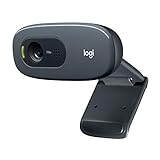
- Compatible with Nintendo Switch 2’s new GameChat mode
- Crisp HD 720p/30 fps video calls with diagonal 55° field of view and auto light correction. Compatible with popular platforms including Skype and Zoom.
- The built-in noise-reducing mic makes sure your voice comes across clearly up to 1.5 meters away, even if you’re in busy surroundings.
- C270’s RightLight 2 feature adjusts to lighting conditions, producing brighter, contrasted images to help you look good in all your conference calls.
- The adjustable universal clip lets you attach the camera securely to your screen or laptop, or fold the clip and set the webcam on a shelf. You’re always ready for your next video call.
Match quality to your connection and test before going live
- Select resolution and frame rate. Start with a setting your upload connection can sustain consistently. Use YouTube’s current encoder table rather than guessing a video bitrate from the audio settings.
- Use CBR and a two-second keyframe interval as your starting point. YouTube’s current guidance recommends CBR and keyframes every two seconds, with four seconds as the maximum recommended interval.
- Test with representative material. Use the same or similar audio, visual movement, resolution, frame rate, and bitrate as the planned stream. A test using a static image is not representative of a high-motion visual.
- Watch Live Control Room’s stream health. Check for warnings, dropped frames, buffering, or connection problems and resolve them before leaving the channel unattended.
- Check the actual playback. Verify that audio is continuous, the image is correctly proportioned, the loop boundary is acceptable, and the channel is receiving the intended stream.
- Test recovery deliberately. In a controlled test, verify what happens when the connection drops, FFmpeg exits, or the host restarts. Do not assume a process or host will recover just because the initial broadcast worked.
Keep the stream running after the first successful test
A 24/7 stream depends on the whole chain: media source, FFmpeg process, computer or server, network, and YouTube ingest. Plan for each part to fail. Use a process supervisor or equivalent restart mechanism to relaunch FFmpeg after an exit, keep logs you can inspect, and arrange alerts or checks so you know when the stream is unhealthy. Make sure the host can restart after a reboot and has enough disk space for logs and any local recording.
- Source ends or becomes unavailable: confirm that the media loop works, and test the playlist’s end-of-list behavior if you use one.
- FFmpeg exits: inspect its logs and exit status, then use a supervisor or equivalent mechanism to restart it. Test that restart rather than treating it as an uptime guarantee.
- Network or YouTube ingest drops: verify the host can reconnect and that the stream returns in Live Control Room. Confirm recovery during a controlled test.
- Host reboots: configure the stream process to start again after reboot and check that credentials, file paths, and storage are available to it.
- Disk fills: monitor logs and local recording storage, and set a retention policy appropriate to your needs.
FFmpeg and YouTube do not, by themselves, provide an end-to-end guarantee that a 24/7 broadcast will stay live. Recovery behavior depends on your host, network, process management, and stream configuration.
Free tools Windows power users keep installed
One-click scans. No signup required.
Best Value

- 1080P Webcam with Cover for Video Calls - EMEET computer webcam provides design and Optimization for professional video streaming. Realistic 1920 x 1080p video, 5-layer anti-glare lens, providing smooth video. C960 computer camera delivers 1920x1080 video with fixed focus (11.8–118.1 inches), so as to provide a clearer image. C960 USB webcam has a cover and can be removed automatically to meet your needs for privacy. For optimal image performance, use the webcam in a well-lit environment.
- Built-in 2 Omnidirectional Mics - EMEET webcam with microphone for desktop features 2 built-in omnidirectional microphones, picking up your voice to create clear audio for communication. When installing the webcam, select EMEET C960 as the default microphone input device in your computer and video applications and select C960 as the default device in Zoom/Teams and ensure microphone permissions are enabled for proper use. Please note that C960 does not include built-in speakers.
- Automatic Light Adjustment - Automatic exposure adjustment is applied in EMEET HD webcam 1080p so that the streaming webcam can deliver stable image performance. EMEET C960 camera for computer also features color adjustment and exposure optimization to help you look your best. For optimal video quality, it is recommended to use the webcam in normal or well-lit environments and select suitable video settings in your application. Proper lighting helps achieve a clearer and more balanced image.
- Plug-and-Play & Upgraded USB Connectivity - New C960 webcam features both USB Type-A & A-to-C adapter connections for wider compatibility. For stable performance, connect the webcam directly to the computer's main USB port and ensure the device is recognized correctly. If a hub or docking station is used, please ensure it provides sufficient power and stable data transmission, as limited ports may affect performance. 90° wide-angle lens captures more participants without frequent adjustments.
- High Compatibility & Multi Application - C960 webcam for laptop is compatible with Windows 10/11, macOS 10.14+, and Android TV 7.0+. Not supported: Windows Hello, TVs, tablets, or game consoles. It works with Zoom, Teams, Facetime, Google Meet, YouTube and more. Please select C960 webcam as the default camera and microphone device in your application and ensure camera/microphone permissions are enabled, especially on macOS. (Tips: Incompatible with Windows Hello)
Do not rely on YouTube to archive a 24/7 broadcast
YouTube says streams shorter than 12 hours can be automatically archived; a stream that exceeds 12 hours may not be captured at all. Plan a local recording if a complete archive matters, and monitor that recording separately. An external drive is one possible destination, but the storage required depends on bitrate, codec, resolution, and duration.
Copyright permission does not guarantee monetization
Technical ability to stream and permission to use recordings do not establish eligibility for YouTube Partner Program monetization. YouTube’s channel monetization policy says content should be original and authentic, and identifies highly repetitive or mass-produced content and collections of songs from different artists as examples that may not qualify. A looped instrumental broadcast should not be assumed monetizable just because its music is licensed. YouTube clarified on July 15, 2025 that it renamed “repetitious content” as “inauthentic content”; its policy says the reused-content policy did not change in that update. Eligibility is assessed under the platform’s policies and in the context of the channel.
Or let it run in the cloud
If you would rather not keep a computer, FFmpeg process, and home connection running, StreamNeo runs an uploaded-video YouTube stream from the cloud. The setup is: upload a recording or build a playlist, add your YouTube stream key once, then go live. It plays uploaded videos rather than broadcasting from a camera, and it streams to YouTube.
- Nothing has to stay on at home; the stream keeps running from the cloud.
- Every slot uses one flat price for any uploaded quality up to 4K 60fps, without re-encoding or quality tiers.
- Automatic recovery is included if YouTube drops the stream.
- The first day is free, with no card required.
Monthly service is $9.99 per month. In India, UPI and cards are accepted; card checkout is available worldwide. The first day is free once per account, and you can cancel any time. Start at StreamNeo’s free trial signup.
Quick wins for a faster PC:
Repair Windows errors before they cause bigger problemsFix Now →Scan for outdated or missing drivers - takes under a minuteDriver Scan →Clear out junk files and repair common Windows errorsFree Scan →Quick Recap
Product prices and availability are accurate as of the date/time indicated and are subject to change. Any price and availability information displayed on Amazon at the time of purchase will apply.

