
Free tools Windows power users keep installed
One-click scans. No signup required.
Protecting PoE equipment from lightning-related surges takes more than adding an RJ45 protector. Plan the cable route, use a surge protector compatible with the link, and connect it to the site’s grounding and bonding system as specified by its manufacturer. These measures can reduce risk; they cannot guarantee survival of a direct strike or every electrical surge.
Why outdoor PoE links are exposed to surge damage
Outdoor copper Ethernet can carry lightning-induced or other transient voltages toward connected equipment. A run between an outdoor camera, access point, or radio and indoor network equipment can expose both ends. A surge may also arise from ground-potential rise: connected systems at different locations can temporarily sit at different electrical potentials, creating a damaging voltage between them. IEEE’s active IEEE 1692-2023 guide covers protection of communication installations from lightning effects, including surges associated with ground-potential rise and similar potential differences. Its public listing describes the scope, not a complete design prescription.
Surge protection is therefore a system decision. Routing, signal-line protection, equipment compatibility, and grounding or bonding have to work together. A protector with no effective connection to the prescribed grounding system cannot be assumed to divert a surge safely.
How to assess and protect a PoE installation
- Map the exposed links. Identify Ethernet runs that are outdoors, aerial, routed between buildings, or entering a building. Note the PoE source (such as a switch or injector), the powered device, and any outdoor AC power involved.
- Check the equipment instructions. Confirm the device’s PoE requirements, grounding terminal, and instructions for shielded cable or a grounded PoE adapter. These details vary by product. For example, TP-Link Pharos guidance discusses shielded CAT5e or higher and a provided grounded PoE adapter for some installations, along with a separate grounding-terminal method for general cable. Do not assume another vendor uses the same method.
- Plan the route and bonding. Avoid copying a wiring diagram without checking how it applies to the site. TP-Link’s lightning-protection guide advises against unprotected aerial cable runs and recommends signal arresters for outdoor cable connections. It also discusses bonding earthed systems into an equipotential zone. Cable shielding, route, entry point, and connection to the site’s bonding system all matter.
- Choose a compatible protector and install it as directed. Match its data rate and PoE capability to the actual link, including the power requirements and any vendor-specific passive-PoE behavior. Follow the specified port direction and connect its grounding point as instructed. TP-Link’s installation instructions specify incoming cable to “IN,” the protected device to “OUT,” and connection of the arrester ground terminal to the grounding system.
- Get site-specific help when the electrical design is complex. Outdoor AC power, a link between buildings, a lightning-protection system, or complicated bonding arrangements call for an appropriately qualified electrical or network professional and compliance with local rules. The cited manufacturer guides do not establish a universal do-it-yourself wiring prescription.
Where should an Ethernet surge protector go?
Possible locations include near the outdoor device, at the building entry, or at both points when the installation design calls for it. Ubiquiti’s ETH-SP-G2 datasheet illustrates protectors near an outdoor CPE and at a building entry. Treat that as vendor guidance for its use case, not a universal code requirement or a guarantee of protection.
Recommended Free Tools
#1 Best Overall

- (2 Pack) Ethernet Surge Protector for Gigabit GbE PoE/High PoE++ (HPoE) 1000 Mbps LAN Ethernet Network
- Gas Discharge Tubes for Full Protection GDT - Lightning Suppressor RJ45 Cable Protection CAT6/CAT5
- Aluminum Case,Ground Wire 12AWG,Line-Line Line-Ground Protection,Bidirectional Clamping,20KA 8/20μs
- Thunder Arrestor Protects Computer Networking Equipment Devices like Router,Modem,Camera,Switch etc
- Provide transient protection for the protected differential line pair to IEEE 802.3 af/at/bt (PoE++ 15V/24V/30V/48V/50V/56V Transmission) Mode A and B IEC 61000-4-5 (Lightning/Surge) 20KA (8/20μs) with PoE current of 1.6A / 2 pairs and 3.2A / 4 pairs (154W/48V max)
Location is only useful when the protector’s grounding connection is effective and integrated with the site’s grounding and bonding design. Do not assume a metal pole, rack, or mounting surface is bonded just because it is metal, and do not improvise a separate ground path. Use the equipment’s approved grounding point and follow its installation instructions and applicable local electrical rules.
How to choose a PoE-compatible Ethernet surge protector
Check the complete specification and instructions rather than selecting by a headline discharge-current rating alone. Confirm:
Rank #2
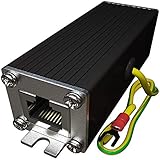
- Ethernet Surge Protector for Gigabit GbE PoE/High PoE++ (HPoE) 1000 Mbps LAN Ethernet Network
- Gas Discharge Tubes for Full Protection GDT - Lightning Suppressor RJ45 Cable Protection CAT6/CAT5
- Aluminum Case,Ground Wire 12AWG,Line-Line Line-Ground Protection,Bidirectional Clamping,20KA 8/20μs
- Thunder Arrestor Protects Computer Networking Equipment Devices like Router,Modem,Camera,Switch etc
- Provide transient protection for the protected differential line pair to IEEE 802.3 af/at/bt (PoE++ 15V/24V/30V/48V/50V/56V Transmission) Mode A and B IEC 61000-4-5 (Lightning/Surge) 20KA (8/20μs) with PoE current of 1.6A / 2 pairs and 3.2A / 4 pairs (154W/48V max).
- Data rate: The protector must support the speed of the Ethernet link and connected ports. TP-Link specifically tells installers to match the arrester’s port rate to the device port.
- PoE implementation and power: Verify that the protector supports the PoE type and power budget the link uses. Do not presume every RJ45 arrester passes every PoE standard or passive-PoE arrangement.
- Connection and grounding: Check the connector arrangement, installation direction, grounding terminal, and any instructions for shielded cable or a drain wire.
- Published evidence: Review the manufacturer’s stated standards, test conditions, signal bandwidth, PoE capability, environmental rating, and installation requirements. A kA figure by itself does not establish link compatibility or whole-system protection.
One documented example is the Ubiquiti ETH-SP-G2, but its published speed descriptions differ by source: the datasheet describes PoE and non-PoE use up to 1 Gbps, while the manufacturer’s current technical page lists PoE support and protection up to 2.5 Gbps. These are manufacturer specifications, not independent comparative test results. Verify the exact product revision and its requirements against the devices on the link.
For grounding, Ubiquiti’s quick-start guide documents grounding to a grounded metal pole or structure when using STP cable, or using a drain wire connected to a remote grounding point. Follow the instructions for the specific installation and ensure the connection fits the site’s bonding design.
Quick wins for a faster PC:
Fix the driver behind crashes, sound loss and screen glitchesFind Drivers →Clear out junk files and repair common Windows errorsFree Scan →Scan for outdated or missing drivers - takes under a minuteDriver Scan →Rank #3

- 【2 Pack POE+ Surge Protection】Equipped with GDT and TVS dual protection, 20KV common mode/1.5KV differential mode surge resistance, and 20KA discharge current. Full 8-pin RJ45 protection, ≤1ns response time, and ≤0.5dB insertion loss—safeguards devices without compromising network speed.
- 【Full PoE Compatibility】Compliant with IEEE 802.3af/at/bt (PoE++) standards, supporting up to 120W per port (max 154W for High PoE++) and 60V DC input. Works with 10/100/1000Mbps Gigabit networks, Mode A/B, and both PoE/non-PoE Ethernet devices for versatile use.
- 【Wide Application & Cable Fit】Compatible with CAT5/CAT5e/CAT6 cables, protecting routers, PoE cameras, switches, modems, servers, and more. Defends against lightning strikes, electrostatic discharge, and voltage spikes, operating stably from -40℉ to 185℉.
- 【Durable Aluminum Construction】Features high-quality aluminum alloy housing for excellent heat dissipation, corrosion resistance, and mechanical strength. Includes 12AWG grounding wire, line-line/line-ground bidirectional clamping, and shielded design for long-term reliability.
- 【Easy & Flexible Installation】Supports DIN rail mounting, wall mounting, and desktop placement. Clear IN/OUT directional marks, dual-side flanges, and standard shielded RJ45 interface enable plug-and-play setup—no complex tools or assembly required.
Standards and the limits of surge protection
IEEE lists IEEE 1692-2023 as an active guide for protecting communication installations from lightning effects; its listing gives a publication date of August 21, 2024, and ANSI approval date of March 3, 2025. IEEE C62.43.1-2020 is an application guide for surge protective devices and circuits used in ICT circuits, including smart grid; IEEE’s listing also notes amendment C62.43.1a-2023. The public listings do not reproduce the full standards, so they should not be used to infer detailed compliance requirements.
PoE-specific surge behavior is also addressed in a Texas Instruments application note that relates its analysis to IEEE 802.3, IEC 60950, and ITU-T K.44. It is older engineering material, so use current standards and the relevant product instructions for design decisions.
Rank #4

- 【Surge Protection】:Ethernet surge protector is designed to protect equipment against transients from lightning, ESD, and ground surges. Awishwell surge protector supports speeds up to 1 Gigabit -1000 Mbps, and provides PoE++ 802.3af/at/bt compatibility with 10KV surge protection, without affecting network performance. Peak surge current protection up to standard 20KA 8/20μs.
- 【Performance Support】: Our Ethernet Lightning Arrestor provides 8-wire line protection; response time ≤ 1ns; insertion loss (Ae) ≤ 0.5dB; operating voltage (Un): 48V DC. Supports both Mode A and Mode B and compatible with PoE and non-PoE Ethernet connections.
- 【Structural Performance:】: The aluminum housing offers excellent corrosion resistance, heat dissipation, and mechanical strength. Equipped with network transformer, reducing electromagnetic interference and noise, ensuring more stable signal transmission. The Gas Discharge Tube (GDT) effectively protects your equipment from surge damage.
- 【Easy Installation】: The network surge protector features a 12AWG, 7.87-inch grounding wire. Directional IN (for the incoming line)/OUT (for the protected device) markings, and dual-side flanges for easy wall-mount installation (screws not included).
- 【Device Protection】: The RJ45 surge protector is suitable for routers, computers, cameras, switches, servers, and other network equipment; Compatible with CAT5, CAT5e, and CAT6 cables. It effectively suppresses lightning strikes, voltage spikes, and PoE overvoltage transients, minimizing potential damage to your network devices.
As TP-Link puts it in guidance for its surveillance-equipment context, “To prevent the hazards of induced lightning strikes, the following aspects are crucial: grounding, reasonable wiring, and the use of lightning arresters.” That is useful manufacturer advice, not a substitute for local electrical rules or a site-specific design. A small inline protector should never be treated as a promise of immunity from a direct strike or every surge scenario.
Quick Recap
Best Value

- Gas Discharge Tubes(GDT) and Transient Voltage Suppressor(TVS) provide dual protection.
- Compatible with 802.3af/at ,support PoE+ 30w (0.6A/48V) and 10/100/1000 Base-T networks.
- 10KV lightning protection for all 8 pins of RJ45 ports.
- Plug-and-play ,standard shielded RJ45 interface compatible with CAT5,CAT5e CAT6, for Network Devices like PoE camera,Ethernet switch,router.
- Support wallmount,equiped with 17AMG groung wire.
Product prices and availability are accurate as of the date/time indicated and are subject to change. Any price and availability information displayed on Amazon at the time of purchase will apply.

