
iTechGuides is reader-supported. When you buy through links on our site, we may earn an affiliate commission. As an Amazon Associate I earn from qualifying purchases. Learn more
Two internet connections do not automatically create a resilient business network. A dependable design starts by defining which services must remain usable, proving that the routes do not share hidden failures, sizing the surviving link for degraded operation, and testing the exact behavior users and applications will see. Depending on the site and recovery goals, the right design may be a standby circuit, active-active links, a managed multi-ISP service, or full multihoming with BGP.
Start with a service objective, not a router
Write down what “the internet must keep working” means for your business before selecting circuits or edge equipment. A retail office, a call center, a software company hosting public services, and a warehouse may all buy two links but require very different failover behavior.
Inventory the services that matter
List every site, application and dependency that uses the connection. Include cloud applications, voice and video, payment or point-of-sale systems, remote desktop, virtual private networks, software repositories, backups, public websites, APIs, email, DNS, identity providers and monitoring systems. Note whether each service is outbound-only, accepts inbound connections, or depends on a fixed source address.
Record dependencies outside the office. If identity, DNS, certificate validation or security gateways are reached through the same provider or building, losing that dependency can look like an internet outage even when a circuit remains lit.
Popular on Amazon
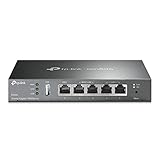
- 【Five Gigabit Ports】1 Gigabit WAN Port plus 2 Gigabit WAN/LAN Ports plus 2 Gigabit LAN Port. Up to 3 WAN ports optimize bandwidth usage through one device.
- 【One USB WAN Port】Mobile broadband via 4G/3G modem is supported for WAN backup by connecting to the USB port. For complete list of compatible 4G/3G modems, please visit TP-Link website.
- 【Abundant Security Features】Advanced firewall policies, DoS defense, IP/MAC/URL filtering, speed test and more security functions protect your network and data.
- 【Highly Secure VPN】Supports up to 20× LAN-to-LAN IPsec, 16× OpenVPN, 16× L2TP, and 16× PPTP VPN connections.
- Security - SPI Firewall, VPN Pass through, FTP/H.323/PPTP/SIP/IPsec ALG, DoS Defence, Ping of Death and Local Management. Standards and Protocols IEEE 802.3, 802.3u, 802.3ab, IEEE 802.3x, IEEE 802.1q
Define acceptable interruption and recovery behavior
For each critical service, specify the maximum interruption the business can tolerate, what data loss is acceptable, and whether users may reconnect manually. A browser session that can be retried is different from a payment transaction, a voice call or a long-running database connection. State whether the objective covers a failed access line, an upstream provider outage, a failed edge device, building power loss, or a shared duct and building entry.
Do not assign a universal recovery-time number to every design. Detection, routing convergence, application retries, DNS caching and provider restoration all affect the result. Set a target from the business requirement, then validate it in a controlled test.
Measure normal and degraded demand
Collect peak and sustained traffic by direction, application and site. Include backup windows, software updates, video meetings and seasonal peaks. Then calculate what must remain available after the largest failure included in the plan. A pair of links that comfortably handles ordinary traffic may leave no capacity for essential work when one link is lost.
Outdated Drivers Are Slowing You Down
One free scan finds every outdated or missing driver and matches the right update for your exact hardware.Free scan · exact hardware matchWindows Errors? Fix Them Before They Spread
Repair common Windows errors and clear accumulated junk for a smoother, more stable PC - no reinstall needed.Free scan · no reinstall- Peak downstream and upstream throughput, not just monthly averages.
- Concurrent sessions, connection rates and latency-sensitive traffic.
- Traffic classes that can be throttled or paused during an incident.
- Minimum bandwidth and latency needed by critical applications.
- Whether remote workers or customers will increase demand during a local outage.
Prove that the routes are actually diverse
Different provider names or access technologies are useful clues, not proof that failures are independent. Two circuits can enter through the same building conduit, terminate on the same rooftop radio, use the same local loop, share an aggregation node, or depend on the same upstream carrier.
Map each circuit from the premises to the wider network
For every proposed connection, document the complete path:
- Access medium: fiber, cable, fixed wireless, cellular, satellite or another technology.
- Building entry: the conduit, riser, handhole, rooftop, pole or demarcation point used by the circuit.
- Local loop: the physical span and provider-owned equipment between the premises and the first aggregation location.
- Aggregation and upstream: the node, transport network, carrier handoffs and internet transit used beyond the local loop.
- Power and facilities: shared cabinets, generator arrangements, batteries, cooling and building access.
- Restoration: repair ownership, escalation contacts, target response and any exclusion for shared civil infrastructure.
Ask each provider to identify shared-risk links and to define “diverse” in contract language. Request separate entry points and aggregation where the business objective requires them. A provider may be unable to disclose every physical detail, but its answer should distinguish true route separation from a second service delivered over the same plant.
Also popular on Amazon

- Refer the user manual below for troubleshooting
- Up to 50 IPsec tunnels (for site-to-site and client-to-site VPN) and 5 OpenVPN tunnels for iOS and Android users
- 900 Mbps firewall and 110 Mbps IPsec throughputs
- Feature-rich to meet a wide range of business network requirements
- Supports load balancing and WAN failover for highly reliable Internet connectivity
Understand the “diamond problem”
RFC 5772 describes a “diamond problem”: two apparently separate Layer 2 services can rely on the same Layer 1 provider. A second logical service therefore may not provide a second physical failure path. Treat this as an architectural warning, not as proof that every provider shares facilities. The only reliable answer for a particular address comes from path documentation, contracts and testing.
Free tools Windows power users keep installed
One-click scans. No signup required.
Check dependencies beyond the last mile
Route diversity can disappear at an upstream carrier, internet exchange, data center, DNS provider or cloud security service. Ask whether both circuits use the same transit provider, autonomous-system path, peering location or managed firewall cluster. If public applications are fronted by a single external service, assess that service separately from the office links.
Choose a topology that matches the failure you must survive
RFC 8678 calls site multihoming—connecting a subscriber network to multiple upstream networks with redundant uplinks—a common enterprise architecture for improving internet reliability. The implementation can be simple or highly engineered. Compare each option on route independence, usable capacity in normal and failure modes, recovery behavior, address continuity, IPv4 and IPv6 support, monitoring, security controls, provider commitments and your team’s troubleshooting ability.
| Design | Normal operation | After one link fails | Strengths | Important limitations |
|---|---|---|---|---|
| One provider, two access paths | Usually one primary path with a secondary available | Traffic moves to the surviving access path if provider infrastructure beyond the split remains reachable | Can address a cut local loop or access device without adding a second commercial relationship | Shared provider aggregation, ducts or upstream transport may defeat the intended independence |
| Two providers | Standby or simultaneous use, depending on edge design | One provider carries the required services | Reduces dependence on one provider’s operations and repair process | The providers may lease the same underlying carrier, building entry or transit |
| Standby failover | Primary link carries planned traffic; secondary capacity is reserved | Policies switch selected or all traffic to the backup | Often simpler to operate and easier to reason about | Backup bandwidth may be insufficient, and existing sessions commonly need to reconnect |
| Active-active or load-balanced links | Both links carry traffic according to policy | Policies remove the failed link and redistribute traffic | Uses more purchased capacity in ordinary operation | Requires health checks, session symmetry, address planning and enough surviving capacity |
| BGP multihoming | Edge routers exchange routes with multiple upstream networks | Routing policy withdraws or changes paths when a peer or link fails | Can provide deliberate inbound and outbound path control for demanding sites | Needs routing expertise, security controls, provider coordination and operational monitoring |
| Managed SD-WAN over multiple ISPs | A managed overlay selects paths using application and link policies | Traffic is steered over healthy underlay links | Useful for several sites and policy-based path selection without building every routing function in-house | Adds an overlay control plane, service dependency and contract-specific troubleshooting |
RFC 4031 distinguishes redundancy from load balancing: redundancy maintains connectivity when a component fails, while load balancing uses redundant-link capacity to improve performance when components are available. Apply that distinction carefully because the RFC addresses provider-provisioned Layer 3 VPN requirements, not every business internet implementation.
When a standby design is appropriate
Standby is a sensible fit when the business can tolerate reconnection, most traffic is outbound, and the secondary circuit can carry the critical workload. It reduces policy complexity because one path is preferred until health checks declare it unusable. Confirm that “up” means useful reachability, not merely an electrical carrier signal.
When active-active is worth the complexity
Use both links in normal operation when the site needs their combined capacity or wants to avoid paying for an idle circuit. Define which applications may use each path, how long a flow is pinned to one link, and how traffic is redistributed after a failure. Stateful firewalls, VPNs and payment systems can break when a session changes source address or takes an asymmetric return path.
Also popular on Amazon

- 【Flexible Port Configuration】1 2.5Gigabit WAN Port + 1 2.5Gigabit WAN/LAN Ports + 4 Gigabit WAN/LAN Port + 1 Gigabit SFP WAN/LAN Port + 1 USB 2.0 Port (Supports USB storage and LTE backup with LTE dongle) provide high-bandwidth aggregation connectivity.
- 【High-Performace Network Capacity】Maximum number of concurrent sessions – 500,000. Maximum number of clients – 1000+.
- 【Cloud Access】Remote Cloud access and Omada app brings centralized cloud management of the whole network from different sites—all controlled from a single interface anywhere, anytime.
- 【Highly Secure VPN】Supports up to 100× LAN-to-LAN IPsec, 66× OpenVPN, 60× L2TP, and 60× PPTP VPN connections.
- 【5 Years Warranty】Backed by our 5-years warranty and free technical support from 6am to 6pm PST Monday to Fridays
When to consider BGP or a managed service
BGP multihoming is appropriate only when the organization can operate routing policy and monitoring or has a qualified managed provider. It is commonly paired with provider-independent address space when stable addressing and inbound control are important. A managed SD-WAN service can be a better fit for several offices, application-aware steering and centralized operations, but it does not remove the need to verify physical diversity and security.
Size capacity for the failure state
Compare usable bandwidth in two states: ordinary operation and the loss of the largest in-scope component. If two links each carry half of the normal load, losing one may leave the survivor oversubscribed even though the total purchased bandwidth looked generous.
Build a degraded-mode traffic policy
Rank traffic before an outage occurs:
- Keep payment, voice for essential staff, identity, emergency communication and other safety or revenue-critical traffic at the highest priority.
- Permit normal business applications with defined limits.
- Throttle large backups, software distribution, streaming and nonessential synchronization.
- Pause discretionary traffic when the survivor reaches a defined utilization or latency threshold.
Document how the policy is enforced: firewall queues, SD-WAN classes, application controls or manual change procedures. A policy that exists only in a diagram will not protect capacity during a real incident.
Account for link characteristics, not just megabits
Latency, packet loss, jitter, data caps, upload speed and provider traffic shaping can matter more than headline download rate. A cellular or wireless backup may have different latency and usage limits from a fiber primary. Test critical applications on each link independently and under realistic contention.
Plan addressing and routing deliberately
Failover changes how traffic reaches the internet. Decide whether the business can operate with provider-assigned addresses that change, or whether public services require continuity of an address block.
Outbound addressing
Many edge devices can select a preferred WAN and perform network address translation for outbound traffic. Applications that allow multiple source addresses usually recover by opening a new connection. Services that restrict access by source IP, use long-lived sessions or embed addresses in callbacks need explicit allow-list and reconnection planning.
Also popular on Amazon

- Please update the firmware upon initial setup of the router, as it greatly enhances the device's performance and ensures a superior user experience.*** 【WiFi 6 Standard with ultra-low latency】Wi-Fi 6 speeds up to 6 Gbps to let you enjoy smoother 4K streaming, gaming, video calls and more, DDR4 1GB / eMMC 8GB
- 【High Speed Gaming Router】Dominate with uninterrupted performance with the ultimate MT6000 gaming internet router, equipped with 8-stream Wi-Fi 6 technology, the Flint 2 delivers blazing speeds, ensuring a stable and high-speed connection during intense multiplayer battles.
- 【Rapid OpenVPN & Wireguard speed】Wireguard VPN and OpenVPN speeds up to 900Mbps and 880Mbps respectively, giving you complete control over your gaming, streaming and working bandwidth. Actual speed may differ depending on internet service provider, network environment, VPN server location, VPN service provider, etc.
- 【AdGuard Home Supported】Enabling the use of a DNS server for blocking unwanted tracking and offers a convenient web interface for filtering selected digital advertisements. Users can take full control of their online experience and enjoy a clutter-free browsing environment with ease.
- 【Mass device connectivity】Experience enhanced online connectivity with our higher storage capacity, catering to over a hundred devices and fulfilling the requirements of DIY users seeking to install additional plugins. Enjoy stable and reliable connections, ensuring seamless performance and accommodating a wide range of digital needs.
Inbound services
If a public service is advertised through one provider-assigned address, switching circuits can make it unreachable until DNS caches expire or a new path is announced. Lowering DNS time-to-live does not instantly clear every cache. For important inbound services, evaluate redundant hosting, an external front end, dynamic DNS behavior, or routed address space with the operational expertise to announce and protect it.
Recommended Free Tools
IPv6 considerations
RFC 8678 describes provider-assigned IPv6 multihoming as an approach that can avoid provider-independent address space and enterprise BGP in some cases. It still requires careful source-address selection and forwarding behavior. Do not treat that IPv6 guidance as a complete answer for IPv4, public-service continuity or every operating system and firewall. Test IPv6 failover separately; a design that works for IPv4 can leave IPv6 traffic on a broken path.
Small-site edge routing
A small office may use a dual-WAN router or a managed gateway to prefer one provider, run health checks and move selected traffic to another. Validate WAN port configuration, throughput with security features enabled, health-check targets, IPv6 handling, firmware support, management access and compatibility with both providers. Some businesses receive this routing equipment as part of a managed service rather than buying it separately.
More demanding multihoming
Sites with their own public services, multiple locations, strict address continuity or complex inbound policy may need edge routers, provider-independent address space and BGP. Route filtering, prefix limits, authentication, fail-safe defaults and independent management access should be designed before production activation. Bring in a qualified network engineer when the organization cannot review these controls internally.
Independent reader supportYour contribution helps us test, update, and keep practical guides available for everyone.Define what “failed” means and how traffic changes
Link lights and interface state are not sufficient. A provider can have an intact handoff while upstream reachability, DNS resolution or a major application is unavailable.
Health detection
Use more than one target and more than one test type where the equipment permits it. Combine interface state with monitored routing or internet endpoints, DNS resolution and application-level checks. Avoid declaring a circuit healthy because it can reach only a device inside the provider’s network.
Also popular on Amazon

- 1x GbE RJ45 port with IEEE 802.3af/at PoE Input and 2x GbE RJ45 ports with 48V Passive PoE output or IEEE802.3af (GWN7002/GWN7003)
- Supports multiple Gigabit RJ45 ports and Gigabit SFP ports
- Built-in VPN support allows easy access to corporate networks for remote employees
Route-change behavior
Document the trigger, hold-down and recovery timers, preferred paths, traffic classes affected and whether failback is automatic. Automatic failback can cause repeated switching when a circuit flaps; manual restoration may be safer for revenue-critical systems.
Sessions and remote users
Expect many existing TCP, VPN, voice and web sessions to fail when their source address or path changes. Explain the user action—retry, reconnect to the VPN or reload the application—and provide an alternate administrative channel. If inbound access is address-dependent, publish the new access method through a channel that does not rely on the failed route.
Separate physical resilience from routing security
A diverse pair of circuits can still be misrouted. NIST SP 1800-14 explains that inaccurate internet routing information can send traffic along inefficient paths, detour it to malicious destinations, misdeliver it or prevent delivery entirely. Physical diversity protects against some infrastructure failures; it does not validate the routes your network accepts or advertises.
What’s actually slowing this PC down?
Pick the symptom - the matching free tool is one click away.
- Use explicit import and export policies rather than accepting or announcing every route.
- Apply prefix-length and maximum-prefix limits appropriate to each provider.
- Authenticate routing sessions where supported and protect router management separately from user traffic.
- Monitor unexpected origin, path and reachability changes.
- Keep a known-good configuration and a tested rollback procedure.
- Review who can change DNS, BGP, firewall, SD-WAN and edge-router policy.
For a complex design, have a qualified network engineer review routing policy, filtering, monitoring and incident procedures. Do not present route security as a substitute for physically diverse access.
Test every failure mode and keep evidence
A resilience plan is credible only when a controlled exercise demonstrates the expected behavior. Schedule tests during an approved window, notify affected users and define a rollback owner.
Minimum test matrix
| Test | What to observe | Evidence to retain |
|---|---|---|
| Disconnect access line A | Detection, route change, surviving capacity and application recovery | Time-stamped device logs, monitoring graphs and user-impact notes |
| Disconnect access line B | Same measurements in the opposite direction | Equivalent records for comparison |
| Block upstream reachability while the interface remains up | Whether health checks detect a real provider failure | Probe results, triggered policy and restoration timeline |
| Power off the primary edge router or firewall | Redundant-device behavior, management access and state recovery | Hardware and configuration logs |
| Remove a shared building dependency in scope | Whether the supposedly diverse circuits fail together | Provider confirmation and incident notes |
| Exercise inbound public services | DNS, address continuity, remote access and external reachability | External probes, resolver observations and application logs |
| Run IPv4 and IPv6 tests separately | Address selection, forwarding and policy consistency | Test commands, paths and results for both protocols |
Measure the outcome, not just the switchover event
Record detection time, route-convergence time, time until a user can complete a representative transaction, packet loss, latency, surviving-link utilization, session failures and manual actions. Capture what happened to DNS, VPN, voice, public services and monitoring. A fast route change is not a successful recovery if the payment system remains unusable.
Retest after changes
Repeat the relevant tests after a provider change, circuit move, firewall or router replacement, firmware update, address change, major configuration edit or building work. Preserve diagrams, provider answers, contracts, test dates, logs and corrective actions so the next engineer can verify the assumptions rather than reconstruct them.
Quick wins for a faster PC:
Fix the driver behind crashes, sound loss and screen glitchesFind Drivers →Repair Windows errors before they cause bigger problemsFix Now →Scan for outdated or missing drivers - takes under a minuteDriver Scan →Questions to ask providers and managed network teams
- Which ducts, poles, risers, handoffs, aggregation nodes and upstream carriers are shared?
- Does “diverse” mean separate building entry, local loop, aggregation and upstream transport, or only separate ports?
- What power, repair access and restoration arrangements apply to each path?
- What are the committed response and restoration terms, and what exclusions apply to shared infrastructure?
- Can the service support the required IPv4 and IPv6 addressing, routing and inbound use?
- Which equipment performs health checks, failover, NAT, VPN termination and traffic shaping?
- How are outages communicated, escalated and documented?
- What customer-controlled tests are permitted, and can the provider participate?
Availability, pricing, service commitments and route maps depend on the business address and the candidates under consideration. Confirm current terms and capabilities in writing rather than relying on a generic coverage map or an old diagram.
A practical implementation sequence
- Approve the service objective: critical services, failure events, interruption tolerance and degraded-mode priorities.
- Gather evidence: circuit details, building entry, aggregation, upstream dependencies, power and restoration arrangements.
- Model capacity: normal demand, largest in-scope failure, traffic classes and throttling rules.
- Select the topology: standby, active-active, managed SD-WAN or BGP based on operational capability and address needs.
- Design addressing and policy: outbound source selection, inbound services, DNS behavior, IPv4, IPv6, VPNs and route security.
- Implement observability: independent probes, link and application monitoring, logs, alerts and an alternate management path.
- Run controlled failure exercises: test each link, provider reachability, edge equipment, power and shared dependencies in scope.
- Correct and document: fix capacity, policy or diversity gaps; retain evidence and assign an owner for recurring reviews.
The Bottom Line
Resilient business connectivity comes from verified route independence, sufficient degraded-mode capacity, deliberate addressing and routing, and repeatable tests—not from simply ordering a second circuit. Treat provider infrastructure, application behavior and routing security as part of the same operational design.

