
Recommended Free Tools
Use NFC as the default normalization form for Indian-language text, applying the same Unicode behavior to indexed content and incoming queries. Preserve the original text, then treat compatibility folding, language-specific substitutions, tokenization, and transliteration as separate search decisions. Test each against the languages, scripts, corpus, and search engine you actually support: no single normalization filter fixes every apparent mismatch.
How do I normalize Indian-language text for search?
Unicode allows some text to be represented by different sequences of code points that are canonically equivalent. A user may therefore enter a sequence that looks the same as stored text but has a different binary representation. The Unicode Consortium’s normalization FAQ says programs should compare canonically equivalent strings as equal; normalizing both strings gives them the same binary representation.
For a general text baseline, normalize both documents and queries to NFC. Apply the same defined behavior at indexing and query time, and retain the original text separately for display, export, and recovery. NFC addresses canonical representation; it does not correct spelling, OCR errors, keyboard mistakes, or every visually similar form.
- Keep the source value. Store the original text unchanged, or otherwise retain a reliable way to display it. Make the normalized value a search-processing representation rather than a replacement for user content.
- Choose a baseline. Use NFC for general text unless a documented requirement justifies another policy.
- Apply it consistently. Normalize searchable content during ingestion and query text before matching, using the same Unicode behavior and a controlled version of the processing pipeline.
- Add broader transformations only for a stated retrieval need. For each one, record which forms it treats as equivalent and what false matches or information loss it might introduce.
- Measure the change. Compare relevant queries and expected non-matches before and after each transformation.
Should I use NFC or NFKC?
NFC resolves canonical-equivalence differences while preserving compatibility distinctions. NFKC and NFKD also fold compatibility distinctions, so they may help with selected loose-matching cases, but can discard information. The Unicode Consortium describes NFC as the best form for general text because it is more compatible with strings converted from legacy encodings; it cautions against applying compatibility normalization blindly to arbitrary text.
#1 Best Overall

- The Best GIFT for any occasion
- High-quality stickers for different keyboards Desktop, Laptop and Notebook
- The Hindi Alphabet is spread onto transparent - matt sticker, with yellow color lettering
- Stickers are made of high-quality transparent - matt vinyl, thickness - 80mkn, typographical method.
- Applying stickers on you keyboard properly once, and you can be aware that letters will stay for ever.
| Form or policy | What it is for | Search implication | Source |
|---|---|---|---|
| NFC | Canonical normalization | Conservative general-text baseline; compare canonically equivalent sequences consistently. | Unicode Consortium, FAQ – Normalization and UAX #15 |
| NFD | Canonical decomposition | A valid Unicode normalization form, but not a general-text recommendation to substitute for NFC without a defined need. | Unicode Consortium, UAX #15 |
| NFKC | Compatibility decomposition followed by composition | Can support selected loose matching, but compatibility distinctions may be lost; test for unintended matches. | Unicode Consortium, FAQ – Normalization and UAX #15 |
| NFKD | Compatibility decomposition | Also removes compatibility distinctions; do not use as an automatic cleanup step for arbitrary stored text. | Unicode Consortium, UAX #15 |
Unicode 18.0.0, Revision 58 of UAX #15, dated 2026-08-12, details the normalization forms and their behavior. The choice is not simply “more normalization is better”: compatibility folding changes the equivalences your search accepts. Keep any broader search key distinct from source content, and evaluate its false-positive risk against actual queries.
Why does a Hindi search miss a word that looks the same?
Appearance alone does not establish that two strings have the same code-point sequence or normalization behavior. Canonically equivalent sequences can be brought to a consistent representation by NFC, but Unicode normalization is deterministic, not a general-purpose Hindi or Indic spelling-correction system. Nor does it make all similar-looking or language-specific forms interchangeable.
Rank #2
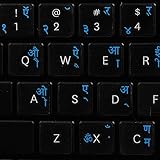
- The Best GIFT for any occasion
- High-quality stickers for different keyboards Desktop, Laptop and Notebook
- The Hindi Alphabet is spread onto transparent - matt sticker, with blue color lettering
- Stickers are made of high-quality transparent - matt vinyl, thickness - 80mkn, typographical method
- Applying stickers on you keyboard properly once, and you can be aware that letters will stay for ever
Indic scripts also have details that matter when designing matching rules. UAX #15 lists composition exclusions, including Devanagari letter QA and precomposed nukta letters in Bangla/Bengali, Devanagari, Gurmukhi, and Odia/Oriya. An exclusion is a defined part of Unicode normalization behavior, not evidence that a text is malformed or that a search engine should replace it with another spelling. Avoid inventing substitutions based on visual resemblance; establish the intended equivalence for the target language and test it.
A miss can also occur outside normalization: tokenization, grapheme handling, spelling variation, OCR noise, or input-script differences may be involved. Test with real examples to identify which layer is responsible rather than broadening Unicode normalization to compensate for every mismatch.
PC Slower Than It Used to Be?
A free scan shows the junk files, broken settings and background clutter dragging Windows down - then fixes them in one click.Free scan · Windows 10 & 11Crashes, No Sound, or Screen Glitches?
Random freezes, missing sound and display glitches usually trace back to one bad driver. Find and replace yours safely.Free scan · under a minuteRank #3

- Arabic English Letters:This USB wired keyboard adopts advanced laser engraving technology, which will not fade when typing for a long time, allowing you to clearly see letters and symbols, bidding farewell to the trouble of character wear and tear causing unclear reading
- Waterproof and anti slip: The keyboard is waterproof, comfortable to the touch, Reduce finger pressure.with a wire length of 1.6 meters and anti slip silicone pad on the back, making the keyboard work efficiently,The space bar has a crisp sound, not silent
- Arabic QWERTY English 104 key keyboard layout with numeric keypad,Has all Arabic letters including commonly missed ones (see pics), suitable for offices and work. There are uppercase lock indicator lights and numeric lock indicator lights in the upper right corner of the keyboard
- Efficient office work: The wired keyboard has 12 multimedia shortcut key combinations for instant access to music, volume, computer, email, and more.The space bar has a normal tapping sound, not a quiet keyboard
- Plug and play: wired USB interface, no need to download programs, saving the trouble of replacing batteries or charging, suitable for Windows, Android, smart TV and Mac (Note:Mac systems may not be compatible with multimedia buttons)
How are normalization, tokenization, and grapheme handling different?
Normalization standardizes Unicode representations under a selected equivalence policy. Tokenization decides how text is divided into searchable units. Grapheme-aware processing concerns how users perceive text characters: in Indic writing, a visible unit may involve multiple code points, combining marks, or conjuncts. These are related pipeline concerns, but NFC or NFKC does not choose token boundaries or guarantee correct grapheme behavior.
A 2023 paper by Ansary and colleagues, “Unicode Normalization and Grapheme Parsing of Indic Languages,” describes orthographic syllables and complex graphemes and proposes a normalizer and grapheme parser. It is useful motivation for language-aware tests, not proof that one proposed implementation is a universal production solution.
Rank #4

- The Best GIFT for any occasion
- High-quality stickers for different keyboards Desktop, Laptop and Notebook
- The Hindi Alphabet is spread onto transparent - matt sticker, with blue color lettering
- Stickers are made of high-quality transparent - matt vinyl, thickness - 80mkn, typographical method. Clear transparent background makes stickers invisible, and allows existing characters to show through.
- Applying possess doesn't take more than 10-15min. English letters located underneath each sticker - will accurately indicate buttons on with you will apply corresponding stickers.
- Include combining-mark sequences and relevant conjuncts in test data.
- Test script-specific forms such as nukta-related cases where applicable.
- Check that the engine’s tokenizer and any grapheme-aware components preserve the units your language and users require.
- Keep this analysis separate from canonical normalization so a tokenizer change is not mistaken for an NFC effect.
What can a search engine do beyond NFC?
Search engines may provide language-aware analysis filters in addition to general Unicode normalization. Elasticsearch documents hindi_normalization and indic_normalization filters. Its ICU normalization filter supports nfc, nfkc, and nfkc_cf. These are implementation options, not a guarantee that a named filter covers every language, script, or corpus requirement.
Check the documentation for the Elasticsearch version you deploy and verify the actual behavior with representative inputs. Decide where the filter belongs in the analyzer and ensure query-time analysis is compatible with the way indexed text was processed. Do not infer from “Hindi” or “Indic” in a filter name that it will correct spelling, handle OCR, select the right tokens, or improve results for every Indic language.
Best Value

- Portable 78-Key Computer Wired Keyboard, signal transmission is stable, and the line length is 1.3 meters (equal to 51 inches). Size:28x12x1.8cm
- Comfortable switch - Provides you with improved typing speed and accuracy. Over 15 million keystroke tests, keyboard is durability.
- High Quality ABS Production - Use strong grade and strong, environmental protection materials, the keyboard bottom has anti-slip mat, will not move, convenient your work.
- FN Shortcuts - Easy access to media controls such as playback, pause, next and previous tracking, increase volume, etc. The Number Function keys Hide under the letter, saving your space, and more convenient and fast.
- Simple Plug and PLay for Windows - Compatible with desktops and laptops with Windows 10, Windows 8, 7, Vista, XP, Chrome OS.
How should I handle Romanized or cross-script queries?
Romanized input is a separate retrieval problem from Unicode normalization. Transliteration systems vary in their goals and trade-offs: a scheme may prioritize standards compliance, coverage, pronunciation, or reversibility, and cannot necessarily optimize all of them at once. Choose and name a transliteration system or model, define which language and script variants it covers, and test ambiguous or non-reversible mappings.
One option is a documented query-expansion policy; another is maintaining parallel searchable fields. Either can increase matches, but can also create false positives when a romanized form has multiple plausible readings. Keep the source-script text intact and evaluate transliteration as its own transformation, not as a reason to overwrite canonical text.
Madhani and colleagues’ 2022 Aksharantar paper describes 26 million transliteration pairs across 21 Indic languages and 12 scripts, and reports the IndicXlit model. Those figures describe a research dataset and model resource; they do not establish that a particular mapping improves search on your corpus.
How do I test whether a normalization policy helps?
Build a regression set around the languages and scripts your service actually supports. Record expected matches and expected no-matches, and compare recall and false positives before and after each pipeline change. No cited source establishes a universal analyzer or benchmark for Indian-language search, so report results for your corpus and query set rather than claiming a general ranking improvement.
The Tool Desk
Outbyte PC Repair FREEClear out junk files and repair common Windows errorsFree Scan →Outbyte Driver Updater FREEScan for outdated or missing drivers - takes under a minuteDriver Scan →- Native-script queries, including canonically equivalent sequence variants.
- Combining marks, conjuncts, and relevant script-specific cases, including nukta forms where applicable.
- Romanized queries if users enter them, including ambiguous spellings and language variants.
- Visually similar but semantically distinct forms that must remain distinct.
- Expected no-match cases, which reveal over-broad compatibility folds or transliteration expansion.
- Examples that exercise the actual engine analyzer and deployed version, not just a standalone normalization library.
Compare candidate policies on four questions: which equivalences they add, how much information they preserve, which languages/scripts and engine behaviors they cover, and whether display or round-trip requirements are affected. Make one change at a time so the regression results show whether NFC, a compatibility fold, a language-specific filter, tokenization, or transliteration caused the difference.
Quick Recap
Product prices and availability are accurate as of the date/time indicated and are subject to change. Any price and availability information displayed on Amazon at the time of purchase will apply.

